
China’s construction of a nuclear-powered supercarrier larger than America’s most advanced warship signals a dramatic shift in global naval power that Washington can no longer ignore.
Story Snapshot
- China’s Type 004 carrier under construction at Dalian Shipyard displaces 110,000-120,000 tons, exceeding the USS Gerald R. Ford’s 100,000 tons
- Satellite imagery reveals potential nuclear reactor structures, marking China’s first nuclear-powered carrier expected to enter service around 2030
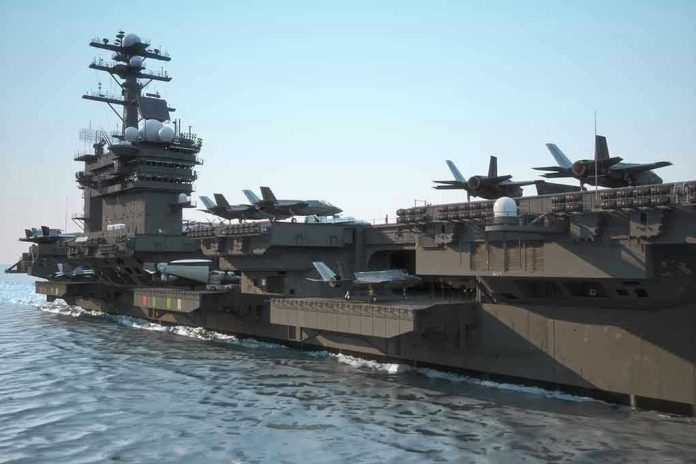
- The supercarrier will feature electromagnetic catapults and carry over 100 aircraft, matching or surpassing U.S. Ford-class capabilities
- Beijing plans six additional carriers by the mid-2030s, challenging American naval dominance in the Indo-Pacific region
Nuclear Propulsion Marks Strategic Leap
China’s Type 004 aircraft carrier represents a fundamental departure from its previous vessels. The People’s Liberation Army Navy has operated only conventional carriers—the refitted Soviet-era Liaoning commissioned in 2012, the indigenous Shandong in 2019, and the Fujian launched in 2022. Satellite imagery from early 2026 shows structures at Dalian Shipyard consistent with nuclear reactor containment, though Beijing has issued no official confirmation. Jane’s defense analysts identified twin reactor designs that would eliminate refueling requirements, enabling sustained global operations without the logistical constraints plaguing conventional carriers.
Size and Capability Surpass American Benchmark
The Type 004’s reported displacement of 110,000 to 120,000 tons positions it as potentially the world’s largest aircraft carrier, surpassing the USS Gerald R. Ford’s 100,000-ton displacement. The supercarrier will incorporate electromagnetic aircraft launch systems similar to American EMALS technology, supporting operations of more than 100 aircraft including J-35 stealth fighters and KJ-600 early warning planes. This combination of nuclear propulsion, advanced catapult systems, and expanded aircraft capacity addresses limitations that constrained China’s earlier ski-jump carriers. For Americans who’ve watched decades of unchallenged naval supremacy, this development should raise serious questions about whether our government’s spending priorities have left us vulnerable.
Construction Timeline Accelerates Rivalry
Construction evidence emerged through satellite monitoring over recent years, with significant structures visible at Dalian Shipyard as of early 2026. Defense analysts project the carrier will enter service around 2030, part of China’s broader plan to field six additional carriers by the mid-2030s. This aggressive timeline contrasts sharply with delays and cost overruns plaguing American shipbuilding programs. The rapid pace reflects centralized decision-making through state-owned China State Shipbuilding Corporation, unencumbered by the bureaucratic obstacles and political infighting that have hampered U.S. defense procurement. The question patriots must ask: why can’t American shipyards match this efficiency despite our supposed technological advantages?
Strategic Implications for American Security
A nuclear-powered Chinese supercarrier fundamentally alters Indo-Pacific power dynamics. Nuclear propulsion enables unlimited range and sustained operations far from Chinese ports, projecting power throughout the Pacific without refueling vulnerabilities. This capability directly challenges the U.S. Navy’s ability to protect allies like Taiwan, Japan, and South Korea while securing critical trade routes. The carrier supports Beijing’s “blue-water” naval ambitions, moving beyond coastal defense to global force projection. While America maintains eleven carriers, China’s construction pace and focus on advanced capabilities suggest a determined effort to achieve parity or superiority. Both conservative and liberal Americans frustrated with government dysfunction should recognize this represents a security threat born from complacency and misplaced priorities in Washington.
The Type 004 leverages China’s nuclear submarine expertise to overcome technological hurdles that long separated American and Chinese naval capabilities. Jane’s analysts confirm the design incorporates lessons from the Ford-class while potentially avoiding some of its troubled systems. This development pressures the United States and its allies to accelerate their own carrier programs, potentially triggering a naval arms race with massive economic implications. Yet the real concern goes deeper than military hardware—it reflects whether America’s political class, consumed by partisan battles and self-preservation, can muster the focus to address genuine threats to national security and the prosperity ordinary citizens depend on.
Sources:
China Developing Fourth Nuclear Aircraft Carrier to Surpass U.S. Ford-Class Air Power
China Hints Its Fourth Aircraft Carrier Will Be Nuclear-Powered, Bolstering Blue-Water Ambitions
Type 004 Aircraft Carrier – Wikipedia
China’s 120,000-Ton Type 004 Nuclear Supercarrier Emerges