

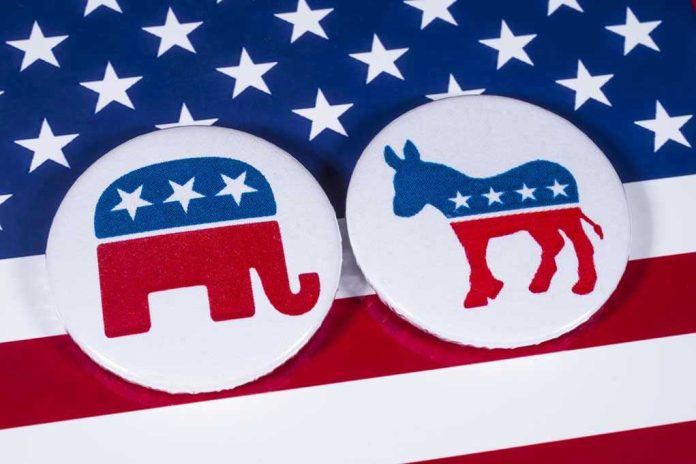
The ugliest word in Texas politics right now is not “liberal” or “MAGA” — it is “scumbag,” and it is aimed at a little-known candidate who turned donor trust into collateral and then switched teams.
Story Snapshot
- A Texas candidate raised money as a Democrat, then resurfaced as a Republican, igniting a grassroots donor revolt.
- Viral posts and political chatter turned a low-level race into a case study on betrayal and party loyalty.
- Texas’s history of party switching collides with today’s polarized, donor-driven politics.
- The scandal exposes how little legal guardrails exist when candidates cash checks from one side, then run for the other.
How A Small-Town Campaign Became A Statewide Morality Play
The candidate at the center of this storm did not start as a villain. In 2022 and 2023, this person did what countless Texas hopefuls do: filed as a Democrat, adopted the party’s talking points, shook hands at local club meetings, and raised money from progressives eager to believe they had found “one of their own.” Donors wrote checks because they assumed a simple rule: if you take our money, you fight for our side. That assumption is exactly what broke.
'Scumbag': Texas candidate skewered for running as Republican after fundraising off Dems https://t.co/8tYq0VAZev
— Matthew Chapman (@fawfulfan) December 10, 2025
By 2024, the campaign had built a respectable Democratic profile: photos with local activists, fundraising appeals invoking voting rights and reproductive freedom, and endorsements that only come when party stalwarts feel secure about your allegiance. Then, as filings for the next cycle approached, something snapped. The candidate switched to the Republican column and began pitching themselves as a conservative choice—without so much as a public reckoning with the people who bankrolled their earlier ambitions.
Texas Tradition Meets Twenty-First-Century Outrage
Texas has seen party switching before. For decades, conservative Democrats drifted into the GOP as the state realigned. Those shifts usually came with a slow ideological migration, often rationalized as the parties “changing underneath” them. Today’s switch looks different. The donor class, especially on the left, now treats campaign money as a values contract. When a candidate raises funds as a Democrat and then runs as a Republican, that looks less like evolution and more like a bait-and-switch transaction.
Modern tools make this kind of maneuver politically radioactive. Archival screenshots of fundraising emails, ethics commission filings, and old social posts circulate in hours, not years. Critics post side‑by‑side receipts: one image shows the candidate promising to defend Democratic priorities; the next shows them waving the Republican banner. In that environment, the label “scumbag” sticks because it matches what people can see with their own eyes—a pattern that offends both basic honesty and the common‑sense expectation that you do not take a team’s money and then bat for the rival.
Donor Trust, Conservative Values, And The Ethics Line
The legal reality is stark: Texas law does not forbid someone from fundraising as a Democrat and later filing as a Republican. The ethics fight is about something deeper than statutes. Donors across the spectrum operate on a shared premise that resonates with American conservative values as much as with progressive ones: personal responsibility, honoring your commitments, and telling people what you stand for before you cash their checks. When a candidate skips that, critics are not inventing outrage; they are enforcing a basic moral floor.
Some conservatives argue that party switching can reflect a late but genuine ideological awakening, especially in a GOP-leaning state where Democrats often face uphill odds. That argument carries weight when a politician’s record and rhetoric gradually align with their new affiliation. In this Texas case, the facts reported by observers point in the opposite direction: the candidate built a brand on Democratic messaging, leveraged it for resources, then pivoted once it was strategically convenient. That pattern looks far less like conscience and far more like careerism, which offends the same common-sense standard many conservatives apply to “flip‑floppers” on the left.
What This “Scumbag” Label Tells Us About Future Campaigns
The backlash is not just about one campaign; it is about everyone who writes a political check or volunteers for a phone bank and wonders whether their efforts matter. Democratic donors now talk about vetting candidates more aggressively, pressing for clearer commitments, and even exploring mechanisms to pressure defectors to refund contributions. Republican activists face their own questions: do you welcome a new recruit who treated promises as disposable, or do you insist that integrity matters more than one extra candidate on the ballot?
The bigger lesson lands squarely on political hopefuls in both parties. In an era of permanent receipts, you cannot treat party labels as costumes you swap depending on which primary looks easier to win. Voters may tolerate ideological nuance; they do not tolerate feeling conned. Switch parties if your convictions truly change, but speak plainly, own your history, and respect the people who paid your filing fees. Otherwise, the word that follows your name on every search result will not be “Representative” or “Senator.” It will be the one Texans are spitting today: “scumbag.”
Sources:
Politico – James Talarico, Miriam Adelson, and billionaire donations
Washington Times – 2 Democrats, 2 strategies in Texas Senate battle
San Antonio Observer – Jasmine Crockett scrambles Democrats as she weighs Texas Senate run
Texas Tribune – Texas Tribune Festival and the US Senate Democrats field
AOL – Top Democrat in contested Senate race