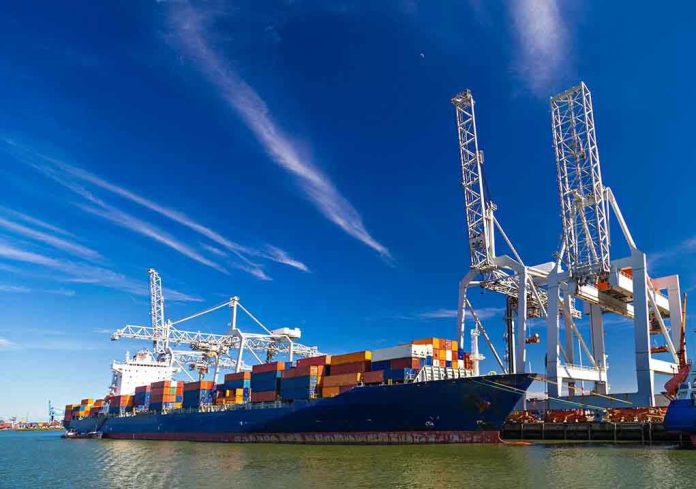
A little-known United Nations shipping plan could quietly raise prices on everyday goods while deepening public distrust of global elites.
Story Snapshot
- The UN’s maritime agency has designed a de facto global carbon tax on ocean shipping, but final approval is delayed and uncertain.
- Supporters say it will cut pollution and fund green tech; critics warn it is a backdoor tax on consumers and national sovereignty.
- U.S. officials under President Trump call it a “global carbon tax on Americans” and have led a campaign to block or weaken it.
- Both left and right worry that unaccountable international bodies are making huge economic decisions with little public debate or hard data.
What the UN Shipping Plan Would Actually Do
The International Maritime Organization, a United Nations agency that regulates global shipping, has drafted a Net-Zero Framework that would set binding emissions limits and prices for greenhouse gases across the entire shipping industry.[1] The rules would apply to large ocean-going ships over 5,000 gross tons, which account for the vast majority of carbon dioxide from international shipping.[1] Backers say this is the first time one global system would tie strict emissions rules to a price on pollution across a whole sector.[1]
The plan combines a tough fuel standard with a payment system for ships that do not meet the new targets.[1] It would measure emissions over a fuel’s whole life cycle, from production to use, often called “well-to-wake.”[1] The framework sets a greenhouse gas intensity threshold for ship fuels starting in 2028 and then tightening sharply after 2035, pushing companies away from traditional fuel oil toward cleaner options.[1] In simple terms, dirtier fuel means higher costs, cleaner fuel means rewards.
How the Money Side Works — And Why Critics See a Hidden Tax
Ships that exceed their allowed emissions would have to buy what are called Remedial Units, which are essentially carbon credits.[2] One tier is priced around $380 per ton of carbon dioxide, and a lower tier at about $100 per ton, creating a steady revenue stream that behaves like a global carbon tax on fuel use.[2] For families already dealing with high prices, any new cost on shipping raises fears that food, clothes, and electronics will get even more expensive.
Supporters argue the money will not just vanish into a black hole.[1] A new Net-Zero Fund inside the International Maritime Organization would collect the revenues and pay out rewards to low-emission ships, fund innovation in poorer countries, and help the most vulnerable states cope with higher transport costs.[1] Small island and least-developed countries are supposed to benefit from targeted support, at least on paper.[1] But there is no public track record yet showing who would really get the money and how much.
Who Backs the Plan — And Who Is Trying to Sink It
Sixty-three countries, including major maritime players, endorsed the framework in April 2025, signaling broad support among many governments that rely on trade.[3] Climate policy groups describe it as a key step to cutting shipping emissions to net zero by around mid-century.[5] At the same time, powerful “flag states” like Liberia and Panama, which together cover about one-third of the global fleet, pushed hard to weaken the carbon pricing parts of the deal during talks.[3] They have not fully embraced the final design, leaving serious doubts about enforcement.[3]
Opposition from the United States under President Trump has been intense and sustained.[6] Senior officials labeled the proposal a “European-led neocolonial export of climate rules” and warned it would raise shipping costs worldwide, making goods more expensive for American families.[6] The State Department declared that the United States would refuse to agree to the framework, helping delay final adoption and pushing the decision into 2026.[9] Officials also pressed for a tougher voting standard that would make it harder for the plan to take effect.[6]
Deep-State Fears: Trade Pressure, Media Framing, and Big-Money Interests
Reports from policy watchers say U.S. diplomats explored tariffs, visa limits, and port fees to pressure countries that might vote for the plan.[6] This kind of behind-the-scenes leverage feeds the belief, on both the right and the left, that trade policy and climate rules are being tied together in secret, far from public oversight. Critics worry that the same countries and corporations that shaped past trade deals are again calling the shots, this time under a green label.
'Shipping is not merely a sector. It is a strategic artery for trade, resilience, and shared prosperity; and it must now align with the climate reality of our time'.
At the #SB64 Side Event on the @IMOHQ Net-Zero Framework, Kenya's message was clear:
– We support a strong… pic.twitter.com/PrXyTrR87C— Ali Mohamed (@ClimateEnvoyKe) June 22, 2026
Media narratives have sharpened the divide instead of clarifying it.[6] Some outlets echo the “global tax on Americans” line, while others dismiss all concerns as selfish or anti-science, even though no side has published a full, independent study of how much this will add to prices at the store.[6] Shipping companies and shipbuilders also stand to profit from new vessel orders and retrofits, especially in China, yet there is little transparent analysis of who wins, who loses, and by how much.[6] That vacuum of hard data lets fears about “elites” and “deep state” control thrive.
What Both Sides Should Be Asking For Next
People across the spectrum share a basic worry: powerful global bodies are designing complex tax-like systems that touch every product we buy, while elected lawmakers and ordinary citizens watch from the sidelines. Independent research groups have long argued that any global carbon price on shipping should come with clear economic modeling, transparent revenue use, and strict oversight so it does not become yet another unaccountable cash machine.[16][17] Those tools exist; what is missing is the political will to use them in the open.
For conservatives, the key questions are how much this will cost families, whether it undercuts national sovereignty, and who really controls the fund. For liberals, central concerns include whether the rules truly cut emissions, protect poorer nations, and reduce the gap between rich and poor. Both sides have reason to demand sunlight: full release of diplomatic records, detailed cost studies by neutral bodies, and annual public audits of where every dollar goes. Without that, a “green” tax on global trade will look less like climate action and more like another elite project done to people, not with them.
Sources:
[1] Web – UN plan to levy taxes on global trade…
[2] Web – IMO approves net-zero regulations for global shipping
[3] Web – IMO Net-Zero Framework
[5] Web – IMO Net-Zero Framework – Wikipedia
[6] Web – International Shipping | Climate Action Tracker
[9] YouTube – Carbon Tax on Shipping DID Not Pass the UN’s IMO
[16] Web – UN reaches deal on global shipping net-zero standard in spite of US …
[17] Web – Impact and motives of Trump opposition to IMO net-zero framework