
A deadly California library shooting now raises hard questions about copycat violence, media narratives, and what it really means to stop the next Columbine-style attack.
Story Snapshot
- Police say 18-year-old Bradley Scott Sayer tried to stage a Columbine-style massacre in a Chico public library.
- Two adults were killed, a child was injured, and officers found more guns in Sayer’s car after the attack.
- Officials say Sayer was influenced by the Columbine High School massacre, but key evidence has not been released.
- Federal agents joined the case, and Butte County shut all libraries, showing how fast government can clamp down.
Police Describe a Columbine-Inspired Library Attack
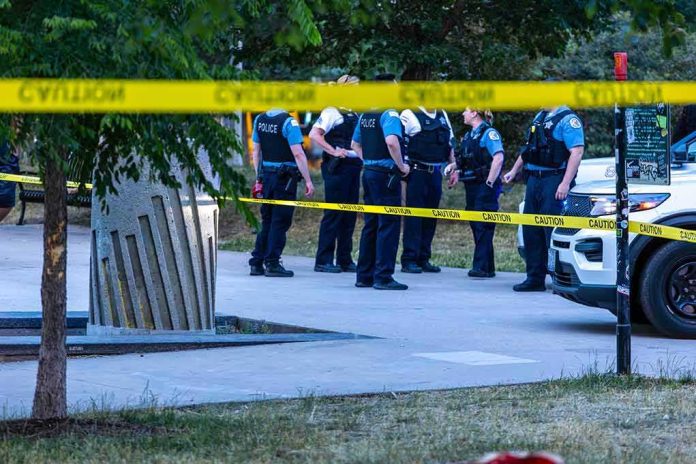
Chico police say 18-year-old Bradley Scott Sayer walked into the Butte County Library branch in Chico and opened fire, killing two adults and injuring a child.[1] Officers identified Sayer as a local resident and booked him into Butte County Jail on two counts of murder.[1] Investigators say he had no known connection to the victims or the library, which points to a random public target. Police say interviews led them to believe Sayer wanted a Columbine-style mass shooting.[2]
According to the Chico Police Department, Sayer fired about eight rounds inside the library before officers arrived within minutes and arrested him without firing a single shot.[1] One firearm was recovered inside the building, and two more were found in his vehicle outside.[1][2] Detectives from Chico Police, the Butte County Sheriff’s Office, and the Federal Bureau of Investigation (FBI) are now reviewing digital and physical evidence from the library, Sayer’s car, and his home to understand how far his plan went.[2]
Officials Claim Columbine Influence but Hold Back Evidence
Detectives say that based on their interviews with Sayer, he was influenced by the Columbine High School shooting and similar mass casualty attacks.[2] Some reports go further and say he allegedly intended a Columbine-style massacre, framing this attack inside what researchers call the “Columbine effect,” where the 1999 school shooting becomes a model for later killers.[4] However, police have not released any transcripts of those interviews, written statements, or social media posts from Sayer that would let the public verify this motive for themselves.
Media reports and officials mention that Sayer’s clothing and online activity pointed to Columbine influence, even claiming he wore a shirt that matched what one of the Columbine shooters wore.[2][7] Yet, so far there are no public arrest photos or crime scene images showing that shirt. There is also no detailed forensic report on the firearms used in the attack. One outlet notes that police have not disclosed the specific type of weapon, which makes it hard to compare his gear to Columbine or other copycat cases.[1] For now, much of the motive story rests on what police say, not on documents the public can see.
Libraries Closed, Federal Agents Called In, and Public Fear Grows
Authorities responded to the shooting by closing all Butte County library branches, signaling that officials viewed this event as part of a wider security threat, not just one crime scene.[3] The FBI joined Chico police and the Butte County Sheriff’s Office in the investigation, a step usually reserved for cases with signs of planned mass violence or possible wider risks.[1] For many citizens, that level of federal involvement and the sweeping shutdown of public spaces raise worries about how quickly government can clamp down after a crisis.
18-year-old Bradley Scott Sayer planned ‘massacre-type shooting’ at California library, kills 2 before being arrested — Chico police. pic.twitter.com/rpOtz8LUqa
— AfrikTimes (@afriktimesint) June 24, 2026
At the same time, the Columbine label shapes how people think about the crime. Research on mass shootings shows that when officials and media frame an attacker through a famous event like Columbine, it can drive public fear and shape attitudes about whole groups.[5] It also gives law enforcement and politicians strong justification for more surveillance, faster lockdowns of public spaces, and pressure for new gun control measures. Yet in this case, core evidence about Sayer’s exact motive, planning, and online activity remains sealed, leaving citizens to judge the narrative without a full record.
Copycat Violence, Media Narratives, and Questions for Conservatives
Scholars who study the Columbine effect note that later attackers sometimes admit they were inspired by Columbine, while in other cases officials infer that motive from clothing, weapons, or online patterns.[4] The Chico library shooting has already been added to that list as a Columbine-inspired case.[4] For conservatives who value individual liberty and due process, the tension is clear: police must act fast to protect lives, but the public also needs transparent evidence before accepting sweeping narratives that can drive long-term policy and restrict everyday freedoms.
Many mainstream outlets have echoed the police view that Sayer acted alone and was driven by Columbine, with little challenge or review of unreleased evidence.[1][2][7] Social media posts have largely repeated the same claims. This kind of consensus can quickly harden into “settled” truth. Yet, without open access to Sayer’s interview records, social media history, and detailed gun forensics, citizens cannot fully test how strong the Columbine motive case really is. For readers concerned about government overreach, the Chico case is a reminder to demand facts, not just slogans, before giving officials more power.
Sources:
[1] Web – Suspected California library gunman influenced by Columbine shooting …
[2] Web – Chico library shooting: Suspect arrested after 2 … – Sacramento Bee
[3] YouTube – California library shooter aimed to commit Columbine …
[4] Web – Deadly Chico library shooting | Police identify the suspected …
[5] Web – Chico Library Shooting Investigation Update The suspect …
[7] Web – Gunman Bradley Scott Sayer (18) charged with two counts of murder …