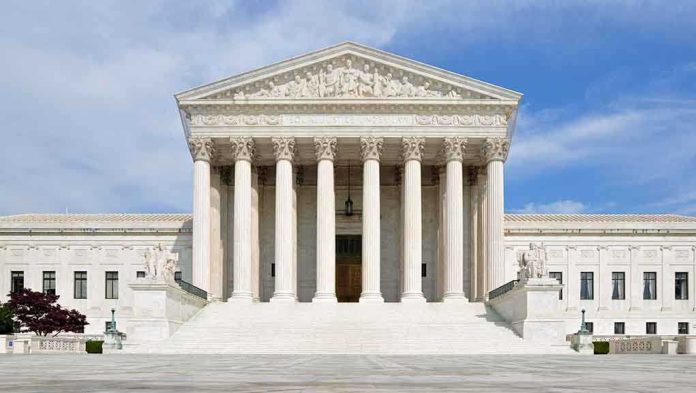
The Supreme Court’s 6-3 ruling kept birthright citizenship intact—and Democrats answered by threatening to expand the Court.
Story Highlights
- The Court struck down President Trump’s executive order and upheld birthright citizenship for almost all babies born on U.S. soil.
- Democratic leaders praised the decision but renewed calls to add justices, despite no specific bill or seat number now on the table.
- Republicans control Congress, making any expansion proposal a near-certain dead end for now.
- Dissents and a partial concurrence signaled ongoing legal debate over the Fourteenth Amendment’s scope.
What The Court Decided And Why It Matters
On June 30, 2026, the Supreme Court ruled 6-3 that the Fourteenth Amendment guarantees birthright citizenship. The decision rejected President Trump’s executive order that tried to limit citizenship for some children born in the United States. Chief Justice John Roberts wrote the main opinion and cited long-standing history and law that children born here are citizens, with narrow exceptions like foreign diplomats. News outlets described the ruling as a clear defeat for the administration’s approach.
The ruling followed arguments that the Citizenship Clause was meant only for freed slaves, not for children of people who are here unlawfully. The government’s brief pressed that reading, focusing on the phrase “subject to the jurisdiction”. The majority rejected that claim. Justice Brett Kavanaugh agreed with the result based on mid-twentieth-century law, but he did not join all of the majority’s history and reasoning. Three justices filed dissents arguing the majority read the Fourteenth Amendment too broadly.
How Democrats Responded—Praise And A New Push To Reshape The Court
After the ruling, top Democrats celebrated the affirmation of birthright citizenship. House Democratic Leader Hakeem Jeffries said babies born in America are citizens, period. Senate Democratic Leader Chuck Schumer said the Court pushed back on pressure and confirmed the rule. Senator Elizabeth Warren said even a Court shaped by Republican appointments did not accept the executive order’s limits. Their statements underscored a view that the Constitution, not politics, drove the outcome.
At the same time, Democrats renewed calls to expand the Supreme Court. The party has floated this idea before, including a 2023 push to add four seats. That earlier bill did not become law, and current leaders have not released new bill text or a specific seat count after this case. The lack of details makes the expansion talk more of a message than a plan. With Republicans running the House and Senate, any effort to add justices faces long odds.
Why Expansion Talk Is Surging Again—and The Barriers Ahead
Court expansion spikes after big rulings. This is part of a cycle seen for decades. Proposals tend to rise after one side loses major cases and sees the Court as out of step. Congress has the power to change the number of justices, but it rarely tries, and almost never succeeds in modern times. A House hearing in May 2026 framed “court packing” as a threat to legitimacy, showing how charged the debate has become.
Advocates on the left argue expansion, term limits, or new ethics rules could restore trust and balance. Groups have listed options, from eighteen-year terms to tighter rules on emergency orders. But those ideas need votes, and some might even need a constitutional amendment. That is a heavy lift in any Congress, especially one controlled by the party that opposes the change.
The Shared Frustration—And What Comes Next
Many Americans on the right and left feel shut out by powerful insiders. They see courts and Congress locked in trench warfare while daily costs rise and trust falls. This case shows that even when the Court sets a clear rule, the fight shifts to structure and process. Democrats call for expansion without specifics. Republicans vow to block it. The result is more heat than light, and few concrete steps that fix the wider system.
In the Supreme Court’s June 30, 2026, decision in Trump v. Barbara, the Court (in a 6-3 ruling, with nuances in separate opinions) struck down President Trump’s executive order that sought to limit birthright citizenship under the 14th Amendment’s Citizenship Clause. The majority…
— AKLibertarian59 🇺🇸 (@AKLibertarian59) June 30, 2026
Next steps look set. The birthright rule stands as binding law. Expansion talk will likely fuel fundraising, hearings, and op-eds. Without a detailed bill, clear legal grounding, and bipartisan buy-in, the odds of change stay low. Voters who want stable rules and honest governance will keep asking a simple question: who is solving real problems, not just trying to tilt the playing field?
Sources:
twitchy.com, npr.org, constitutioncenter.org, bbc.com, youtube.com, aclu.org, law.cornell.edu, theusconstitution.org, cambridge.org