

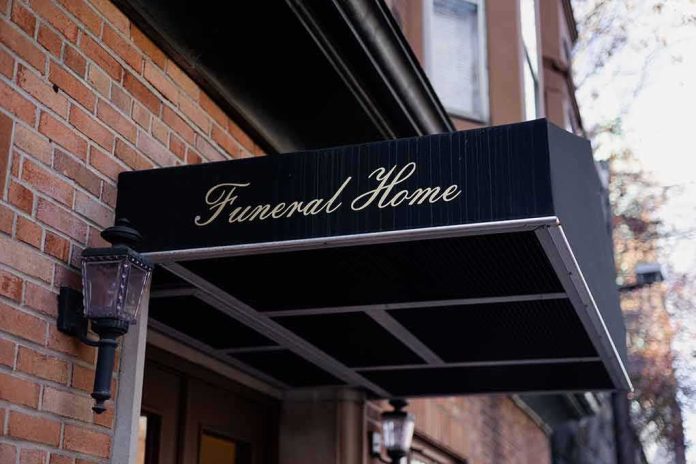
More than 50 decomposing bodies found inside a Chicago funeral home have turned a foul smell into a public scandal about state oversight, family trust, and basic human dignity.
Quick Take
- Investigators found more than 50 bodies in various states of decomposition at South Chicago Chapel on East 95th Street.
- State regulators suspended a funeral director’s license after citing unrefrigerated storage, rodent infestation, and maggot infestation.
- Neighbors said they had noticed a strong odor for months before the discovery.
- The funeral home’s owners had already faced prior trouble tied to mishandled remains.
What Officials Found
Cook County medical examiner officials said investigators found more than 50 bodies in various states of decomposition at South Chicago Chapel on the city’s Southeast Side. Reporting from ABC 7 Chicago and the Associated Press said the remains were being reviewed as staff worked to identify the dead and gather death certificates for family notices. Officials said the process could take several days, which shows how large and messy the scene was from the start.
The discovery did not look like a small paperwork problem. ABC 7 Chicago reported that Chicago police were assisting the Illinois Department of Financial and Professional Regulation with a license investigation, and the same reporting said state records listed Clark Morgan as the owner of the facility. Other reports described the bodies as being found in basement and attached garage areas, which points to storage outside normal funeral-home standards. The scale of the case also forced a hazardous materials response.
Why Regulators Stepped In
Illinois regulators suspended the license of funeral director Johanna Morgan after saying her continued practice threatened public safety, interest, and welfare. The suspension order, as reported by CNN and ABC 7 Chicago, said multiple decedents were kept in an unrefrigerated area with deplorable conditions, including rodent infestation, decomposition, and maggot infestation. Those are not minor code issues. They suggest a system that broke down at the most basic level of care.
That breakdown matters because funeral homes handle families at one of the hardest moments in life. When regulators say bodies were left unrefrigerated, the story stops being only about one building and becomes about the state’s failure to catch problems earlier. The Chicago Tribune editorial tied the case to a wider question about reverence for death and the standards expected of death-care businesses. For many readers, that will sound like another case of weak oversight meeting local suffering.
Families who used South Chicago Chapel are demanding answers after authorities reported the discovery of 56 bodies that were allegedly stored improperly at the funeral home. https://t.co/Zapbckqo50
— ABC 7 Chicago (@ABC7Chicago) August 8, 2026
What Neighbors Said
Neighbors said the smell had been building for months before the discovery, and ABC 7 Chicago reported that residents noticed a foul odor long before officials entered the building. NBC Chicago quoted one neighbor describing a “rotten and just a foul smell that is unbearable,” which helps explain why the case spread beyond a licensing dispute and into the neighborhood’s daily life. The community story is important because it suggests the warning signs were not hidden.
AP coverage said residents and advocates described a “really strong smell” and said complaints had gone unanswered for a long time. That is the part of the case that will likely frustrate people across the political divide. People who already distrust government will see another example of regulators moving only after a crisis. People who trust agencies may still ask why a complaint-driven system did not catch this sooner. The record now shows odor complaints, but not a full public timeline of who knew what and when.
Why This Case Is Bigger Than One Funeral Home
The operators’ history will shape how the public sees this case. AP and CBS Chicago reported that the same couple previously ran a crematory that was shut down after mishandled remains were found there. That does not prove every detail of the current case by itself, but it does create a strong pattern in the public mind. When the same names appear in a second grave-duty scandal, trust drops fast, and recovery becomes much harder.
The deeper issue is not just one tragic discovery. It is the way death-care enforcement seems to rely on complaints, surprise inspections, and after-the-fact discipline. ABC 7 Chicago and the Associated Press both said the official process to identify the bodies could take days, which means families are left waiting while institutions sort out records. In a country already angry about elites, bureaucracy, and slow accountability, that delay feeds a broader sense that ordinary people are always the last to know.
Sources:
youtube.com, facebook.com, nbcchicago.com, cnn.com, chicagotribune.com, instagram.com