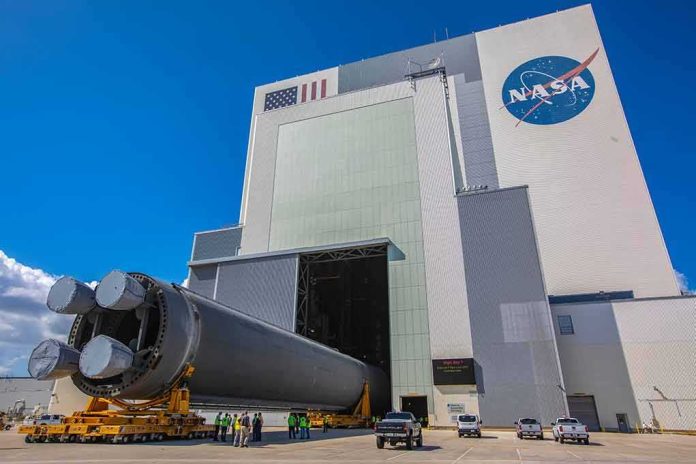
NASA’s newest space telescope rocketed off a Florida launch pad on a SpaceX Falcon Heavy, kicking off a mission to map dark energy and hunt for planets around distant stars.
Story Snapshot
- The Nancy Grace Roman Space Telescope launched August 30, 2026, at 7:26 a.m. EDT on a SpaceX Falcon Heavy rocket from Launch Complex 39A at Kennedy Space Center in Florida.
- The telescope will study exoplanets, dark energy, dark matter, and infrared astrophysics from a stable orbit near the Sun-Earth L2 point.
- NASA says the mission launched eight months ahead of its original schedule, a rare feat for a major agency science project.
- The telescope is named for Nancy Grace Roman, NASA’s first chief astronomer, often called the “Mother of Hubble.”
Rocket Lifts Off From Historic Pad
SpaceX launched the Roman telescope on a Falcon Heavy rocket from Launch Complex 39A, the same pad once used for Apollo moon missions and space shuttle flights. Liftoff happened at 7:26 a.m. EDT on August 30, 2026, exactly as NASA and SpaceX had targeted for weeks. A backup launch window on August 31 was not needed after weather and hardware checks cleared the way for an on-time flight.
Reporters from the National Public Radio (NPR) and other outlets confirmed the telescope’s name honors Nancy Grace Roman, NASA’s first chief astronomer, who helped build the case for the Hubble Space Telescope decades ago. The spacecraft will now spend about three months traveling to its permanent post, a gravitationally stable spot known as the second Sun-Earth Lagrange point, roughly a million miles from Earth.
What The Telescope Will Search For
Once settled into position, Roman will use a wide-angle camera nearly 100 times larger than Hubble’s to survey huge patches of sky in infrared light. Scientists plan to use the data to study dark energy, the mysterious force speeding up the universe’s expansion, and dark matter, the invisible material that outweighs ordinary matter across the cosmos. The telescope will also search for exoplanets orbiting stars far beyond our solar system.
NASA held two pre-launch briefings at Kennedy Space Center on August 29, giving mission scientists a chance to explain Roman’s instruments and expected discoveries before the flight. Construction on the telescope wrapped up on November 25, 2025, giving engineers several months to prepare it for the trip to the launch pad.
A Rare Case Of Beating The Clock
NASA’s own blog post announcing the launch date called Roman “officially slated to launch Aug. 30, eight months ahead of schedule and even earlier than previously targeted”. That timeline stands out against the agency’s usual track record. Government watchdogs have repeatedly found that NASA’s big science and exploration projects run over budget and behind schedule far more often than they finish early.
A 2026 government oversight report found NASA’s major projects have racked up nearly $4.7 billion in combined cost overruns and 14 years of cumulative schedule delays across the agency’s portfolio. Roman moving up its launch date, rather than slipping it, breaks from that pattern and gives NASA a rare good-news story to point to amid broader concerns about how federal agencies manage large, taxpayer-funded programs.
NASA launches newest space telescope 'Roman'
Telescope launch on Falcon heavy rocket
Roman begins a 3-month journey to an orbit 1 million miles away @JyotsnaKumar13 gets you more pic.twitter.com/t4aLhtWXG5
— WION (@WIONews) August 31, 2026
For a public increasingly skeptical of whether big government programs deliver what they promise, on time and on budget, Roman’s early liftoff offers a small counterexample. The mission still faces years of work ahead, deploying its solar panels, calibrating instruments, and beginning its science survey, but Sunday’s launch marks the first concrete milestone scientists and taxpayers can point to as proof the project is moving forward.
Sources:
youtube.com, science.nasa.gov, npr.org, space.com, spacepolicyonline.com