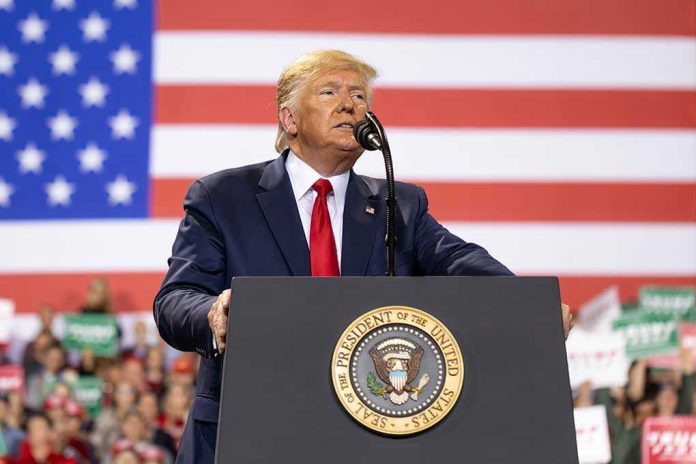
Three weeks into airstrikes against Iran, President Trump stands at a crossroads where every path forward threatens to lock him into the costliest gamble of his presidency—send ground troops to finish a war with no clear end, or accept that overwhelming air power alone cannot topple a regime.
Story Snapshot
- Operation Epic Fury enters its third week with over 2,000 targets struck but no ground forces deployed, as Trump oscillates between claiming the war is “very complete” and warning of the “most intense day” of bombing ahead
- US military planners craft daily “off-ramps” for de-escalation or escalation options, including potential ground troop deployment, as the original 4-6 week timeline approaches without achieving unconditional surrender
- The death of Supreme Leader Khamenei and 787+ Iranian casualties mark unprecedented escalation, yet Iran refuses negotiations and Trump’s endgame for regime change remains undefined
- Oil prices surge 40 percent as strikes pummel Kharg Island and infrastructure while avoiding energy exports “for decency,” exposing the tension between military objectives and economic reality
The Commander’s Contradiction
Trump told NBC that Iran stands ready to surrender, but the terms “aren’t good enough.” Hours later, he announced plans for the most devastating bombing campaign yet. This whiplash messaging reveals the central problem facing the White House three weeks into Operation Epic Fury: air dominance has decimated Iran’s leadership and military infrastructure, killing top Revolutionary Guard commanders and destroying naval assets, yet the Iranian regime shows no signs of capitulation. Defense Secretary Pete Hegseth called the campaign “only just the beginning,” while Press Secretary Karoline Leavitt insists the 4-6 week timeline holds until threats are eliminated—a moving target that defines nothing.
The Arithmetic of Escalation
The Pentagon’s daily war planning sessions now include explicit off-ramps, according to officials familiar with the process. These exit strategies sit alongside escalation options that military planners dare not name publicly but everyone understands: boots on the ground. Over 2,000 targets have been struck across Tehran, Isfahan, and strategic sites like Kharg Island, which handles 90 percent of Iran’s oil exports. The US spared oil infrastructure, a nod to global energy markets already reeling from a 40 percent price spike. But precision strikes and naval blockades cannot install a new government. Regime change, Trump’s stated objective, has historically required occupation—a word no administration official will utter but hangs over every briefing.
When Victory Becomes the Enemy
Trump’s declaration that the war is “very complete” after a phone call with Vladimir Putin stands in stark contrast to the facts on the ground. Iranian proxies continue launching missiles at Israeli and US bases. Kata’ib Hezbollah, despite losing commander Abu Ali al-Askari in a Baghdad strike, maintains operational capability. Iran’s new leadership, emerging from the chaos following Khamenei’s death, rejected talks through former negotiator Ali Larijani. The regime appears willing to absorb punishment rather than surrender, calculating that American patience will expire before Iranian resilience does. This bet rests on historical precedent—no US president since Harry Truman has committed ground forces to a major Middle Eastern land war without eventually facing domestic revolt against endless deployment.
The Price of Irreversibility
Every bombing sortie buys time but solves nothing. Hospitals in Tehran lie in ruins, verified by BBC investigators. Four Kuwaiti officers died in retaliatory strikes. Over 787 Iranians, per the Iranian Red Crescent, have been killed, a number that climbs daily. Israel coordinates closely, hitting nuclear sites and Quds Force remnants, creating facts on the ground that preclude any negotiated settlement preserving Iran’s pre-war status. Trump faces a decision matrix with no good options: declare victory and leave Iran’s regime wounded but intact, inviting charges of weakness and guaranteeing future conflict; continue airstrikes indefinitely, hemorrhaging resources and international support; or commit ground troops to guarantee regime change, opening a land war with no exit date against a nation of 89 million.
The Clock Nobody Mentions
White House statements insist the timeline remains on track, but officials refuse to define what “track” means. The original 4-6 week estimate assumed either quick capitulation or clear military objectives. Three weeks in, neither exists. Trump’s conversation with Putin about war endgames suggests even the President recognizes the need for an exit that preserves American credibility without committing to occupation. But credibility is the one commodity Trump cannot afford to spend carelessly—voters tolerate winning or rapid withdrawal, not grinding stalemate. The window for a clean exit narrows daily as each strike deepens American commitment and Iranian defiance, creating a logic that ends in one place: the irreversible decision to send troops or accept that air power reached its limit.
The Iran War Is Three Weeks Old and Trump Already Faces the One Decision He Cannot Walk Back — Ground Troops or Accept Defeathttps://t.co/hcScfJJesq
— Harry J. Kazianis (@GrecianFormula) March 18, 2026
History suggests Trump understands the political cost of ground wars. His 2016 campaign criticized endless Middle Eastern entanglements. Yet history also shows that presidents who bomb without follow-through invite accusations of weakness that define legacies. The Iran war’s third week reveals a commander caught between instincts and circumstances, where the only decision that cannot be walked back approaches faster than anyone in the White House will admit.
Sources:
As Trump boasts of success in Iran, war’s timeline and endgame remain murky – The Times of Israel
Timeline of the 2026 Iran war – Wikipedia
US war plans on Iran include exit options as timeline remains unclear – i24NEWS