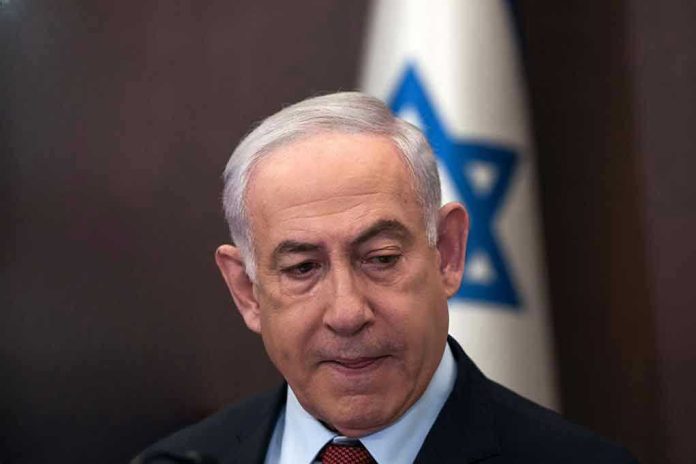
Benjamin Netanyahu just abandoned his most defiant public stance by formally requesting a presidential pardon, signaling that Israel’s longest-serving prime minister has finally run out of legal options.
Quick Take
- Netanyahu submitted a 111-page pardon petition to President Isaac Herzog on November 30, 2025, reversing his previous categorical refusal to seek clemency
- The prime minister faces corruption charges across three separate cases involving allegations of bribery, fraud, and breach of trust
- Netanyahu seeks to “wipe the slate clean” without fully admitting guilt, attempting to eliminate daily court appearances that have constrained his administration
- President Herzog’s office acknowledged the “extraordinary request” and committed to careful consideration after reviewing all relevant opinions
The Dramatic Reversal That Changed Everything
Netanyahu’s decision to petition for a pardon represents a stunning about-face from his previous public declarations. The prime minister had repeatedly insisted he would never seek clemency, dismissing the corruption trial as “ridiculous” and vowing to fight through the legal process. That uncompromising stance vanished on November 30, 2025, when Netanyahu submitted his formal petition to President Herzog. The shift reveals a calculation that the legal battle has become untenable and that executive clemency offers the only viable path forward for a sitting prime minister drowning in multiple simultaneous legal proceedings.
Understanding the Legal Minefield
Netanyahu faces corruption charges across three separate cases, each involving serious allegations that strike at the foundation of public trust. The charges encompass bribery, fraud, and breach of trust—the kind of accusations that would typically end a political career. What makes Netanyahu’s situation unique is that he has continued serving as prime minister throughout these proceedings, managing a coalition government while simultaneously navigating courtroom appearances and legal strategy sessions. The accumulation of cases, each demanding time and attention, has created a grinding pressure that appears to have finally broken through his defiant exterior.
The Strategy Behind the Petition
Netanyahu’s 111-page petition deliberately avoids a complete admission of guilt while seeking comprehensive legal rehabilitation. Rather than confessing to the charges, the prime minister frames the pardon request as a necessity for governance—arguing that he needs to “wipe the slate clean” and redirect his energy toward running the country. This strategic framing attempts to separate the pardon from questions of innocence or guilt, positioning it instead as a practical solution to an administrative problem. His coalition allies in the Knesset have signaled that supporting this pardon request represents a top political priority, providing Netanyahu with substantial legislative backing for his clemency bid.
The President’s Impossible Position
President Isaac Herzog now holds authority over a decision with extraordinary implications for Israeli governance and the rule of law. His office acknowledged receiving an “extraordinary request” that “carries with it significant implications,” committing to consider the petition “responsibly and sincerely” after gathering all relevant opinions. Herzog faces competing pressures: coalition allies supporting Netanyahu, a public with mixed views on accountability, and international observers watching whether an Israeli president will grant clemency to a sitting prime minister facing serious corruption charges. The decision will establish precedent for how executive clemency functions when applied to high-ranking officials.
What’s Actually at Stake
A granted pardon would provide Netanyahu with immediate relief from daily court appearances and create space for him to exercise greater political power within Israeli coalitions. It would signal that executive clemency can override judicial processes, potentially undermining public confidence in governmental accountability. Conversely, denying the pardon would intensify legal proceedings and likely weaken Netanyahu’s political position. The broader implications extend beyond Israeli politics, touching fundamental questions about separation of powers, judicial independence, and whether sitting leaders can insulate themselves from legal consequences through executive mechanisms.
Sources:
Netanyahu Asks Israel’s President to Pardon Him in Corruption Cases