A 29-year-old Pennsylvania volunteer firefighter now stands accused of living every small-town nightmare: setting the fires that his own crew rushed out to fight.
Story Snapshot
- Police say volunteer firefighter Justin Sholly admitted to setting three fires in about 30 hours, then responded to at least two with his department.
- Court documents and broadcast reports describe license-plate-reader hits and fire-setting materials in his vehicle as key evidence.
- Officials say barns, vehicles, and nearby homes were threatened, forcing evacuations and heightening community anger.
- The case taps into a rare but real pattern of “firefighter arson,” raising tough questions about trust, oversight, and media sensationalism.
A small town, a trusted volunteer, and a shocking set of charges
Police in eastern Pennsylvania say they were not hunting a mystery drifter when barns and property started burning; they were tracking one of the people paid nothing to protect those very places.[1][2][4] Court documents and network reports name the suspect as 29-year-old volunteer firefighter Justin Sholly, charged with multiple felonies including arson, reckless burning, and causing catastrophe after a concentrated series of fires near Souderton and Franconia Township.[1][2][6] Sholly has not yet entered a plea.[1]
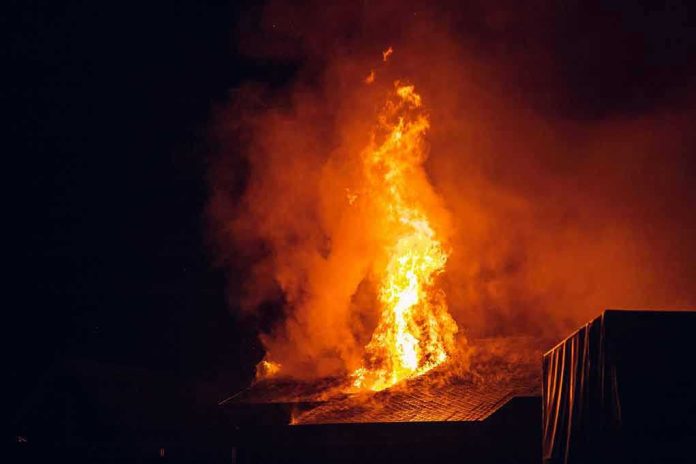
Investigators and national outlets describe a pattern that unfolded over roughly 24 to 30 hours: three separate fires, two barns destroyed or damaged, several vehicles burned, and at least 18 civilians forced to evacuate nearby homes.[1][2][4][6] Authorities say that after setting some of the blazes, Sholly went back to his station and then rolled out with his volunteer company to fight the very fires he had allegedly ignited, an allegation that inflames public anger far beyond an ordinary property-crime docket.[1][2][4]
How investigators say they built the case
Local police and state investigators describe a relatively modern trail: license-plate-reader technology, targeted interviews, and a vehicle search that allegedly turned up the tools of the crime.[1][2][4] Police officials told reporters they used automated plate readers to place Sholly’s vehicle near the fire scenes within key time windows, then used that lead to focus on him as a suspect.[1][2][4] A subsequent search of his car reportedly produced fire starter logs, lighter fluid, and a fire radio, items that prosecutors argue line up with the ignition methods suspected at the scenes.[1][2]
National coverage goes further, citing a police affidavit that describes statements Sholly allegedly made after investigators confronted him.[2] According to those reports, court documents say he admitted to setting all three fires, including describing igniting wood logs at one site before the flames spread to a detached barn structure.[2] One complaint summary also says he placed a fire near property he believed belonged to a former employer who fired him in 2015, suggesting at least one motive grounded in resentment rather than random thrill seeking.[1] The defense has offered no public counter-narrative so far, and his attorney reportedly declined comment.[2]
Allegation versus proof, and the missing pieces in public view
Breaking coverage presents a clean storyline—confession, plate-reader hits, fire logs in a trunk—but the underlying record available to the public is thinner than the headlines imply.[1][2][4] Reporters quote from a police affidavit, yet the full sworn complaint, supporting exhibits, and audio or video of any interview have not been published, leaving outsiders unable to judge context, tone, or whether his alleged statements were partial, qualified, or disputed later.[2] No lab reports, accelerant analyses, or detailed ignition-pattern diagrams have surfaced in open sources, which means the case remains allegation-heavy and evidence-light for anyone outside the courtroom.
From a common-sense, conservative perspective, that matters. Law and order depends on both punishing real arsonists harshly and resisting the media’s habit of converting accusations into convictions on day one. The technology and physical items described by police can be compelling, but they still need timestamps, chain-of-custody documentation, and cross-checks with dispatch logs and body-camera or scene video before citizens should treat them as conclusive. The justice system, not cable segments, is supposed to finalize guilt.
The rare but real problem of firefighter arson
This case feels like a screenplay because it taps into a disturbing but rare phenomenon: firefighters who start the fires they later help extinguish.[3][6] Fire-service studies and crime research describe “firefighter arson” as a persistent issue involving a tiny fraction of personnel, often volunteers, whose motives range from thrill-seeking and a desire to play hero to anger, financial stress, or attempts to cover other wrongdoing.[3][6] One forestry commission review and Federal Bureau of Investigation (FBI) research even sketches a loose profile: younger males, shaky work histories, fascination with emergency culture, and a hunger for excitement or validation around the fireground.[3][6]
A volunteer firefighter has been arrested for allegedly setting fires and then responding to them with his fire department, according to officials in eastern Pennsylvania.
Justin Sholly, a 29-year-old member of the Perseverance Volunteer Fire Company in Souderton, was arrested…
— Qᴀɢɢ.ɴᴇᴡꜱ (@qaggnews) June 3, 2026
Reports note that arson remains a small slice of overall crime, and firefighter-caused arsons represent an even smaller subset, though some estimates suggest roughly one hundred firefighters per year are convicted nationwide.[3][6] That rarity cuts in two directions. On one hand, the overwhelming majority of volunteers and career firefighters earn trust every day and deserve not to be smeared by sensational cases. On the other, precisely because such incidents are rare and dramatic, they invite moral panic, political grandstanding, and pressure for policy overreach based on a handful of high-profile arrests rather than sober risk analysis.
Trust, transparency, and what comes next
Communities that rely on volunteer departments face an uncomfortable question: how do you guard against the very small number of bad actors without suffocating the many good ones in red tape? Some experts argue for tighter background checks, closer supervision of new volunteers, and better tracking of members who seem unusually eager for calls or who consistently appear around suspicious incidents.[3][6] Others emphasize transparency: rapid release of affidavits, dispatch logs, and non-sensitive evidence, so citizens can distinguish solid cases from overhyped ones and maintain trust in both their firehouse and their courts.
For now, the Sholly case sits at that intersection of outrage and uncertainty. Prosecutors say they have his admission, his car, his logs, and his movements. He retains the presumption of innocence, and the public still lacks the full affidavit, forensic reports, and sworn testimony that will either cement or collapse the narrative dominating the airwaves. That tension—between the story we are told and the proof we can see—is where responsible citizens must live until a verdict is actually reached.
Sources:
[1] Web – Volunteer firefighter arrested for setting blazes and responding to …
[2] Web – Volunteer firefighter in Montgomery County accused of setting fires …
[3] YouTube – Volunteer firefighter accused of arson spree in Pennsylvania
[4] Web – Pa. firefighter charged with 27 felonies in weekend arson spree
[6] Web – Arrested firefighter confesses to arson spree | 6abc.com – ABC30