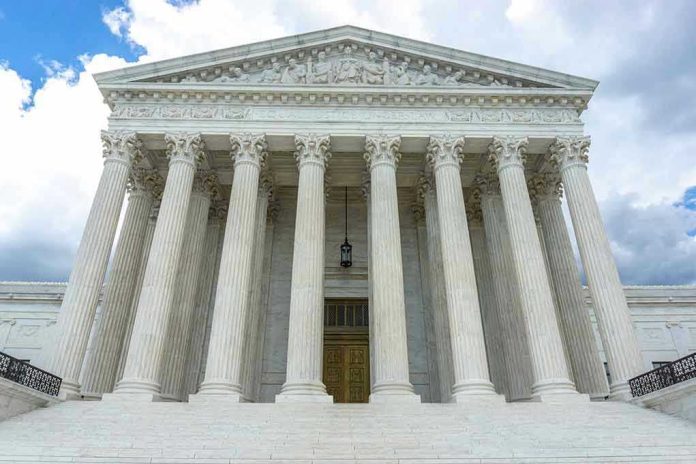
The Supreme Court just handed Steve Bannon a stunning legal reversal that exposes how quickly the machinery of justice can shift when political winds change direction.
Story Snapshot
- Supreme Court vacated Bannon’s 2022 contempt of Congress conviction on April 6, 2026, reversing a federal appeals court decision that had upheld it
- The Trump administration prodded the Court’s action and requested dismissal “in the interests of justice” through the Department of Justice
- Bannon already served his four-month prison sentence in 2024, making any dismissal purely symbolic rather than practical
- The reversal weakens congressional subpoena enforcement power and signals executive branch influence over prosecutions of political allies
From Defiance to Conviction: The Journey Through the Courts
Steve Bannon’s legal odyssey began when the House Select Committee investigating January 6 issued him a subpoena on September 23, 2021. The committee wanted documents and testimony about his communications with Trump, his role in “stop the steal” efforts, and his ominous prediction that “all hell is going to break loose.” Bannon refused to produce documents or appear for his deposition in October 2021. The full House voted 229-202 along partisan lines to hold him in contempt, and the Department of Justice indicted him on two criminal counts in November 2021.
The Conviction That Seemed Ironclad
A jury convicted Bannon on both contempt counts in July 2022. The judge sentenced him to four months in prison and a $6,500 fine that October, though the sentence was stayed pending appeal. Bannon challenged the conviction through the D.C. Circuit Court of Appeals, which affirmed his conviction in May 2024. When he asked the Supreme Court to keep him out of prison while appealing, the justices denied his request on June 28, 2024. He reported to federal prison on July 1, 2024, and served his full four-month sentence.
The Reversal Nobody Saw Coming
Everything changed when Trump returned to office after the 2024 election. The new Trump administration’s Department of Justice executed a complete about-face, requesting dismissal of Bannon’s conviction and indictment. On April 6, 2026, the Supreme Court issued an unsigned order throwing out the D.C. Circuit’s ruling and sending the case back to the trial judge to consider the dismissal request. The move represents a dramatic departure from the Court’s earlier denials of Bannon’s appeals during the Biden administration.
What This Means for Congressional Power
The implications extend far beyond one man’s criminal record. Criminal contempt of Congress traces back to an 1857 statute designed to give teeth to congressional investigations. The Supreme Court has long held that Congress cannot legislate effectively without information-gathering power. Yet contempt prosecutions remain rare; before Bannon, the last indictment occurred three decades earlier against a Reagan-era official. This reversal threatens to make an already uncommon enforcement mechanism even weaker, potentially emboldening future witnesses to defy congressional subpoenas with impunity.
The Symbolic Victory With Real Consequences
For Bannon personally, dismissal offers no tangible benefit since he already served his time behind bars. The conviction’s erasure serves as political vindication rather than practical relief. Yet the broader message resonates loudly: executive branch priorities can override judicial proceedings when administrations change hands. The parallel Supreme Court order issued the same day for a former Cincinnati councilman suggests this approach may become a pattern rather than an isolated incident. Democrats who championed January 6 accountability face a significant setback, while Trump allies gain ammunition for their narrative about partisan weaponization of justice.
The Partisan Divide Deepens
The case crystallizes the chasm between competing visions of accountability and executive power. The original January 6 Committee comprised seven Democrats and only two Republicans, with the House contempt vote splitting almost entirely along party lines. Bannon and Trump viewed the subpoena as congressional overreach and an attack on executive privilege, despite Bannon having left the White House years before January 6. The Biden-era DOJ aggressively prosecuted the case, while the Trump DOJ now seeks its dismissal. This whiplash exposes how politicized federal prosecutions have become, raising questions about whether any conviction of politically connected figures can survive an administration change.
Sources:
Steve Bannon wins Supreme Court order likely to lead to dismissal of contempt of Congress conviction
Bye-Bye Bannon: An Explanation of the Steve Bannon Contempt of Congress Trial
Bannon Contempt of Congress Indictment Timeline
Bannon v. United States – SCOTUSblog