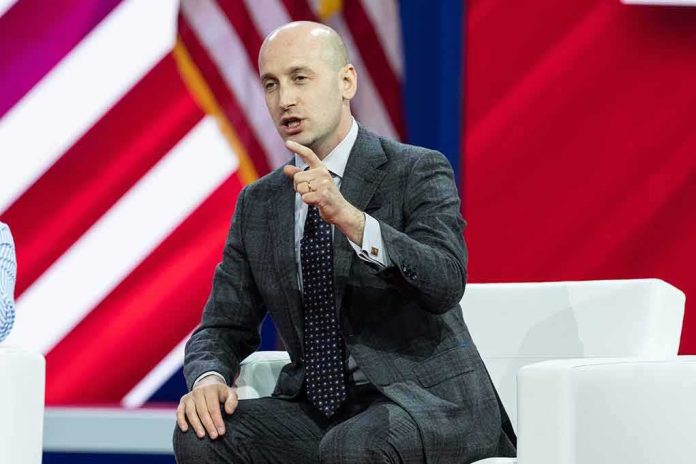
Stephen Miller’s furious TV rant over the Supreme Court’s birthright citizenship decision lays bare a deeper fight over who counts as an American — and who decides.
Story Snapshot
- The Supreme Court upheld birthright citizenship, rejecting Donald Trump’s executive order and Stephen Miller’s legal theory.
- Stephen Miller blasted the justices on Fox News, demanding a 9-0 ruling to end birthright citizenship and warning America has “no future” if it continues.
- The Court reaffirmed that the 14th Amendment’s phrase “all persons born” covers children of undocumented immigrants, following a 125‑year precedent.
- The clash exposes a wider crisis of trust, with many Americans seeing both sides as serving elites and political agendas rather than ordinary citizens.
What The Supreme Court Decided On Birthright Citizenship
The Supreme Court’s ruling in Trump v. Barbara kept birthright citizenship in place and struck down Trump’s attempt to end it by executive order. Chief Justice John Roberts wrote that the 14th Amendment’s words “All persons born or naturalized in the United States, and subject to the jurisdiction thereof, are citizens” are clear and leave no carve‑out for children of immigrants. The Court reaffirmed the 1898 case United States v. Wong Kim Ark, which said anyone born on U.S. soil, other than narrow exceptions like foreign diplomats, is a citizen at birth.
The ruling was 6–3, and even some conservative justices appointed by Trump agreed that Congress and presidents cannot erase birthright citizenship without changing the Constitution itself. The majority stressed that if politicians want to limit citizenship, they must convince two‑thirds of both houses of Congress and three‑quarters of the states to pass a new amendment, a very high bar. That message cut across party lines: neither executive orders nor simple laws can quietly undo a core promise that has stood for more than a century.
Stephen Miller’s Rant And His Push To Redefine Citizenship
Stephen Miller, Trump’s longtime immigration strategist, responded to the ruling with an angry Fox News appearance, calling birthright citizenship an “outrage” and “atrocity.” He said any child born here to undocumented parents gains the power to vote, collect welfare, and sit on juries, which he argued destroys national sovereignty. Miller claimed the author of the 14th Amendment made clear it did not apply to “aliens” and insisted the Reconstruction Amendments were meant only to enfranchise former slaves, not the children of immigrants.
Miller went further, saying that if America “one way or another” does not end birthright citizenship, “this country doesn’t have a future,” tying his warning to the 250th anniversary of the nation’s founding. He demanded a unanimous 9–0 Supreme Court ruling to overturn birthright citizenship, saying anything less means the democracy is not functioning. In other media hits, Miller has described birthright citizenship as “illegal,” “suicidal,” and the “biggest financial rip‑off of Americans in history,” blaming it for welfare fraud, terrorist risks, and a supposed “invasion.”
How The Constitution And History Counter Miller’s Claims
Legal history strongly undercuts Miller’s reading of the 14th Amendment. The amendment’s text says “All persons born or naturalized in the United States…” without any explicit exclusion for children of immigrants, lawful or unlawful. In Wong Kim Ark, the Supreme Court held that the amendment “affirms the ancient and fundamental rule of citizenship by birth within the territory,” including “all children here born of resident aliens,” except narrow cases like children of foreign sovereigns or hostile occupiers. That ruling has anchored American citizenship law since 1898.
Research on the amendment’s drafting shows its framers expected it to cover immigrant children as well as freed slaves. Congressional records indicate that the broad guarantee of birthright citizenship “was always intended to include the children of immigrants, regardless of their parents’ legal status.” Modern constitutional scholars across the spectrum say undocumented immigrants and their children are “subject to the jurisdiction” of the United States because they must follow U.S. laws, unlike diplomats who have legal immunity. The Supreme Court has followed that logic again in cases like Plyler v. Doe, where it held undocumented children have a right to public education under the Constitution.
Shared Public Frustration: Immigration, Elites, And A System That Feels Rigged
Many conservatives over 40 hear Miller’s warnings and see real problems they have felt for years: illegal immigration, strains on schools and hospitals, and a political class that talks about “global citizenship” while ordinary workers fall behind. To them, the idea that someone can cross the border unlawfully, have a baby, and gain a path to benefits and voting power sounds like another example of elites ignoring the cost on taxpayers and local communities. Miller’s fiery tone taps into that anger, even when his legal claims do not match the text or history.
Stephen Miller suggested that since the SC has rejected the EO to abolish birthright citizenship, the admin could retaliate by banning U.S entry for all foreign pregnant women as a means of preventing the birth right from being granted.
Artist: Chris Weyant… pic.twitter.com/Bl8spWLoGX— AMISTAD (@JV3MJD) July 1, 2026
At the same time, many liberals over 40 see the Trump order and Miller’s campaign as proof the government can be used to strip basic rights from people born here, especially minorities and the poor. They point to the long record of the 14th Amendment protecting Black Americans, immigrant families, and others against second‑class status, and they fear that changing birthright citizenship would create a permanent underclass. Both sides, in different ways, feel the system serves powerful insiders more than regular citizens and worry that judges and politicians use complex legal fights to dodge deeper issues like wages, housing, and corruption.
Why This Fight Over Citizenship Matters For America’s Future
This clash is not just about one Supreme Court case or one angry television rant. It raises basic questions: Who is “one of us”? Who decides the rules of belonging? And can those rules be changed without a broad, honest debate that includes the people most affected? The Court’s decision says that changing something as foundational as birthright citizenship must go through the hard path of a constitutional amendment, not the quick path of executive power.
For readers across the political spectrum, the episode highlights a deeper worry: leaders keep using extreme moves and courtroom battles instead of fixing the real problems people face. The fear of “anchor babies” and the fear of mass rights removal both grow in a climate where trust in institutions is low and where many believe the “deep state” and wealthy elites call the shots. Whether one cheers or condemns the ruling, the larger question remains: will the government tackle root causes of frustration, or keep fighting over who gets counted while millions struggle to reach the American Dream?
Sources:
thegatewaypundit.com, yahoo.com, nytimes.com, instagram.com, pbs.org, facebook.com, youtube.com, americanimmigrationcouncil.org, oyez.org, supremecourt.gov, brennancenter.org, rnlawgroup.com