A Florida teachers union finds itself at the center of a firestorm after officials claimed educators required students to protest federal immigration enforcement, yet the evidence tells a strikingly different story.
Story Snapshot
- Hillsborough Classroom Teachers Association accused of mandating student ICE protests but explicitly denies organizing or requiring any walkouts
- Florida Education Commissioner threatens discipline for educators and students amid multiple school walkouts across Tampa Bay and Central Florida
- Principal under investigation after lawmakers claim she instructed teachers not to prevent student protests during school hours
- Students continue demonstrations despite suspension threats, citing fears about immigration enforcement impacting families
- Sensationalized headlines obscure actual events, with no verified evidence union mandated student participation
When Headlines Outrun Reality
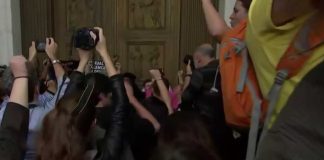
The Hillsborough Classroom Teachers Association issued an emphatic denial on February 11, 2026, stating it neither organized nor required student protests against Immigration and Customs Enforcement. This denial followed explosive accusations from Republican lawmakers who claimed Principal Denise Savino at Lennard High School instructed teachers to allow student walkouts on January 30. The union countered that existing safety policies predating the controversy guided administrator responses, accusing state officials of weaponizing student activism to target educators politically. No video or documentation has surfaced proving the union mandated participation.
THESE TEACHERS SHOULD BE FIRED! Outrage After Florida Teachers Union Says Children Protesting ICE is 'Required' (Video) | The Gateway Pundit | by Margaret Flavin https://t.co/tQj8MlQS4N
— ArmyMom224⛪️✝️🇺🇸🪖 (@ArmyMom224) February 16, 2026
Multiple Schools Join Spontaneous Movement
Student walkouts erupted across Florida schools throughout early February 2026, spanning St. Petersburg High, Hollins High in Pinellas County, and Blake, Plant, Alonso, and Hillsborough high schools. Students like Valentina Santiago and Nicole Cochran organized an after-school rally at Wharton High School in Tampa on February 9, drawing over 20 participants protesting ICE enforcement they characterized as racial profiling. By February 13, demonstrations spread to Central Florida’s Brevard County schools. These organic youth movements reflected genuine anxiety within diverse student populations about escalating federal immigration raids threatening family separation.
State Leadership Draws Hard Line
Florida Education Commissioner Anastasios Kamoutsas issued a February 3 letter to superintendents warning against encouraging protests disrupting instruction, threatening consequences for students, teachers, and entire districts. His public statements declared the state would not tolerate educators encouraging school protests that disparage law enforcement. Governor Ron DeSantis amplified this position via retweet, proclaiming children should not serve as pawns for political activism while demanding education over indoctrination. State lawmakers Representatives Danny Alvarez and Michael Owen pushed investigations into Principal Savino, establishing a confrontational dynamic between Florida Republican leadership and education administrators.
First Amendment Collides With Classroom Order
Legal experts debate whether these walkouts merit constitutional protection under the landmark Tinker v. Des Moines decision from 1969, which permitted symbolic student expression unless substantially disruptive. Adam Goldstein from the Foundation for Individual Rights and Expression distinguishes between protected symbolic acts like wearing armbands versus walkouts that interrupt instruction. ACLU attorney Michelle Morton emphasizes balancing student rights against school order maintenance, suggesting silent protests face fewer legal obstacles. The critical question remains whether adult facilitation occurred, which would dramatically shift legal analysis from protected student expression to potential educator misconduct.
Political Theater Obscures Legitimate Concerns
The sensationalized framing of this controversy misrepresents verifiable facts while politicizing genuine student anxieties. No credible evidence supports claims that unions required protest participation, yet inflammatory headlines persist. Students organizing after-school demonstrations to avoid discipline show consciousness about balancing expression with educational responsibilities. Meanwhile, state officials threatening sweeping consequences before investigations conclude reveals prioritization of political messaging over measured response. The real story involves young people responding to fears about family separation while navigating complex legal boundaries, not nefarious union indoctrination schemes.
Chilling Effects Ripple Through School Communities
Immigrant and Hispanic students throughout affected Florida counties face heightened anxiety as enforcement actions intensify and educational authorities warn against protest participation. Teachers risk employment for perceived facilitation, creating incentives to suppress student expression regardless of constitutional protections. Districts defer decision-making to individual principals, leaving administrators exposed to political crossfire between student rights advocates and state enforcement priorities. Zander Moricz from youth nonprofit SEE Alliance argues adults should support students reasonably responding to perceived injustice, yet educators increasingly calculate career preservation against constitutional principles when confronting organized student activism during instructional time.
Historical Precedents Offer Murky Guidance
The 2018 Parkland shooting aftermath produced similar tensions when students nationwide walked out demanding gun control measures, facing varied district responses ranging from supportive accommodation to threatened discipline. Civil rights era sit-ins frequently disrupted public order with consequences for participants, complicating claims that effective protest requires consequence-free participation. Florida’s recent battles over curriculum content and book availability established precedent for aggressive state intervention in local education decisions. These accumulated tensions position current immigration protest responses within broader culture war dynamics where competing values about education’s purpose, appropriate student activism, and governmental authority collide without consensus resolution frameworks.
Sources:
WUSF: ICE Protests Tampa Bay Students Despite Pushback State Officials
AOL: Florida Education Leaders Caution Students