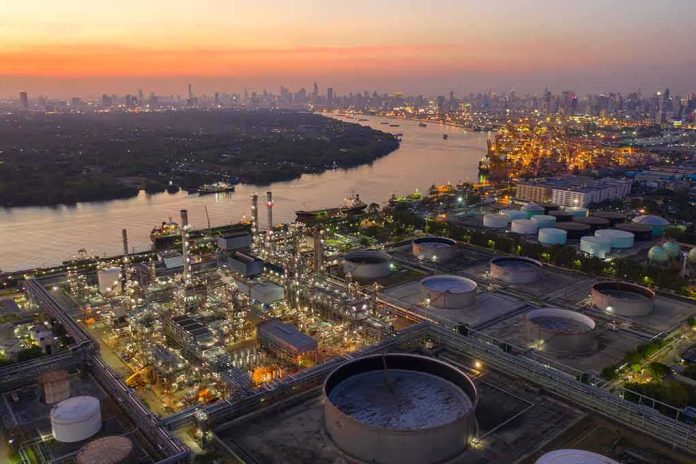
Ukraine’s drone campaign against Russia’s oil sector has now reached deep into the country’s core refining network, and the fuel system is starting to feel it.
Quick Take
- Reuters, BBC Verify, AP, and other outlets have reported strikes on many major Russian refineries, including plants in Moscow, Omsk, Saratov, Syzran, Ilsky, and Tatarstan.
- Reuters reported that attacks on refining have caused full or partial shutdowns and reduced gasoline, diesel, and jet fuel output.
- BBC Verify said 21 of Russia’s 38 large refineries had been hit since January, with at least 10 suspending operations fully or partly.
- The strongest evidence supports a campaign of disruption, but the claim that every one of Russia’s eleven biggest refineries has been hit is not fully proved in the provided research.
What the Reporting Shows
Public reporting now shows a steady pattern of Ukrainian long-range drone strikes on Russian refining sites. Reuters has described attacks on the Moscow refinery, Omsk, Ilsky, Saratov, and other plants, while CNBC and The Moscow Times reported additional hits in Bashkortostan and Krasnodar. AP and BBC Verify also said the strikes have spread across a wide range of regions, which points to a broad campaign rather than a single wave of raids.
That wider pattern matters because Russia’s refineries are not small, isolated targets. Reuters said the combined capacity of refineries that were fully or partly halted in May exceeded 83 million metric tons a year, which it described as about one quarter of total Russian refining capacity. BBC Verify later reported fuel shortages and price rises, showing that the strikes are not just symbolic; they are reaching the civilian fuel market too.
Why the Fuel Market Is Under Pressure
The clearest effect in the available reporting is disruption, not permanent destruction. Reuters said attacks on refineries doubled since the start of 2026 and led to full or partial shutdowns, with lower output of gasoline, diesel, and jet fuel. AP also reported that President Vladimir Putin acknowledged a fuel deficit. That combination of official concern, market strain, and repeated strikes suggests a real supply problem inside Russia, even if the scale changes from site to site.
At the same time, the evidence set does not prove the strongest version of the claim. Several reports rely on Ukrainian statements, local fire reports, or social media, while Russian officials often say drones were intercepted or that fires came from falling debris. Reuters itself has noted that it could not always confirm the full damage at specific sites, so the public record supports many strikes, but not a perfect refinery-by-refinery damage audit.
What Remains Unclear
The headline claim that all eleven of Russia’s biggest refineries have been hit is stronger than the evidence provided here. The research package names many major plants, but it does not include a complete, verified list of the top eleven with strike confirmation for each one. The same is true for big throughput claims in barrels per day. The reporting supports a major campaign, but the exact peak loss remains uncertain.
UPDATE — Drone Strike on Nizhnekamsk Kills 13
A Ukrainian drone attack hit the industrial city of Nizhnekamsk in Tatarstan, reportedly killing at least 13 people and wounding 39, according to the local mayor. The strike targeted a major oil refinery, marking one of the deadliest…
— WORFLICT – WAR NEWS (@worflict) August 10, 2026
That uncertainty does not erase the larger picture. BBC Verify, Reuters, and AP all describe a sustained effort to hit Russia’s energy system, and Reuters reported that Ukraine created a long-range command to step up those strikes. For readers on both sides of the political divide, the deeper issue is the same: a powerful state is trying to protect a critical industry, but repeated attacks and limited transparency make it hard to know how much damage has really been done.
Sources:
19fortyfive.com, nbcnews.com, reuters.com, apnews.com, themoscowtimes.com, bbc.com, youtube.com, cnbc.com, carnegieendowment.org, dw.com