

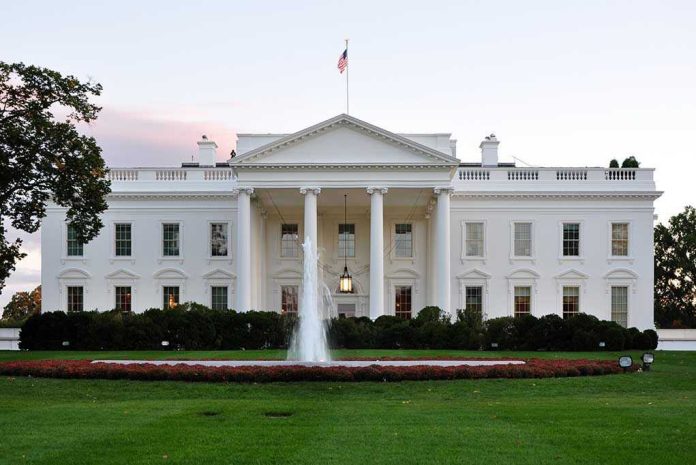
Republicans are now debating whether a $400 million White House ballroom becomes a symbol of national pride—or another Washington spending fight that contradicts the promise of “no taxpayer funds.”
Quick Take
- Sen. Lindsey Graham and GOP co-sponsors plan to unveil legislation authorizing up to $400 million for a White House East Wing ballroom.
- Democrats blocked the idea from riding a party-line reconciliation package, forcing Republicans toward standalone bills and procedural workarounds.
- President Trump previously indicated the ballroom would not be paid for by taxpayers, creating a political and messaging problem for the GOP.
- Sen. Rand Paul is pursuing an alternative approach aimed at avoiding new taxpayer costs, highlighting a split between “legacy project” politics and fiscal restraint.
Why the Ballroom Plan Suddenly Became a Flashpoint
Sen. Lindsey Graham of South Carolina, joined by Sens. Katie Britt of Alabama and Eric Schmitt of Missouri, is moving ahead with legislation tied to constructing a new White House ballroom in the East Wing, with estimates reaching as high as $400 million. After the effort failed to survive inclusion in a party-line reconciliation package, sponsors scheduled a news conference to roll out a standalone bill. The shift underscores a basic reality of divided Washington: big-ticket proposals attract big resistance.
Sen. Tim Sheehy of Montana also signaled he wants authorizing legislation and a fast Senate floor push using unanimous consent procedures—an approach that can move quickly but collapses if even one senator objects. That procedural detail matters because it shows Republicans looking for paths that avoid prolonged debate, amendments, and the kind of slow grind that turns internal disagreements into national controversies. The strategy also suggests supporters believe delay could harden opposition and complicate the funding argument.
The Funding Problem: Trump’s “No Taxpayer Money” Messaging vs. Federal Reality
The political tension is straightforward: President Trump has been associated with the ballroom concept and has publicly suggested such a project would not saddle taxpayers with the bill. A Senate proposal that authorizes major federal spending invites questions about whether the project’s financing is shifting from private support to public funds, or whether lawmakers are attempting to create a legal framework first and solve the funding mechanics later. Available reporting does not provide final budget language or binding offsets.
That uncertainty is where public trust gets tested. Conservatives who backed Trump for shaking up a spend-happy status quo tend to scrutinize new federal outlays, especially when everyday voters are still sensitive to inflation and interest-rate pressures that follow years of debt-driven governance. At the same time, supporters argue that presidential facilities have been upgraded under both parties for decades and that large-scale construction in a secure, historic complex is rarely cheap. The missing piece is clarity on who ultimately pays.
Rand Paul’s Alternative: A Test of Fiscal Credibility Inside the GOP
Sen. Rand Paul of Kentucky, a consistent deficit hawk, has indicated he plans his own version designed to avoid “new taxpayer costs,” leveraging his committee position. That stance highlights a familiar Republican dilemma: the party promises limited government and disciplined spending, yet it also governs an institution where symbolic projects can become priorities. If Paul’s approach relies on offsets, private fundraising, or reprogrammed funds, the details will determine whether it satisfies both fiscal conservatives and the pro-Trump wing eager for visible second-term accomplishments.
Democratic Obstruction, Republican Control, and the Broader Voter Backlash
Democrats have opposed the ballroom push and helped block its inclusion in the reconciliation route, reinforcing the broader pattern of hardline resistance to Trump-era initiatives even when Republicans control Congress. For many voters—right, left, and center—this fight also lands in a sensitive place: Americans increasingly believe the federal government prioritizes insider battles and prestige projects over practical fixes. Critics on the left frame the ballroom as waste, while critics on the right worry it hands opponents an easy talking point about GOP hypocrisy.
What Happens Next—and What We Still Don’t Know
The next milestones are procedural: the bill’s formal unveiling, committee routing, and whether any attempt at fast-track unanimous consent triggers objections. Oversight by the National Capital Planning Commission is also part of the process, and that review can shape design, scope, and timing. What remains unclear from the available reporting is whether the administration will insist on private funding mechanisms, whether Congress will attach explicit offsets, or whether the estimate grows beyond current projections as security and engineering requirements solidify.
If Republicans want this proposal to strengthen, rather than weaken, their argument that Washington can still operate with discipline, the burden is simple: spell out the financing in plain English and show how it fits with promises made to voters. Without that clarity, the ballroom risks becoming less about architecture and more about the deeper frustration shared across the country—that government leaders often treat public trust as optional, especially when a headline-grabbing project is on the table.
Sources:
Ballroom funding in party-line package a no-go
MAGA Stooge Lindsey Graham Reveals Major Plot Twist for Trump’s Ballroom