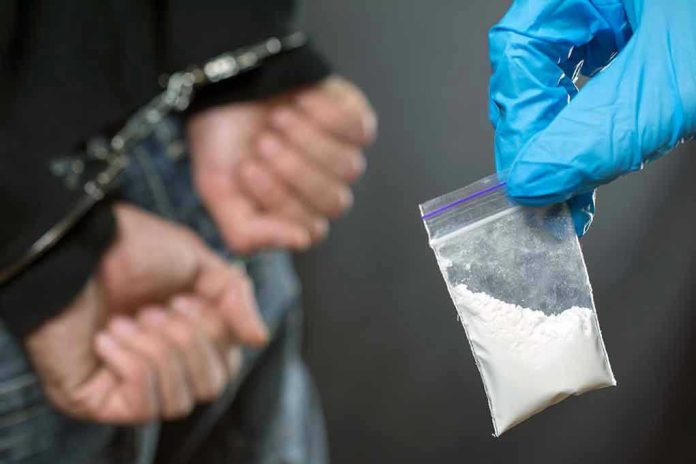
Federal border agents have already seized enough fentanyl in this fiscal year to theoretically kill more than 100 million people, exposing both the scale of the crisis and the stakes of getting border security right.
Story Snapshot
- Customs and Border Protection has intercepted thousands of pounds of fentanyl in early FY2026, on top of tens of thousands of pounds seized in recent years.
- Most fentanyl is caught at official ports of entry, where cartels exploit vehicle traffic and commercial shipments.
- Seizures represent lives potentially saved, but data gaps make it hard to prove how much overall trafficking has fallen.
- Conservatives face a double challenge: keeping pressure on cartels while demanding honest, transparent data from federal agencies.
Fentanyl Seizures Show a Crisis Measured in Pounds and Lives
Customs and Border Protection has already seized roughly 2,900 pounds of fentanyl at United States borders between January and March of fiscal year 2026, including about 613 pounds in March alone, according to a nonpartisan analysis of federal data. Those early numbers sit on top of an estimated 65,123 pounds of fentanyl seized between fiscal years 2023 and 2026, out of roughly 1.9 million pounds of illegal drugs intercepted overall.[1] Each pound represents potentially thousands of deadly doses kept off American streets.
OpenImmigration’s compilation of Customs and Border Protection seizure data estimates that the 65,123 pounds of fentanyl seized from fiscal year 2023 through fiscal year 2026 could translate into billions of potential lethal doses, underscoring why fentanyl has become the leading killer of younger adults.[1] While the exact “death equivalent” depends on potency and purity, the basic point remains: the country is intercepting staggering quantities of a drug powerful enough to kill in tiny amounts. For many families, these numbers echo the human cost already felt at the dinner table.
Ports of Entry Are the Front Line Against Cartel Smuggling
Customs and Border Protection’s own budget testimony stresses that the fight is concentrated at official border crossings, not just open desert.[2] The agency reported seizing nearly 22,000 pounds of fentanyl in 2024 and said it was on track to seize similar or higher amounts in 2025, with more than 7,000 pounds already taken off the market at that point.[2] Officials emphasized that over 90 percent of illicit drugs seized, including fentanyl, come through ports of entry, where cartels hide loads in cars, trucks, and commercial shipments rather than on migrants’ backs.
That pattern is visible on the ground. A United States Attorney’s Office report from the Southern District of California described how, in just the first nine months of fiscal year 2022, agents in that region alone seized 5,091 pounds of fentanyl, about 60 percent of all fentanyl confiscated nationwide during that period. Prosecutors called the San Diego corridor a “national epicenter” for fentanyl trafficking, as cartels exploited heavy cross-border trade to move high-purity powder and counterfeit pills. These enforcement snapshots reinforce the conservative argument that a secure, well-resourced border is not optional—it is a matter of life and death.
Seizures Matter, but Americans Deserve Honest Metrics of Success
Customs and Border Protection and its supporters rightly point out that every seizure permanently removes poison from the illicit supply chain and denies cartels profits and operating cash.[2] The agency’s budget materials explicitly frame drug busts this way, arguing that interdiction keeps fentanyl out of communities and disrupts criminal organizations.[2] For many conservatives, that is exactly what they want federal government employees to be doing: enforcing the law at the line, not pushing social experiments or looking the other way while traffickers profit.
Yet seizure numbers alone do not tell the full story of whether the crisis is easing. The same data that show 2,900 pounds intercepted early in fiscal year 2026 and detailed monthly trends going back years do not reveal how much fentanyl still gets through, or how many overdoses those seizures actually prevent.[1] Analysts warn that “record seizures” can mean either stronger enforcement, bigger trafficking volumes, or both, and current public records do not fully separate those effects.[1] Transparency on this front is critical if Americans are to trust what Washington tells them about border security.
Sources:
[1] Web – Drug Seizures at the U.S. Border – OpenImmigration
[2] Web – Fiscal Year 2026 Budget Request for the U.S. Customs and Border …