

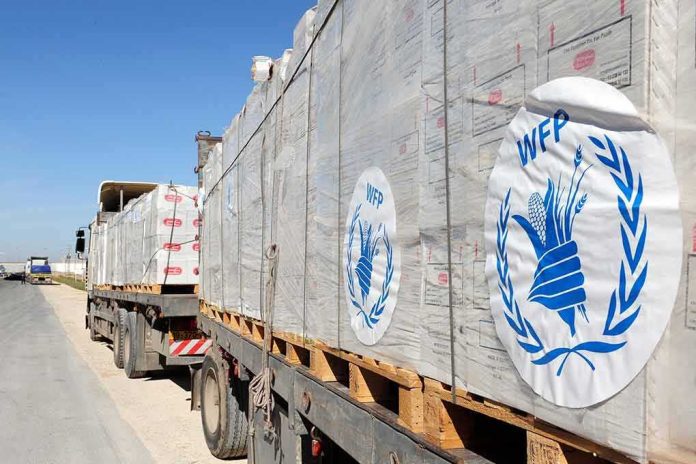
As Washington and Tehran trade missiles, a United Nations warning suggests the real battlefield may be your dinner table, with up to 45 million more people worldwide pushed toward acute hunger if the Iran war and $100 oil drag on.
Story Snapshot
- The UN World Food Programme (WFP) projects nearly 45 million additional people could face acute hunger in 2026 if the Middle East conflict continues and oil stays above $100 a barrel.[5]
- Import‑dependent countries in Africa and Asia, including Somalia, Afghanistan, and Sri Lanka, are already seeing millions more struggle to meet basic food needs.[1][5]
- Rising fuel, fertilizer, and shipping costs tied to Strait of Hormuz disruption are driving global food prices higher, while aid budgets are stretched thin.[3][5][6]
- The forecast is conditional and contested, but it highlights how decisions made by political and economic elites in distant capitals can determine whether families eat.[3][5]
What the UN Is Warning About the Iran War and Hunger
The United Nations World Food Programme (WFP) estimates that if the Middle East conflict continues through mid‑year and oil prices remain above $100 a barrel, almost 45 million additional people could be pushed into acute food insecurity in 2026.[3][5] This increase would come on top of about 318 million people already facing acute hunger worldwide, potentially driving global food insecurity back to record levels last seen after Russia’s invasion of Ukraine.[1][5] WFP describes this as a risk of the worst disruption to lifesaving humanitarian work since the COVID‑19 pandemic.[3]
World Food Programme analysts say they modeled a sustained oil price shock at $100 per barrel that raises transportation costs and global food prices, then applied it to existing data on how many people could afford a basic 2,100‑calorie daily diet.[5] By weighting the impact according to each country’s dependence on imported energy and food, they recalculated how many people would be priced out of that diet and classified as facing acute food insecurity.[5] The result is the headline figure that has been repeated by United Nations news services and international media outlets warning of a looming hunger crisis.[1][3][5]
How a War in Iran Hits Kitchens in Africa and Asia
The projected hunger surge does not come mainly from bombs falling on farms; it comes from higher fuel, fertilizer, and shipping costs triggered by conflict and disruption around the Strait of Hormuz.[4][5][6] The Food and Agriculture Organization of the United Nations reports that the Iran conflict has disrupted shipments of oil, gas, and fertilizers through Hormuz, driving up costs across global agricultural supply chains and raising farmers’ operating expenses worldwide.[6] WFP officials warn that these price spikes could leave millions of families in import‑dependent countries, especially in sub‑Saharan Africa and Asia, unable to afford staple foods.[3][5]
In practical terms, this means countries that rely heavily on imported grain and fuel pay more for every ship that reaches their ports.[2][5] WFP’s regional breakdown suggests food‑insecure populations could rise by about 24 percent in Asia, 21 percent in West and Central Africa, 17 percent in East and Southern Africa, 16 percent in Latin America and the Caribbean, and 14 percent in the Middle East and North Africa if the scenario holds.[2][5] Afghanistan, Somalia, and Sri Lanka are already seeing concrete effects, with WFP reporting that millions more people there are struggling to meet basic food needs as prices climb and aid budgets fall short.[1][5]
Where the Numbers Are Solid—and Where They Are Still a Guess
The core WFP warning is not a claim about what has already happened but a conditional forecast based on specific assumptions: that the conflict continues through June and oil prices stay above $100 per barrel.[3][5] That makes the 45‑million figure a scenario, not a measured outcome, and the available public material does not include the full model documentation, such as all the elasticities and sensitivity tests, needed for outsiders to fully audit the projection.[5] WFP itself acknowledges that many existing crises—Sudan, Gaza, Yemen, Haiti, and long‑running droughts—are already pushing hunger higher even without the Iran war.[3][5]
🚨🌍 The UN World Food Programme warns that the U.S.-Israel war on Iran could push up to 45 million more people into acute hunger
⛽ Rising fuel prices, disrupted supply chains, and deep aid funding cuts are hitting the world's poorest and most fragile countries the hardest
— Global Click (@Globalclick12) June 5, 2026
Critics therefore do not dispute that war and high energy prices make poor families go hungry; instead, they question how much of the projected surge should really be pinned on the Iran conflict alone versus broader mismanagement and vulnerability in the global food system.[2][3] So far, however, there is no equally detailed public counter‑model from governments or other institutions that directly challenges the WFP numbers with alternative data on shipping costs, fertilizer prices, or household food budgets.[3][5] In that vacuum, the debate often turns political, with different outlets using the same WFP estimate to attack or defend national leaders rather than to ask why so many people live one price shock away from starvation.[1][2][3]
Why This Resonates With Americans Tired of Failed Leadership
For many Americans watching from afar, the most disturbing part of this story is not the technical modeling but the familiar pattern it reveals: ordinary people worldwide paying the price for decisions made by a small circle of political and economic elites. WFP’s warning implies that a war half a world away, combined with fragile supply chains and dependence on imported fuel, can erase the ability of tens of millions to feed their families in a matter of months.[3][5][6] That picture fits the growing suspicion across the United States that global systems are built to protect the powerful while leaving working families exposed to every crisis.
Both conservatives and liberals frustrated with Washington can see their concerns reflected here. Voters wary of endless foreign entanglements see yet another conflict raising energy prices and squeezing household budgets at home and abroad.[2][4] Voters angered by rising inequality see how a spike in oil and freight costs becomes a death sentence only for those without savings, land, or political clout, while major energy firms and shipping interests often profit.[2][5][6] The United Nations does not take sides in that domestic argument, but its data underscore a shared reality: when wars, sanctions, and market shocks are treated as abstract policy tools, the human bill is paid by people who have never set foot in the rooms where those choices are made.
Sources:
[1] Web – UN Food Agency Warns Millions Pushed Into Hunger By Prolonged Iran War
[2] Web – UN food agency says millions are being pushed into hunger by Iran …
[3] Web – UN Agency Warns Trump’s Illegal Iran War Pushing Millions Into …
[4] YouTube – UN warns Iran war could drive record global hunger
[5] Web – Middle East war risks pushing 45 million more people into acute …
[6] Web – WFP projects food insecurity could reach record levels as a result of …