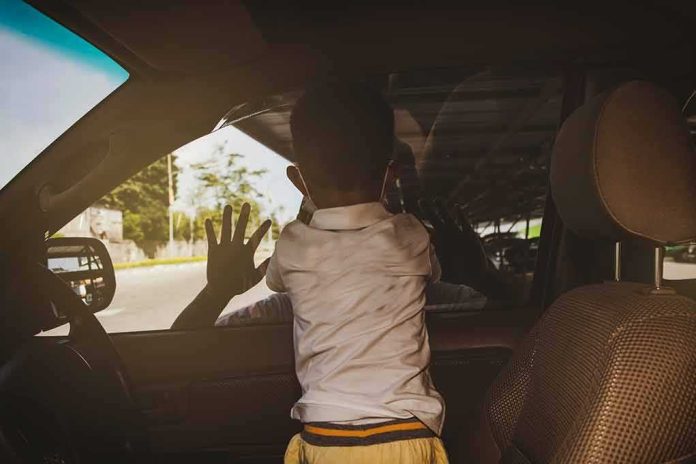
Police say a 5-year-old died after nearly three hours in a hot car during a family party, and both parents now face felony charges in Arizona.
Story Highlights
- Police arrested the parents on negligent homicide and child abuse charges after the boy died in triple-digit heat.
- Investigators say a family miscommunication may have left the child strapped in his car seat after a baptism gathering.
- Court materials describe a dispute over whether a teen was told to remove the child from the car.
- About 37 U.S. children die each year from hot cars, often after a caregiver forgets.
Police Actions and Charges in Peoria Case
Peoria police arrested the child’s parents after their 5-year-old son was found unresponsive in a vehicle during extreme heat. Reporters said prosecutors charged both with negligent homicide and child abuse. A judge found probable cause and set bond, allowing the case to move forward. The mother reportedly called 911 after finding the boy in the car, and officers opened a criminal probe that same day. Authorities stressed that the defendants are presumed innocent while the investigation continues.
Local coverage said the family had hosted a baptism celebration at home before the tragedy. Police statements and reporting described a chaotic scene with many guests. The child remained strapped in a car seat as afternoon temperatures soared, and family members realized he was missing in the late afternoon. First responders could not save him. Police and reporters placed the time in the car at over two and a half hours, matching the peak heat risk window.
Conflicting Accounts About Caregiver Handoff
Investigators and court materials pointed to a breakdown in communication within the family. A police spokesperson said it appeared to be a miscommunication about who would take the child out of the car. One report said the father told investigators he asked his 14-year-old to remove the boy. The teenager, according to the same coverage, denied getting that instruction. That dispute over a key handoff sits at the center of the charging narrative.
Friends quoted in coverage urged the public not to rush to judgment. A family friend said the parents believed another child had taken the boy out and said the couple would not have left him on purpose. Police, however, moved forward with arrests while evidence is still being gathered. Reporters noted that some detailed filings were not publicly available, which limits what the public can review about the timeline and proof.
Heat Risk, Prevention Gaps, and Shared Public Frustration
National data show about 37 children under 15 die each year from heatstroke in vehicles. In many cases, a caregiver forgets a quiet child who fell asleep. Studies over decades document how fast cabin temperatures spike and how a small body overheats quickly, even when outside heat feels survivable. The pattern is tragic and repeatable across states and income levels, and it often involves busy schedules and split caregiving duties.
A five-year-old's parents have been arrested after the boy died in a hot car outside their Arizona home while they hosted a party after church.
Theo Sabo was found unresponsive in a sweltering vehicle, in Peoria on Sunday.
R.I.P. https://t.co/hNLZUIYE6O via @DailyMail— Tamra M McDougall 🇨🇦 🇺🇸 (@TamraMcDougall) September 15, 2026
Families and critics on both the left and right see a larger failure behind these stories. They point to crowded lives, weak safety nets, and products that still ship without simple back-seat alerts or stronger child-detection sensors. Lawmakers, regulators, and carmakers have debated fixes for years, yet gaps remain. People ask why a modern vehicle can warn about low tire pressure but not a child in a rear seat. That question fuels anger across party lines when preventable deaths continue.
Why This Case Resonates Beyond One Family
This case hits core worries about trust, responsibility, and systems that claim to protect children. Police say probable cause supports the charges, and a court agreed to let the case proceed. At the same time, the reported miscommunication shows how a single missed handoff in a crowded home can end a life. The facts so far do not show intent, but they do outline a preventable failure that is seen in national data year after year.
Readers want fair accountability and real prevention. Prosecutors will press their case in court. Families will again ask for tools that backstop human error. Simple steps help today: check the back seat every stop, keep a needed item near the car seat, and set phone alerts. Broader change takes policy, design standards, and steady follow-through. Lives depend on closing the gap between what we know and what we do.
Sources:
katu.com, us.headtopics.com, hoodline.com, nbcnews.com, abc15.com, kvoa.com