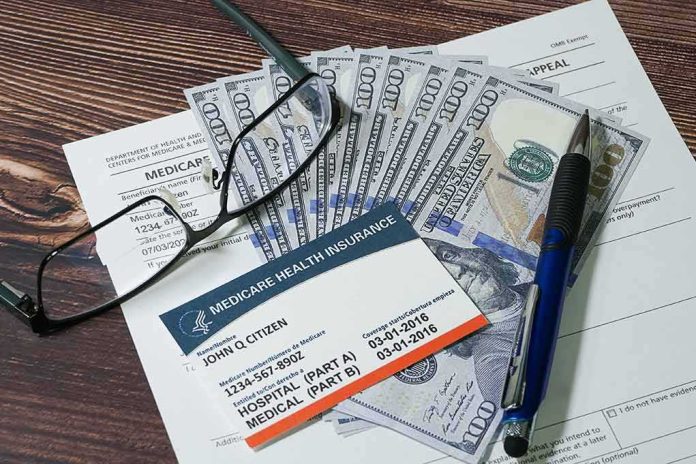
Twenty million seniors are slated to get $90 “premium rebates,” but the law behind those cash deposits still sits in a gray zone.
Story Highlights
- The White House and Medicare agency describe the $90 as a Part B premium rebate, not a stimulus.
- About 20 million people in Original Medicare Part B are eligible for direct deposits or paper checks.
- Money comes from the Medicare Improvement Fund, created by Congress for Medicare “improvements.”
- The statute’s text does not clearly name direct cash rebates, leaving legal questions open.
What the administration says is happening
The White House says most Medicare Part B enrollees will receive a one-time $90 payment in early October. It frames the transfer as a “premium rebate” meant to ease Part B costs. The Centers for Medicare and Medicaid Services says most eligible people will get direct deposits from the Social Security Administration, with paper checks for others. Officials say the money will come from the Medicare Improvement Fund, a pool Congress created for program improvements.
The Centers for Medicare and Medicaid Services explains that eligibility centers on people in Original Medicare Part B who meet residency rules and are not already getting premium help. People whose premiums are paid by Medicaid or who pay an income-related adjustment do not qualify. The agency calls the effort the “Medicare Improvement Fund Premium Rebate” and says the Social Security Administration and Treasury will handle payments through existing channels.
Who gets paid and how it will be delivered
News outlets report the government expects more than 20 million seniors to get $90, mainly by direct deposit, with paper checks for those without deposit information on file. Reports tie the timing to early October and describe the goal as offsetting Medicare Part B premiums. Coverage notes that the rebate is a partial relief measure, since the monthly Part B premium for 2026 stands at $202.90, far above the one-time $90 amount.
Several independent reports match on the core details. They cite the $90 figure, the early October delivery window, and the use of the Medicare Improvement Fund as the source. This cross-check suggests the distribution plan is real and imminent. These outlets also echo the administration’s view that the program is targeted at easing Part B premium pressure for a defined group, not creating a universal cash benefit for all seniors.
The legal hook and the open questions
The legal basis runs through Section 1898 of the Social Security Act, which created the Medicare Improvement Fund. The law says the fund is available to the Secretary of Health and Human Services to “make improvements” to Original Medicare, including adjusting payments to providers and suppliers. The statute does not spell out direct cash rebates to beneficiaries, which leaves room for debate over how far “improvements” can stretch.
Critics point to that gap. They argue that helping people with premiums may be an “improvement,” but the text does not clearly allow cash deposits to individuals. Commentary notes that nothing in the public record proves the payments are unlawful, yet no public legal memo from the Department of Health and Human Services, the Office of Management and Budget, or the Government Accountability Office has been cited to resolve the question. That keeps the legality unsettled in public view.
Why both right and left are uneasy
People across the spectrum see a familiar pattern: Washington moves money with vague labels and thin explanations. Seniors face real costs, but voters also want rules followed, not stretched by insiders. Supporters will say the fund exists to improve Medicare and that easing premiums helps people now. Skeptics will ask why a program labeled “rebate” shows up as cash in bank accounts and why officials have not released a clear legal opinion to back it up.
President Donald J. Trump Announces Medicare Improvement Fund Payments f… https://t.co/gGUXURtdJQ via @YouTube
— Lottie Matiskella (@LMatiskell66990) October 3, 2026
Timing adds heat. Payments land close to elections, which invites talk of politics on top of policy. That noise can drown out the real issue: whether Congress meant the Medicare Improvement Fund to cover one-time checks to individuals, or only system upgrades and provider payment changes. A formal opinion from watchdogs or agency lawyers could answer that. Until then, Americans see help for seniors mixed with the same old doubts about how Washington plays by its own rules.
Sources:
pjmedia.com, cms.gov, whitehouse.gov, cnn.com, usatoday.com