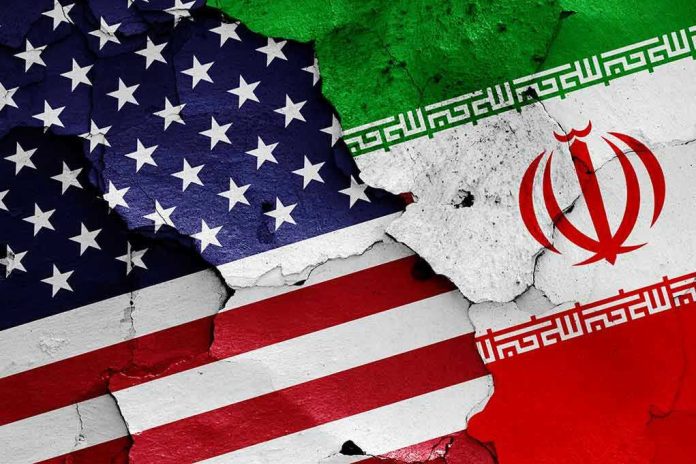
As Iranian streets fill with chants for freedom and bloodied protesters, Donald Trump has openly hinted that America might do far more than just watch.
Story Snapshot
- Iran faces its most explosive mix yet: economic collapse, religious cities in revolt, and a regime firing live rounds into crowds.
- Donald Trump declares the U.S. “stands ready to help,” while advisers quietly game out military, cyber, and information options against Tehran.
- Iran’s leaders threaten that any U.S. move could turn Israel and every American asset in the region into targets.
- The core dilemma: how to support a genuine uprising without handing the regime a foreign‑plot narrative on a silver platter.
Economic pain turns bazaar anger into a political revolt
Protests began where the regime least expected a political earthquake: Tehran’s historic bazaars, the commercial heart that once helped power the 1979 revolution. Runaway inflation crushed merchants and shoppers alike, and what started as fury over prices quickly became a referendum on the entire system. Within days, the unrest leapt from the capital to cities across the map, including Mashhad and Qom—religious strongholds long seen as the ideological insurance policy of the Islamic Republic.
Videos and eyewitness reports described slogans that crossed every red line the regime had tried to preserve. Chants of “Death to Khamenei” and “Clerics must go and get lost” echoed in streets once dominated by regime loyalists. An elderly cleric, identifying himself as Ali Kashani, openly denounced Ayatollah Khomeini’s legacy as “sedition” and called the government “criminal and murderer,” while a woman’s voice off‑camera answered with “Death to Khamenei.” For a theocracy built on clerical authority, that kind of dissent from inside the robe-and-turban class is strategically far more dangerous than any foreign sanction list.
A regime at war with its own population
Iran’s response followed a grim script that has repeated since 2009, only this time with higher intensity and fewer attempts to hide the brutality. Security forces deployed snipers, military rifles, and surveillance drones, firing live rounds into crowds and overwhelming hospitals with gunshot victims. Human rights monitors such as HRANA confirmed at least 116 deaths, while U.S. and Israeli officials assessed that the real toll is several times higher. potentially in the high hundreds.
Doctors in Tehran told reporters bodies were “piled up,” and the Center for Human Rights in Iran warned that blood supplies had run dangerously low in some hospitals. The regime then flipped its most reliable domestic switch: darkness. Nationwide internet shutdowns severed communications, prevented coordination among protesters, and turned casualty counting into a guessing game. Authorities framed the unrest as the work of “terrorists” tied to foreign powers, a familiar narrative designed to justify escalated force and dismiss the economic and political grievances that triggered the uprising.
Trump’s pledge and Washington’s menu of pressure tools
Against that backdrop, Trump’s message landed like a thunderclap in Tehran’s corridors of power and among Iranians scrolling through VPNs: “Iran is looking at FREEDOM, perhaps like never before. The USA stands ready to help!!!” Axios reporting, summarized by Iran International, indicates that behind the exclamation points lies a serious policy debate: how far should Washington go in turning moral support into concrete action? Options discussed reportedly range from visible military posturing to less kinetic but still potent cyber and information operations.
Some advisers floated the possibility of strikes on Iranian targets, but others argued that overt U.S. attack could undercut the protests by validating the regime’s foreign‑plot storyline. From a conservative, America‑first lens, that caution aligns with common sense: America gains little by transforming a homegrown revolt into a nationalist rally-around-the-flag moment for the mullahs. Deterrent deployments, like a carrier strike group parked where every Iranian general can see it, combined with cyber pressure and uncensored information flows, match U.S. interests while keeping Iranians, not Washington, as the authors of their own struggle.
Tehran’s threats, regional stakes, and the freedom calculus
Iran’s leadership answered Trump’s rhetoric with warnings meant to chill both Washington and its allies. Parliamentary speaker Mohammad Bagher Qalibaf declared that if the U.S. attacked, Israel and every American base and ship in the region would become “legitimate targets.” He went further, asserting Iran’s right to act on “objective signs” of a threat, not just after an actual strike. That language points to a willingness to escalate preemptively and to widen any confrontation beyond Iranian soil.
Regional and international responses reveal a split screen. Israel’s foreign minister openly wished success to Iranians “struggling for freedom,” aligning moral support with a clear strategic interest in weakening a hostile regime. Japan called for an immediate end to violence against peaceful protesters, avoiding talk of force while underscoring human rights concerns. In Europe, figures like French MEP Raphaël Glucksmann described the situation as an “open war” against the Iranian people and pushed the EU to designate the IRGC as a terrorist organization, arguing that statements without pressure only reward Tehran’s brutality.
Sources:
TIME: “Iran Threatens to Retaliate Against U.S. As Trump Considers Strikes”
Iran International: “Trump weighing options to back Iran protests – Axios”