A South African police captain was lowered by helicopter into crocodile-infested waters to retrieve a dead 15-foot crocodile—because investigators believed it contained a missing man’s remains.
Story Snapshot
- South African police used a helicopter-lowering tactic on the Komati River to secure a euthanized crocodile carcass linked to a suspected fatal attack.
- Capt. Johan “Pottie” Potgieter, a police diving unit leader, attached a rope to the carcass while hovering over waters known for crocodile danger.
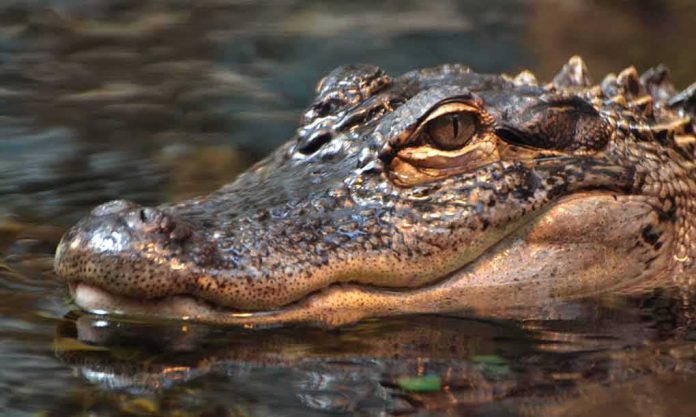
- The crocodile—reported at about 15 feet and roughly 1,100 pounds—was airlifted and transported for examination near Kruger National Park.
- Officials later confirmed human remains were found inside the crocodile, offering evidence and likely closure in the missing-businessman case.
Helicopter-lowered recovery turns a river into an evidence scene
South African authorities carried out an unusual, high-risk recovery on the Komati River in the country’s northeast after a local businessman disappeared and was presumed taken by a crocodile. Police located and euthanized a large crocodile suspected in the incident, but confirming the victim’s fate required retrieving the carcass from water described as crocodile-infested. The operation relied on an aerial approach rather than a conventional boat-based recovery.
Capt. Johan “Pottie” Potgieter, identified as the leader of a police diving unit, was lowered from a helicopter to secure the carcass by attaching a rope for extraction. Video footage circulated publicly, showing the captain dangling over the river and working quickly to connect the line. The basic logic was straightforward: the helicopter reduced time spent in the water and limited exposure in a habitat where other crocodiles may still be present.
What investigators confirmed—and what remains unclear
After the crocodile was lifted out, it was transported for examination associated with the Kruger National Park area. Reports said that an autopsy-like examination confirmed human remains inside the crocodile. That confirmation matters because it provides physical evidence for investigators and, just as importantly, a measure of certainty for the victim’s family. Public reporting did not identify the businessman by name or specify the exact date of the attack.
Those gaps are not unusual in early or sensitive reporting, especially when a death investigation may still be open. Based on the available accounts, authorities have not released detailed statements explaining how they identified the specific crocodile, what additional forensic steps were taken, or whether any negligence issues are under review. What is clear is that the recovery itself was treated as a mission-critical step to establish facts rather than rumor.
Why crocodile country keeps producing deadly headlines
The Komati River’s proximity to Kruger National Park places it in a region where human activity overlaps with high concentrations of Nile crocodiles. Reporting described crocodile attacks as recurring in parts of South Africa, a grim reality in rural areas where waterways serve as work sites, travel routes, and community gathering points. That context helps explain why police and park-linked personnel treat these scenes as both public-safety events and potential forensic operations.
A hard lesson on government priorities: competence beats slogans
American readers watching this clip may focus on the adrenaline, but the broader takeaway is more basic: when government functions, it looks like professionals using specialized skills to solve a concrete problem. In the U.S., voters across the political spectrum have grown tired of agencies that seem optimized for messaging, bureaucracy, or ideology rather than outcomes. This incident is a reminder that public institutions earn trust the old-fashioned way—by doing difficult jobs competently.
At the same time, the operation highlights the limits of “policy talk” when nature and local realities set the terms. No regulation can eliminate predator risk in wild river systems, but clear warnings, smarter river-access planning, and rapid-response capability can reduce deaths and improve case resolution. The reporting available so far emphasizes the recovery and confirmation of remains; it offers limited detail on longer-term prevention steps now being considered.
Sources:
South Africa police officer dangles over crocodile-infested waters in bid to retrieve human remains
Police officer dangles over crocodile-infested waters to retrieve human remains