

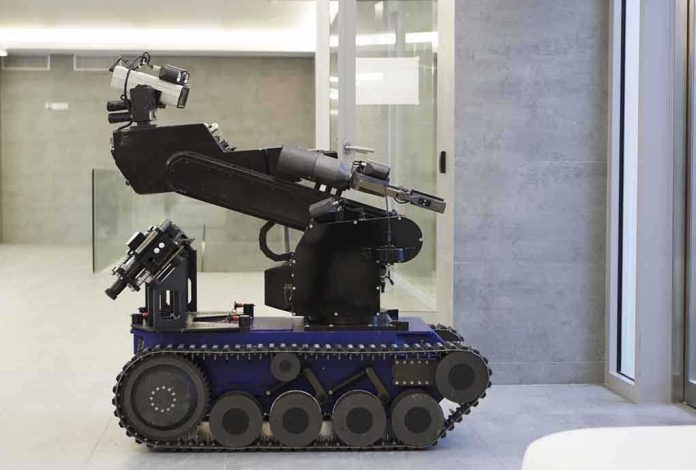
A U.S. “space mechanic” with twin robotic arms is now in orbit, and critics warn it could someday be told to grab enemy satellites instead of fixing friendly ones.
Story Snapshot
- Northrop Grumman’s Mission Robotic Vehicle (MRV) has launched with two powerful robotic arms to service satellites in high Earth orbit.
- Analysts say the same arms that can repair and refuel satellites could also be used to grab, move, or disable foreign spacecraft.
- Northrop’s CEO would not rule out future weapon uses, saying it is up to the U.S. government how the MRV’s capabilities are employed.
- Space experts worldwide now treat robotic servicing craft as “dual‑use” systems that blur the line between peaceful support and space weapons.
Robotic Space Mechanic Or Stealth Space Weapon?
Northrop Grumman’s Mission Robotic Vehicle is billed as a private “space mechanic” able to fix, refuel, and upgrade satellites in geosynchronous orbit roughly 22,000 miles above Earth. The craft carries two advanced robotic arms that can inspect hardware, attach propulsion pods, and even relocate satellites to new positions. The company’s SpaceLogistics division markets this as a way to avoid costly replacements and extend satellite life by as much as eight years, saving operators money while boosting space resilience.
The launch fits a pattern many Americans know too well: technology sold as helpful infrastructure but also quietly perfect for government power. The same robotic arms that can screw in a “jetpack” pod on a friendly satellite could grab a rival’s satellite and push it into a useless orbit or twist its antennas out of alignment. That kind of move would not create space debris like a missile strike, yet it could silently knock out crucial communications or spying systems other nations rely on.
CEO Comments Fuel Fears Of Weaponization
Concerns grew after Northrop Grumman chief executive Kathy Warden was asked directly if there is a market for an “offensive version” of the MRV that could disable other satellites. Instead of saying no, she answered that she would “leave it up to the U.S. government” to decide how the capability might support mission goals. For critics on both the left and right who already feel Washington hides key decisions behind closed doors, that answer sounded like a quiet green light for future weapon uses, if the government chooses.
Foreign media and analysts quickly seized on those remarks. Russian and other outlets highlighted a War Zone report arguing the MRV’s dual robotic manipulators could be used for direct attacks on satellites, not just peaceful servicing. They framed the mission as a U.S. move toward space weapons that look like repair tools, warning that Northrop’s system is “officially” commercial but realistically part of a growing military race in orbit. Those stories play into wider global worry that powerful countries now field space tools that can threaten rivals while staying just inside the gray areas of existing space law.
Dual‑Use Space Tech And The Growing Orbital Arms Race
Space security experts have warned for years that satellite servicing, close‑approach maneuvers, and robotic arms are classic “dual‑use” technologies. The same systems that refuel or clean up old hardware can also spy on, push, or damage another nation’s satellites without firing a shot. A study on dual‑use space systems notes that this kind of capability breeds mistrust because other countries cannot easily tell whether a servicing craft coming close to their satellite is there to help, to watch, or to harm.
SpaceX completed the launch of Northrop Grumman's MRV-MEP mission tonight, which will serve to reach, refuel, and extend the operational life of satellites in geostationary orbit. pic.twitter.com/U2hDskSxN4
— ROCKET Tesla car page (@ManPage80600) July 22, 2026
Officials in the United States Space Force have openly said that satellites with robotic arms or hidden “nesting” vehicles are among the most alarming new counter‑space threats. One expert described how a grappling arm could grab a working satellite and move it into a “graveyard” orbit, effectively killing its mission without an explosion or debris cloud. Similar concerns have been raised about Chinese programs and other nations’ experiments, showing this problem is bigger than one company and reflects a broader race to control the high‑ground of space.
Why This Matters For Ordinary Americans
For Americans already frustrated with elites on both sides of the aisle, the MRV story hits a nerve. People see a private company, backed by defense agencies, sending up a robot that can touch critical space infrastructure, while leaders refuse to clearly say how far they might go with it. Many worry that instead of fixing broken systems at home—like rising costs, broken promises, and a strained middle class—the government is pouring money into space tools that could quietly escalate conflict far above their heads.
At the same time, satellites are the backbone of daily life, from bank transactions and television to weather alerts and military defense. A single robotic craft able to tamper with those systems could give huge leverage to whoever controls it, whether in Washington, Moscow, or Beijing. That reality feeds a shared fear on left and right: that a small group of insiders are building powerful tools in secret, while ordinary citizens carry the risk if a shadowy space skirmish ever disrupts the systems modern life depends on.
Calls For Clear Rules And Real Oversight
Legal and policy scholars argue that the world’s current space treaties do not clearly address dual‑use robotics and other emerging technologies. They say nations must craft new rules for how close servicing craft can come to foreign satellites, what kinds of actions count as attacks, and how to share basic information so mistakes or misreads of intent do not spark wider conflict. Without such guardrails, any country’s “space mechanic” could become a quiet space weapon with one software update or new mission order.
For citizens who believe the federal government has lost touch with basic American values of transparency and accountability, this is exactly the kind of development that cries out for open debate. The MRV may be a real step forward in cutting waste and extending satellite life, but it also shows how quickly helpful tools can become instruments of control when elites decide in back rooms how they will be used. Whether Americans on the right and left can push their leaders toward honest rules for space may decide if these robots stay mechanics—or turn into the next generation of invisible weapons.
Sources:
realcleardefense.com, twz.com, news.northropgrumman.com, iz.ru, vesti.ru, doncio.navy.mil, spacenews.com, btlj.org, documents.unoda.org, studocu.com, escholarship.org, publications.jrc.ec.europa.eu, sciencedirect.com, webthesis.biblio.polito.it