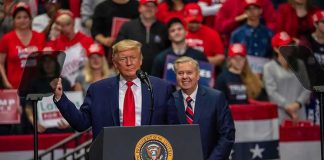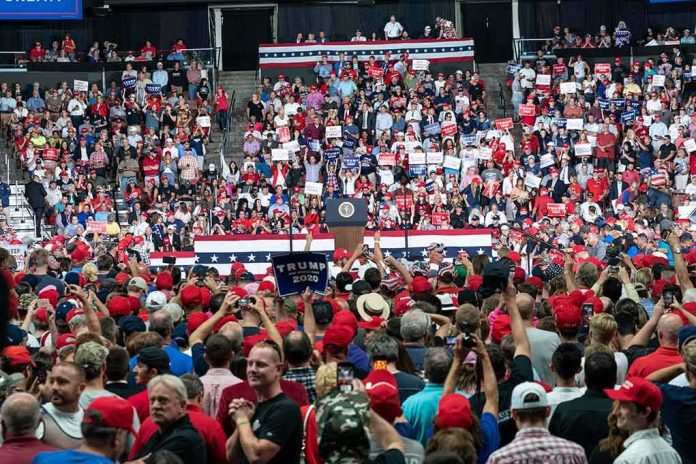
President Trump headlined both nights of the first-ever Republican midterm convention in Dallas, underscoring the party’s all-in push to mobilize voters and keep control of Washington ahead of November’s elections.
Story Highlights
- Trump spoke on both nights at the first Republican midterm convention, held in Dallas.
- Republicans billed the event as a voter-mobilization show to protect their congressional majorities.
- Vice President JD Vance and party leaders joined a two-night program centered on Trump.
- The format recalled older midterm gatherings but leaned on modern media spectacle.
What Happened In Dallas
Republican leaders staged a first-of-its-kind midterm convention on September 9 and 10 at the American Airlines Center in Dallas. President Trump served as the featured speaker on both nights, opening the event and then closing it the following evening. Wire services described the gathering as designed to put Trump “at center stage,” reflecting his role as the party’s lead messenger early in the fall push. The program placed him before and after Vice President JD Vance, creating a two-night frame for the party’s message.
Republicans framed the Dallas convention as a mobilization event to energize voters, protect their House and Senate control, and back the administration’s agenda into the next two years. USA Today reported that party strategists saw the format as a way to lift interest and preserve the Republican trifecta in Washington, District of Columbia. The Associated Press and Reuters coverage emphasized Trump’s expanded role and described the event as unusual in modern midterm politics, with programming built around him.
Why It Matters For The Midterms
Party conventions can boost attention and turnout, at least for a time. Political science research has long found that big, media-focused party events can create a short-lived “bump” as supporters tune in and get engaged. Republicans appear to be betting that a midterm convention can spark that same effect for congressional races. By putting Trump at the center on both nights, the party aimed to unify its message and flood the airwaves during a key stretch before early voting begins.
That strategy speaks to a broader worry shared by many voters across the spectrum. People on the right and left often feel national leaders talk past daily problems like high costs, stagnant wages, and public safety. A large, controlled event lets a party showcase a plan and claim momentum. But it also risks looking like a show instead of substance if specific policy steps are unclear. The Dallas format leaned toward spectacle, with speeches and staging built for television and clips.
Who Shared The Stage
Vice President JD Vance, senior administration officials, Republican candidates, and party leaders joined the two-night lineup in Dallas. Axios reported a fuller rundown of speakers before the event, confirming that Trump would appear twice, with Vance between those slots. Local outlets detailed timing and logistics so attendees and viewers knew when to expect each speech. The set list showed an organized party gathering rather than a one-off rally, with a clear plan to drive media coverage across both nights.
National outlets tracked the convention with live updates and on-the-ground reporting. The Associated Press and Reuters labeled the event “unusual,” stressing that it was a midterm-year invention that centered on President Trump’s role in setting the message for the final campaign stretch. That framing underlined the Republican strategy: tie the midterms to the White House agenda, translate that into local races, and keep the focus on issues that motivate core voters in a low-turnout environment.
The Bigger Trend In Party Messaging
Both major parties now treat conventions as media events aimed at mobilization more than as internal debates. Past research shows that when parties focus attention, they can lift participation among supporters, even if the bump fades. Analysts also note that Trump-era politics often turns on framing battles over what was said and how to interpret it, which can shape how audiences recall a big speech after the lights go out. That makes tightly produced stagecraft even more central to campaign plans.
Trump used his keynote speech at the first night of the Republican midterm convention to make an unusual promise: if his party keeps control of Congress after November, he will give every American adult a $5,000 “dividend.” https://t.co/EMGh9dXQpe
— Stare Decisis (@MsResJudicata) September 10, 2026
For voters who feel Washington is failing them, the test is simple. Do events like Dallas lead to clear steps on costs, safety, borders, energy, and opportunity? Republicans used this convention to say they are ready to “finish the job,” a message that matches their plan to hold Congress and back the administration’s course. The coming weeks will show whether this two-night spotlight moves the needle where it counts: in turnout and in close House and Senate races.
Sources:
nypost.com, reuters.com, fox4news.com, nbcnews.com, washingtonexaminer.com, en.wikipedia.org, cnn.com, ap.org, cambridge.org, journals.sagepub.com