

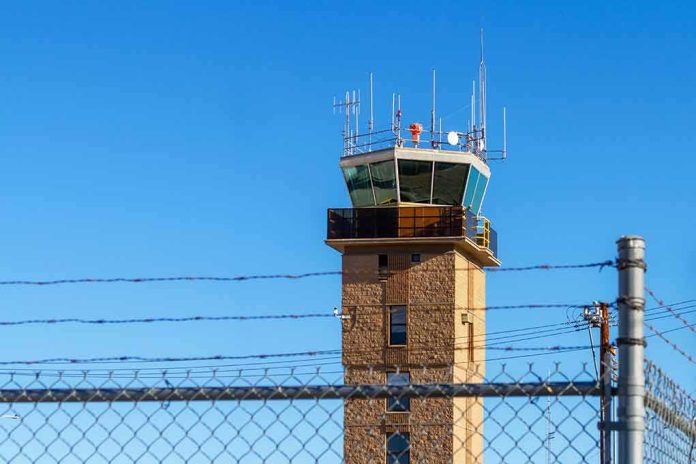
Top intelligence and transportation officials say the wave of outages was not a cyberattack, even as the FAA links the worst flight halt since 2001 to a faulty router upgrade that flooded its network.
Story Snapshot
- Director of National Intelligence Jay Clayton said there is no sign of a coordinated cyberattack behind recent outages.
- Transportation officials traced the FAA ground stop to a contractor router upgrade that overwhelmed systems.
- FAA disabled similar router features nationwide and sent the suspect hardware for joint lab analysis with the Federal Bureau of Investigation.
- Lawmakers pressed for proof; officials said incidents were separate maintenance failures, not one plot.
What Officials Say Caused The Disruptions
Director of National Intelligence Jay Clayton told Congress and the public that investigators found no indication of a coordinated cyberattack or a hostile nation state behind the outages. He said teams looked for known hacking methods and did not find them. The administration described the events as separate service outages linked to maintenance and technical changes, not one plot. These statements anchor the government’s case that the failures were disruptive but not malicious.
Transportation Secretary Sean Duffy gave the most detailed account for aviation. He said a router in an L3Harris telecommunications-system upgrade began sending abnormal connection attempts. The traffic spike hit about 1,000 tries every five seconds, which flooded other routers. That caused problems with aircraft communications and radar data. Officials said the network data became inconsistent, so the Federal Aviation Administration ordered a ground stop to protect safety.
How The FAA Traced And Contained The Failure
Federal Aviation Administration Administrator Bryan Bedford attributed the halt in departures to faulty equipment, not to evidence of an intrusion. Authorities identified the affected router as part of a routine replacement installed in El Dorado, Arkansas. To contain risk, the agency disabled the suspect functionality on about 60 similar routers across the system. The FAA and the Federal Bureau of Investigation shipped the specific router to an L3Harris lab in Florida for joint forensic analysis.
Officials said this traceable chain—contractor, location, installation, and lab review—supports the view that the aviation outage was a technical failure. Still, Duffy noted that the exact fault remained under investigation. He said teams were determining whether the cause was contractor error, installation error, or defective hardware. That caveat shows the attribution to non-malicious failure is strong on the “what,” while the “why” is not fully settled yet.
Why Skeptics Still Want More Proof
Lawmakers from both parties questioned whether the cluster of outages might share a deeper link. They asked for assurance during a House Homeland Security Committee hearing focused on worldwide threats. Officials repeated that there was no evidence of a cyberattack and that the incidents had different causes. But critics said the public had not seen logs or full forensic reports, which makes trust rest on official credibility, not on disclosed artifacts.
President Donald Trump dismissed concerns Wednesday that recent technology disruptions across major banks, airlines and federal agencies are connected, telling Fox News senior White House correspondent Jacqui Heinrich that the incidents were “individual events” tied to equipment…
— News News News (@NewsNew97351204) November 19, 2026
Independent experts said the facts so far fit a common pattern: many big outages come from maintenance mistakes, change errors, or concentrated infrastructure. They warned that this is exactly what makes the situation serious. If a small error can halt flights, an enemy could target the same weak points on purpose. In short, the cause may be accidental, but the risk is structural. That shared concern cuts across party lines because fragile systems fail everyone.
What Comes Next And What To Watch
Transportation officials promised to release more findings after lab work on the router. The most important next steps are documented, public facts. Those include the final FAA and Department of Transportation root-cause report, the Federal Bureau of Investigation chain-of-custody and forensics summary, and a timeline of the L3Harris change. Clear records would help confirm whether faulty hardware, bad configuration, or installation error triggered the flood of traffic that forced the nationwide halt.
Beyond aviation, the open question is how other outages began and whether they truly were unrelated. Officials said Microsoft, banks, and even the National Security Agency faced separate maintenance-linked issues, but gave fewer technical details. A declassified, incident-by-incident matrix would help. It should list each outage, the change window, the checked indicators of compromise, and the specific evidence that ruled out a link. That level of sunlight would earn public trust across the spectrum.
The Bigger Picture For A Frustrated Public
Millions lost time and money while systems failed. People on the right and left watched leaders argue while basic services buckled. The official line says “no attack,” but the public sees a government and industry stack that breaks too easily. That is the core problem to fix. Make the networks simpler. Test changes before go-live. Share proof when things go wrong. Americans can handle the truth; what they will not accept is fragile systems and vague answers.
Sources:
facebook.com, whitehouse.gov, transportation.gov, blackbeltnewsnetwork.com, fedscoop.com, npr.org