

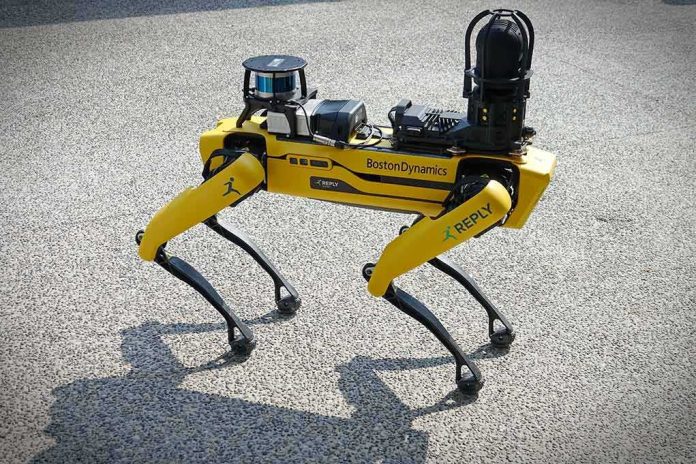
El Salvador released video showing rifle-mounted robot dogs moving with its troops as Haitian and Salvadoran forces retook Port-au-Prince’s national stadium from gangs.
Story Snapshot
- Haitian police and Salvadoran forces retook Sylvio Cator National Stadium in a joint operation.
- President Nayib Bukele shared footage of robot dogs fitted with rifles alongside Salvadoran units.
- The push followed the disappearance of four Salvadoran technicians after an October ambush in Haiti.
- Bukele said the action was under a bilateral agreement with Haitian authorities.
What Happened at the Stadium
Haitian police, backed by Salvadoran special forces, retook the Sylvio Cator National Stadium in Port-au-Prince after gangs held the site for about two years. Reports said Salvadoran troops were seen securing the grounds and posting flags, while Haitian police announced control of the facility. Outlets described a combined operation rather than a solo foreign seizure. France 24 reported participation by about 2,000 Salvadoran soldiers as part of the broader offensive in the capital.
President Nayib Bukele released video clips of the operation. The footage showed Salvadoran units moving through the stadium complex and arresting suspects. The Associated Press said the clips came with a warning to gangs and framed the stadium as a key win in restoring order. The visual push matched Bukele’s practice of publicizing security actions in real time to shape the narrative of force and control in contested urban zones.
Robot Dogs and Their Role
Bukele’s video and multiple outlets drew attention to robotic, four-legged machines carrying rifles on their backs. Newsweek and Jamaica Observer both described the robot dogs operating alongside Salvadoran troops near the stadium. The machines appeared to patrol and provide overwatch during movements. The reports did not document the robots firing weapons or engaging targets, but they highlighted a new face of security tech in a crowded, fragile city environment under gang pressure.
Coverage said the robots were part of a broader show of force meant to deter gangs and support Haitian officers on the ground. The devices functioned as a striking symbol of rising military technology on urban streets. Their presence will likely shape debate over how far governments should go with armed automation in law enforcement and counter-gang missions. That debate spans civil-liberties questions, public safety goals, and the risk of misuse during complex raids.
Why El Salvador Is in Haiti Now
The joint operation followed an October 18 ambush near Croix-des-Bouquets, where four Salvadoran aviation technicians disappeared while working with an international effort. Salvadoran leaders tied the stadium push to a broader campaign to weaken gangs and to search for their missing personnel. Reports did not state that the technicians were found or linked the stadium directly to their case. The missing team remains part of the public rationale for ongoing action.
EL SALVADOR PRESIDENT NAYIB BUKELE HAS DEPLOYED ROBOT DOGS IN HAITI TO GO AFTER HAITIAN GANGS
This is a terrible precedent. This combination of AI & robotics can be used by governments against their own citizens and the AI won’t miss, unlike humans. https://t.co/spiOjmA4xd pic.twitter.com/7y8RtKcmBB
— Zach Jones – Psyops Czar (@ZachJones1994) November 16, 2026
Bukele said the move came under a bilateral agreement with Haitian authorities that placed Haitian police, Haitian armed forces, a Haitian task force, and Salvadoran special forces under a shared effort. Outlets quoted that claim and presented it as the political basis for Salvadoran involvement. The reports did not publish the agreement text or list the legal terms, but they consistently described the operation as coordinated with Haitian leadership and security institutions on the ground.
Broader Stakes for Haiti and the Region
Haiti has seen repeated foreign interventions over the past century, often justified as short-term security fixes that do not settle deeper causes of violence and weak institutions. The Associated Press and Public Broadcasting Service each traced a long record of outside missions in Haiti that restored control in some areas but did not resolve political or economic drivers of instability. This history shapes how Haitians view any new foreign-led or foreign-backed action today.
The stadium win matters because it restores a major public site to state control and signals pressure on armed groups. It also raises questions that many Americans will recognize at home: who is in charge, who is accountable, and how tech-heavy policing affects civil rights. For readers worried about government overreach and elite power, the robot dogs are a vivid sign that the tools of force are changing faster than the rules that guide them.
What to Watch Next
Officials may release more details about the joint command structure, the exact Salvadoran role around the stadium, and the status of the missing technicians. Bukele also claimed Salvadoran forces destroyed a site linked to the 400 Mawozo gang and its leader, Wilson “Lanmò San Jou” Joseph, a statement that helped justify the offensive as an anti-gang push. Independent confirmation of that specific destruction was not presented in the cited reporting.
Haitian authorities will face the harder task after the raid: holding ground, reopening services, and making arrests that stand up in court. Past foreign-backed missions delivered short-term order but struggled to deliver lasting safety and trust. The coming weeks will show whether this joint effort can break that pattern by backing tactical gains with clear rules, steady support for Haitian institutions, and careful limits on new military technology.
Sources:
thegatewaypundit.com, apnews.com, jamaicaobserver.com, haitilibre.org, wfiwradio.com, globalpost.com