

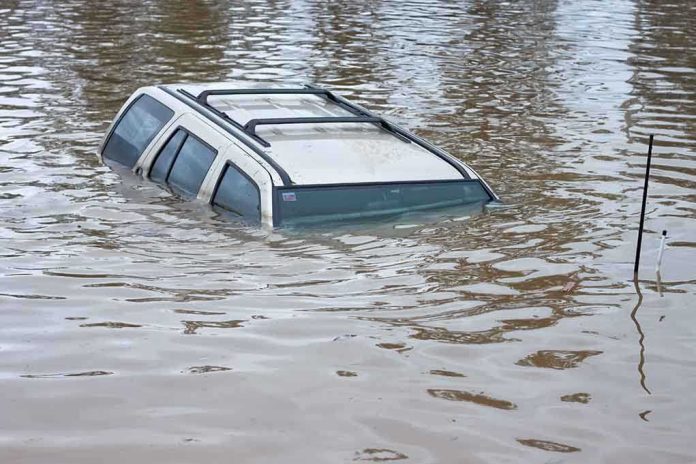
When a river forecast uses the word “catastrophic,” it is not drama, it is a quiet way of saying whole towns may have to decide, overnight, what they really value.
Story Snapshot
- Western Washington confronted one of its most extreme atmospheric rivers, driving multiple rivers to record or near-record flood stages.
- Up to 100,000 people in low-lying communities faced evacuation orders or warnings as officials urged residents to “GO NOW.”
- Governor Bob Ferguson declared a statewide emergency and deployed the National Guard as infrastructure strained under the water’s weight.
- The event sharpened long-running debates about building in floodplains, infrastructure limits, and what real climate preparedness looks like.
How An Invisible River In The Sky Turned Towns Into Islands
Western Washington residents are used to rain, but this time the sky behaved like a broken fire hose locked over the same patch of ground. A powerful atmospheric river stalled over the Pacific Northwest beginning December 8, 2025, funneling warm, moisture-loaded air into the Cascades and lowlands day after day. Up to 10 inches of rain, plus rapid snowmelt from snowlines pushed above 7,000 feet, funneled into rivers already near capacity, turning familiar waterways into fast-moving walls.
The Skagit, Snohomish, Yakima, Cowlitz, Green, Nooksack, and other rivers responded faster than many long-time residents believed possible. Gauges that had behaved predictably for decades suddenly marched past “major flood” lines toward numbers usually reserved for theoretical models. Hydrologists warned that the Skagit near Mount Vernon could crest around 42 feet, an “almost unthinkable” level that moved the conversation from sandbags to life safety. This was not routine winter high water; it was the kind of scenario planners usually discuss in dry conference rooms, not on live television.
The Night Skagit County Told Tens Of Thousands To Leave Now
Skagit County officials faced a brutal calculation: wait for certainty and risk people trapped on roofs, or act early and disrupt tens of thousands of lives. They chose action. Mandatory evacuation orders swept across the Skagit Valley floodplain, including all of Burlington and parts of Mount Vernon and Sedro-Woolley, covering roughly 75,000 residents and affecting up to 100,000 people when wider warnings are counted.Public alerts did not hedge; they told families to “GO NOW” to higher ground before levees or backroads failed.
Local leaders understood that concrete and confidence were not enough. Mount Vernon’s mayor, Peter Donovan, emphasized that this was a flood “we haven’t seen before” and that the “potential for catastrophic flooding is real,” echoing what river forecasts already implied. That frank language matters. In communities that prize self-reliance, some residents hesitate to leave homes, livestock, or businesses. Clear, unvarnished warnings grounded in data respect that mindset while insisting that prudence, not bravado, defines true resilience.
Statewide Emergency, Strained Roads, And Fragile Assumptions
As river gauges climbed, Washington’s governor declared a statewide emergency and mobilized more than 300 National Guard members for rescues and logistics. Guard units pre-positioned in vulnerable corridors, helping local agencies shore up barriers, move supplies, and prepare for possible air or high-water rescues. The move aligned with a conservative instinct: when the hazard is well-documented and life is at stake, government’s first duty is to protect citizens and critical infrastructure, not to wait for perfect information.
Highways told their own story. A fifteen-mile stretch of US‑12 east of Morton shut down due to water and debris, while roads in Kent, Auburn, Sumner, and other low-lying towns became detours or dead ends. Temporary barriers rose along the Green River to shield industrial zones and warehouses that feed regional supply chains. Every closure revealed an uncomfortable truth: decades of development in fertile floodplains built prosperity on ground that turns unreliable when rivers outgrow the assumptions engineers made a generation ago.
What This Flood Exposes About Risk, Responsibility, And The Future
This flood does more than soak basements; it exposes a long-standing bargain many communities made without quite admitting it. Cities placed homes, farms, and logistics hubs on rich river valleys, then trusted levees, dams, and forecasts to tame nature. That approach worked until an event like this stretched the system beyond its design. Multiple rivers broke or neared historic records, from the Snohomish’s all-time crest to record heights on the Yakima and Grays River. Those numbers are a hard audit of past choices.
Coverage already links this event to a pattern of stronger atmospheric rivers and repeated severe floods in the Pacific Northwest. Some commentators now ask whether the region is prepared not only for future storms, but for climate-driven migration that will add more people and assets to already stressed corridors. From a common-sense, limited-government perspective, that conversation should focus less on slogans and more on three priorities: stop subsidizing risky building in known floodplains, harden truly critical infrastructure, and give local communities the authority and tools to adapt without federal micromanagement.
Sources:
Thursday, December 11 – WA House Democrats blog
Washington residents evacuate amid catastrophic flooding – ABC News