
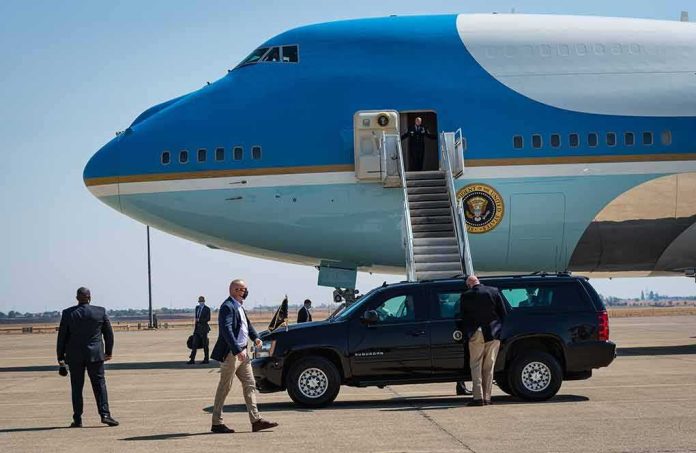
A Coast Guard jet carrying the Homeland Security secretary landed on one engine at Reagan National after the crew declared an emergency.
Story Snapshot
- The pilot reported a right engine failure and requested an immediate landing at Reagan National.
- The Coast Guard C-37A landed safely; 14 people aboard were unharmed.
- A passenger praised the crew’s calm, professional single‑engine landing.
- The event spotlights Coast Guard fleet age and readiness concerns.
What Happened In The Air
Air traffic control audio captured the pilot saying the jet lost its right engine and declaring an emergency while approaching Ronald Reagan Washington National Airport. The pilot reported 14 people on board and enough fuel for two and a half hours. The controller cleared the aircraft to land right away. The crew brought the jet down on one engine without further incident. Reporting across outlets agrees the landing was safe and orderly.
After touchdown, airport fire and rescue units checked the aircraft on the runway. The airport authority reported the plane was inspected and then moved off the runway under its own power. That sequence suggests standard emergency protocol worked as designed. Quick runway checks protect other flights and confirm no leaks, heat, or debris risk. The smooth handoff from the cockpit to ground teams limited airport disruption and kept the focus on safety first.
Who Was On Board And What They Said
The aircraft was a United States Coast Guard C-37A, a military version of the Gulfstream V often used to move senior officials. Reports state Homeland Security Secretary Markwayne Mullin was aboard with other department personnel. Mullin posted that the pilots made the single‑engine landing feel routine and later said the crew told him it was a first for them. He emphasized there was no panic and praised their professionalism during the emergency.
Coverage noted that all 14 people on the flight were safe after landing. The consistency across multiple outlets on the headcount and outcome reduces confusion about the basic facts. The accounts center on the cockpit transmission and Mullin’s public post. Officials have not yet released a detailed maintenance or incident report in the available material, so the exact cause of the engine failure has not been established in reporting to date.
Why This Matters Beyond One Flight
This emergency highlights an old but constant truth in aviation: training and checklists save lives when hardware fails. The Coast Guard relies on aircraft for missions and senior travel, yet government watchdogs have flagged fleet readiness issues in recent years. The Government Accountability Office reported the Coast Guard missed its aircraft availability target from fiscal years 2018 through 2022, underscoring strain on an aging fleet and the people who keep it flying.
RAW VIDEO: U.S. Coast Guard C-37A carrying DHS Secretary makes an emergency single-engine landing at DCA after losing its right engine.
POV from a DCFD fireboat responding on the Potomac.
14 aboard. All safe. pic.twitter.com/dyJevnHHfd
— Donald Trump Jr Q (@Trump_Jr_Q0) September 3, 2026
The Department of Homeland Security has also described one of the Coast Guard’s command‑and‑control jets as more than twenty years old, with obsolescence and maintenance concerns. Leaders have pushed to replace or modernize these aircraft to improve reliability and communications. The safe landing shows the crew did its job under pressure. The broader policy question is whether the fleet gives them the best odds every day, not just on a lucky one.
Safety And The Path Ahead
Standard practice is that the Federal Aviation Administration and the National Transportation Safety Board handle serious incident reviews, with the National Transportation Safety Board leading. Those processes take time and aim to determine what failed, why it failed, and what to fix. For now, the facts stand: a right engine failed, the pilot declared an emergency, and skilled aviators landed safely at a busy airport in the nation’s capital.
Sources:
feedpress.me, kfoxtv.com, wcvb.com, koco.com, washingtonpost.com, facebook.com