
Progressive activists have escalated their resistance to federal immigration enforcement by physically blockading ICE operations, sparking military deployments and transforming the “abolish ICE” slogan into a litmus test for Democratic midterm candidates in 2026.
Story Snapshot
- Trump administration ICE raids in January 2025 detained 538 immigrants across nine cities, igniting nationwide protests featuring street blockades and confrontations with federal agents
- Two fatal ICE shootings in Minneapolis within one week in January 2026 intensified demonstrations, with riots in Los Angeles prompting deployment of 2,000 National Guard troops and 700 Marines
- Democratic primary candidates in Michigan, Illinois, and New Jersey are campaigning on abolishing or defunding ICE, despite centrist warnings of electoral backlash similar to “defund the police”
- Progressive organizations including the Party for Socialism and Liberation and Students for a Democratic Society coordinate protests at detention centers, federal buildings, and raid sites
- Polling shows Americans split 46 to 43 percent on abolishing ICE, highlighting deep partisan divisions over immigration enforcement
From Slogan to Street Action
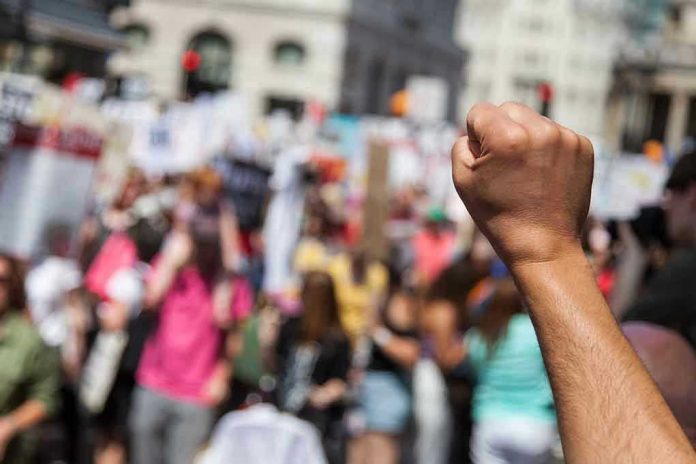
The “abolish ICE” movement that emerged during Trump’s first term as a progressive rallying cry has morphed into direct physical resistance. Protesters in Washington state blocked federal immigration court buildings throughout 2025, while demonstrations in Texas, Minnesota, and California featured activists forming human chains to prevent ICE vehicles from transporting detainees. These actions represent a shift from symbolic protest to tactical interference with federal law enforcement operations. Groups like the Party for Socialism and Liberation openly coordinate blockades, distributing guides on how to disrupt deportation logistics without crossing into federal obstruction charges.
The left unveils new tactic to stop ICE | Wake Up America https://t.co/qiLpkjdEgU via @YouTube
— Clyde Funk (@funk_clyde79683) January 20, 2026
When Protests Turn Violent
Los Angeles erupted in June 2025 after ICE conducted coordinated raids at Mexican restaurants and residential neighborhoods. Rioters set fires, overturned vehicles, and clashed with local police for three consecutive nights. The Pentagon authorized deployment of 2,000 National Guard troops and 700 Marines to restore order, marking the largest domestic military response to immigration protests in modern American history. Similar disturbances occurred in St. Louis and multiple Texas cities, where demonstrators waving Mexican flags chanted “nobody is illegal” while attempting to breach detention facilities. The violence prompted federal prosecutors to file felony charges against dozens of activists.
Minneapolis became ground zero for escalating tensions in January 2026. An ICE agent fatally shot a woman during a raid on January 7, triggering an immediate vigil that drew hundreds. Exactly one week later, another shooting by ICE personnel occurred during a separate operation. Evanston Mayor Daniel Biss, running for Congress, attended a detention center protest where federal agents deployed tear gas. Biss emerged from the chaos declaring on camera that ICE must be abolished or have its funding slashed. His primary opponent, a sitting congresswoman, criticized the statement as politically reckless. The Minneapolis incidents galvanized progressive candidates nationwide who saw an opening to distinguish themselves in crowded primary fields.
The New Democratic Divide
The 2026 midterm primary season exposed fractures within the Democratic Party reminiscent of the “defund the police” debates. Michigan Senate candidate Abdul El-Sayed declared ICE “corrupted at its soul” and called for complete abolition. Illinois congressional candidate Kat Abughazaleh faces criminal charges for allegedly assaulting an officer during a protest, yet her campaign fundraising surged afterward among progressive donors. State Senator Laura Fine introduced legislation prohibiting local police from cooperating with ICE on hiring and operations. These positions electrify progressive base voters but alarm party centrists who remember losing swing districts in 2020 after endorsing police funding cuts.
Representative Haley Stevens represents the centrist counterargument. She advocates reining in ICE through budget constraints and oversight rather than elimination, warning that abolition rhetoric hands Republicans easy attack ads. The National Republican Congressional Committee already labels Democratic candidates supporting abolition as embracing “lunatic policies” and “brain rot.” Internal Democratic polling shows the issue cuts both ways, with 46 percent of voters supporting ICE abolition but 43 percent opposed, leaving crucial independent voters as the tiebreaker. Centrist Democrats privately circulate memos arguing the message will prove “lethal” in purple districts, yet progressive insurgents dismiss these concerns as outdated caution from an establishment that lost the White House.
Federal Response and Escalation
The Trump administration frames its immigration enforcement as targeting criminals, gang members, and security threats. White House statements emphasize that the January 2025 raids focused on individuals with violent records or terrorist connections. Border Patrol Commander Greg Bovino defended operations as lawful and necessary, though the Newark mayor accused agents of conducting warrantless arrests of American citizens during raids in his city. ICE has not publicly addressed these specific allegations. The deployment of military assets to support civilian law enforcement crosses a threshold rarely seen outside natural disasters, signaling the administration’s determination to continue mass deportation operations regardless of protest intensity.
Federal prosecutors pursue felony charges against protesters who physically obstruct agents or damage government property. The legal strategy aims to deter future blockades by imposing serious criminal consequences. Meanwhile, viral videos of confrontations between protesters and armed federal agents circulate across social media, each side using footage to reinforce their narrative. Progressives highlight instances of perceived excessive force, while conservatives emphasize protesters preventing deportation of convicted criminals. The information warfare surrounding each incident polarizes public opinion further, making legislative compromise on immigration reform increasingly unlikely as both parties see political advantage in maintaining the conflict through the 2026 elections.
Sources:
Politico – “Minnesota ICE midterm campaigns”