
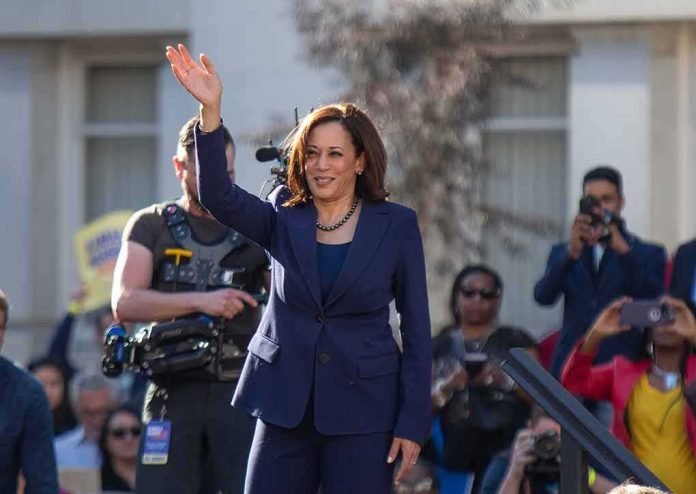
A short Georgia clip of Kamala Harris’s rally line set off a fresh fight over whether politicians are performing for voters or simply speaking to them.
Story Snapshot
- Clips from Georgia show Harris using a punchy cadence that critics call a “Southern” act.
- Commentators compare her delivery with recent stops in other states to claim audience-specific shifts.
- Linguists and some outlets argue the changes reflect normal code-switching, not a fake accent.
- The dispute plays out amid hard-fought Georgia races and 2028 speculation.
What Sparked The Debate In Georgia
October 29 rally coverage from Georgia captured Kamala Harris urging Democrats to turn out, using a clipped line that drew strong reactions online. Commentary outlets said the phrasing and delivery sounded like a Southern or Black Southern accent and highlighted the quote as proof of a shift. The clips came from events backing Senator Jon Ossoff and gubernatorial hopeful Keisha Lance Bottoms during the midterms, which raised the political stakes. A local video feed documented her campaigning swing across central Georgia towns.
Several posts compared the Georgia delivery with remarks from New Hampshire days earlier and with prior stops in Mississippi. Writers said the pattern suggested audience-specific style changes. They also cited a 2024 Atlanta rally as an earlier case, arguing the behavior recurs near key elections. These claims rely on side-by-side clips and short quotes, not full acoustic analysis. The reports do not include direct proof of coaching or a campaign plan to change speech by audience.
Why Code-Switching And “Authenticity” Collide
Linguists and independent experts push back on the “fake accent” charge. One expert told a broadcaster that Harris was not using a Southern accent in the criticized clips. Instead, she was code-switching between speech styles many people use in daily life. Another analyst said her accent stayed essentially the same while her delivery shifted between events. Commentators add that people often adjust tone, rhythm, and word choice to fit setting and audience needs.
Scholars describe code-switching as a normal feature of speech, shaped by context and identity. In political settings, it can help a speaker connect with local crowds or honor shared experience. Some researchers argue critics tend to mislabel African American English features as “Southern” and treat adaptation as artifice. Others say the same behavior can look calculated during heated campaigns, when suspicion runs high and clips are easy to cherry-pick for outrage.
What We Know, What We Do Not
The Georgia coverage confirms Harris campaigned with Jon Ossoff and Keisha Lance Bottoms and used punchy lines that sparked chatter. Video confirms the events occurred before the midterms. Commentary sites framed the delivery as another “put on” voice. But none presented a memo, a strategist’s account, or a linguist’s acoustic study proving intent to mimic a local accent. The core evidence remains short clips and transcripts, which can show cadence, but not motive.
The counter-view has named experts on record, but it also stops short of final proof. Their statements argue the shifts fit common code-switching and that her base accent stays the same. That helps explain the sound without assigning bad faith. Still, it does not resolve every question a skeptic may have about how planned the shifts are in a campaign season. The available public material does not settle that point either way.
Why This Matters Beyond One Rally Line
This flap taps a deeper worry that many voters share. People on the right and left feel national leaders talk at them, not to them. They see staged moments, targeted messages, and a focus on winning the next race. The Harris clips became a canvas for that distrust. To some, it looks like elites gaming language to harvest votes. To others, it looks like a normal way a public figure matches a room. The truth may depend on data we do not yet have.
Real trust needs more than tight slogans and viral sound bites. Campaigns across parties can help by posting full speech videos, not just highlights. They can publish prepared remarks and note when ad-libs depart from scripts. Independent outlets and universities can run side-by-side acoustic reviews with matched audio and blind coders. These steps will not end spin, but they can reduce the space where clips and mockery replace facts and context.
Bottom Line For Readers
The Georgia clips are real, the delivery is punchy, and critics seized on it. Experts call the changes code-switching, not a fake Southern accent. No public record shows planning to adopt a specific accent. The fight continues because short clips feed mistrust in a system many already see as stage-managed. Voters deserve full context and verifiable records, not just viral edits. Until that becomes standard, the loudest cut will keep drowning out the full speech.
Sources:
twitchy.com, redstate.com, thebeltwayreport.com, ground.news, yahoo.com, washingtonexaminer.com, usnews.com, tandfonline.com, wrdw.com, atlantablackstar.com, the-independent.com, colorado.edu, thegrio.com, pittnews.com