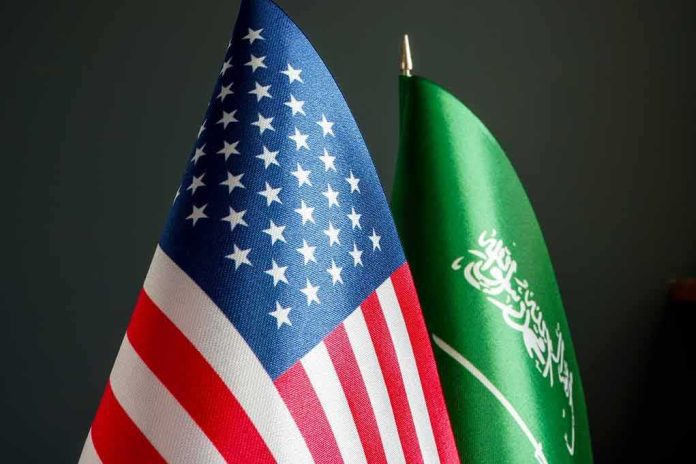
Washington just approved a 30-year nuclear deal that lets Saudi Arabia enrich uranium and reprocess waste without the strongest international inspections, locking in risks and benefits for Americans through 2056.
Story Snapshot
- Trump’s administration signed a civilian nuclear pact with Saudi Arabia that runs through 2056 and allows uranium enrichment.
- The deal leaves out the toughest United Nations inspection rules and replaces past “gold standard” limits with looser safeguards.
- Supporters say U.S. control of technology and bilateral safeguards will keep the program peaceful and boost American industry.
- Critics warn the agreement could hand Saudi Arabia a path to nuclear weapons and deepen fears of a corrupt, unaccountable foreign policy.
What Trump’s Saudi Nuclear Deal Actually Does
The United States Energy Department says the new nuclear cooperation agreement lets Saudi Arabia build reactors using American technology and enrich uranium on its soil. The pact, known as a “123 Agreement,” would stay in force until about 2056, shaping energy and security ties for three decades or more. Energy Secretary Chris Wright and Saudi Energy Minister Prince Abdulaziz bin Salman signed the deal, alongside a separate safeguards agreement meant to monitor nuclear material. The White House describes the deal as a “decades-long, multi-billion-dollar nuclear energy partnership” guided by strong nonproliferation standards.
Under United States law, civil nuclear agreements must meet nine basic nonproliferation conditions, including promises not to use United States materials for nuclear weapons and to maintain security at nuclear sites. Past agreements with partners like the United Arab Emirates went further, adding a binding pledge not to enrich uranium or reprocess spent fuel at all, the so-called “gold standard.” In the Saudi case, Trump’s team chose a different path, dropping an outright ban on enrichment and instead promising “additional safeguards and verification measures” focused on sensitive fuel-cycle steps. That change is at the heart of today’s debate.
Missing Guardrails: Inspections and Enrichment Fights
Unlike a plan floated under President Biden, the current deal does not include the International Atomic Energy Agency’s “Additional Protocol,” which allows snap, intrusive inspections at suspect sites. A report reviewed by Reuters says Washington lifted earlier limits on enrichment and quick United Nations inspections, arguing that deep United States involvement will itself raise safety. The agreement would allow Riyadh to enrich uranium and reprocess nuclear waste, both recognized paths to material that can fuel a bomb. That alarms nonproliferation experts who point out that Saudi Arabia has hinted it might match any future nuclear capability in Iran.
Critics in Congress and the arms control community say the deal walks back decades of efforts to tighten nuclear standards and could spur an arms race in the Middle East. An Arms Control Association analysis describes the Saudi package as a “gilded sweetheart deal” that relaxes key conditions without clear technical need. A right-leaning think tank notes that 123 agreements are supposed to set strict rules for trade in nuclear technology, but warns that softening them for one favored partner weakens the system for everyone. Lawmakers from both parties have already demanded that any Saudi deal must not create a new pathway to nuclear weapons. Their concern matches a broader public feeling that foreign policy choices are made for elites and contractors, not ordinary Americans.
Supporters’ Case: Jobs, Leverage, and Oversight
Supporters inside the administration and the nuclear industry argue the agreement gives the United States more control, not less. By anchoring Saudi Arabia’s nuclear future to American reactors, fuel, and training, they say Washington can bake in safety rules, modern reactor designs, and long-term transparency. A White House fact sheet claims the deal ensures that “all cooperation will be conducted in a manner consistent with strong nonproliferation standards,” and that United States firms will be Riyadh’s “civil nuclear cooperation partners of choice.” Industry advocates add that if America refuses to work with Saudi Arabia, Russia or China will step in with weaker standards and fewer safeguards.
The administration’s waiver report to Congress says the bilateral safeguards agreement “employs additional safeguards and verification measures” on the most sensitive parts of the fuel cycle, including enrichment, fuel fabrication, and reprocessing. Under Section 123 of the Atomic Energy Act, the United States also keeps a legal right to halt cooperation and demand the return of equipment if a partner misuses United States-supplied materials for weapons. These tools, supporters argue, give Washington leverage that would not exist under a Russian or Chinese deal. Still, much of the detailed text remains classified or undisclosed, forcing the public to take officials’ promises on faith.
Congress’s Role and Fears of a Failing Government
Now that Trump has approved the deal, Congress has 90 session days to pass resolutions blocking it before it automatically takes effect. Any attempt to stop the agreement would need majorities in both the House of Representatives and the Senate, and then two-thirds support to override a likely presidential veto. That high bar makes it hard for critics to do more than hold hearings and demand changes. For many Americans, this looks like another example of a system where big, long-term commitments move forward while ordinary citizens barely hear the details.
U. S. Foreign Policy must be adopting the idiotic theory that the only thing that stops a Shia Islam theocracy with a bomb is a Sunni Islam absolute monarchy with a bomb. #ETTD
Coveted U.S. Nuclear Deal Is a Coup for Saudi Crown Prince https://t.co/uMmbYgzKGH
— Spence Williams (@beoduck) July 22, 2026
Both conservatives and liberals who distrust the “deep state” see familiar red flags here: secrecy around a 30-year nuclear deal, benefits for well-connected energy firms, and real security risks pushed aside in the rush to claim a win. Conservatives worry that weaker guardrails could one day threaten United States troops and allies if Saudi Arabia or its rivals move closer to nuclear weapons. Liberals fear the same outcome and add concerns about human rights and regional wars. The shared bottom line is simple: Americans on both sides doubt that Washington’s foreign policy machine is truly working for them.
Sources:
humanevents.com, abcnews.com, armscontrol.org, gao.gov, brookings.edu, newsmax.com, reuters.com, cnn.com, energy.gov, thebreakthrough.org, docs.house.gov, fdd.org, lawfaremedia.org, armscontrolcenter.org, heritage.org, thebulletin.org, en.wikipedia.org, ans.org