

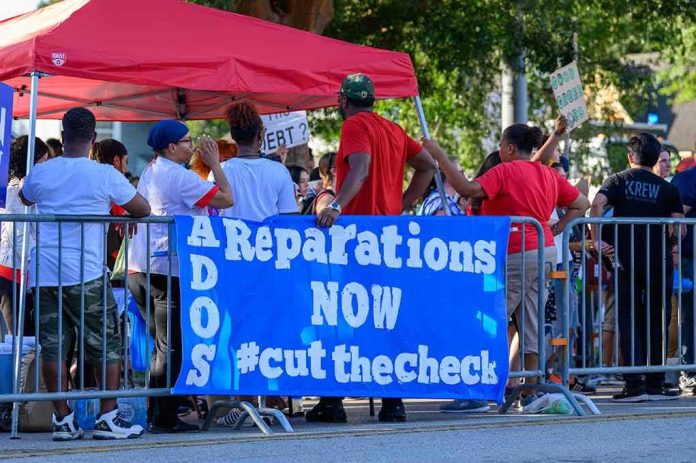
Reparations leaders are blasting blue-state commissions for widening eligibility far beyond slavery’s descendants, saying the shift bends history to fit a new political agenda.
Story Snapshot
- Advocates with the U.S. Freedmen Project demand lineage-based eligibility tied to U.S. slavery.
- Academic and advocacy plans in some states consider broader, identity-based or tiered models.
- The fight centers on who qualifies and whether programs can survive legal tests.
- Both left and right see mission creep as another sign government drifts from clear promises.
What Sparked The Latest Clash
Reparations activists from the U.S. Freedmen Project told a national outlet that states are using the history of slavery to justify benefits for groups beyond the descendants of people enslaved in the United States. They argued eligibility must be based on lineage to survive court review. They also said recent immigrants and non-foundational communities should not be included. Their message comes as state-level panels weigh plans that reach well past direct family ties to slavery-era harm.
This dispute touches a core design question: how to define the group that should receive help. Some scholars describe three approaches that often appear together in proposals. One tier focuses on descendants of enslaved people. A second tier includes all people who publicly identified as Black or African American. A third tier offers universal policies open to everyone, such as housing or business aid. These tiers aim to balance history, identity, and broad social needs.
The Lineage Case And Its Legal Rationale
Freedmen advocates frame lineage as the cleanest legal anchor. They say a program tied to provable descent links aid to a documented harm and a specific group in U.S. history, rather than to race alone. Supporters of this approach often point to genealogical records and public documents to establish a family line. They argue this standard targets the intended beneficiaries and narrows legal risk under equal protection rules, which can be tougher on race-based plans.
Lineage models also promise technical clarity. Officials could verify claims through birth, death, and census records. That process is not easy, and documents can be missing. But backers say the standard is still more precise than identity alone. They argue that precision guards limited funds, improves trust, and aligns with the idea of making a specific injured group whole. For many readers, that feels closer to a contract: keep the promise to the families who were directly wronged.
The Broader-Eligibility Push And Its Goals
Other plans argue that harm did not end in 1865. Advocacy groups like the National African American Reparations Commission say all Black people harmed by racially exclusionary policies after Emancipation should qualify, including immigrants who faced discrimination once in America. A recent review notes that this plan can extend eligibility to all people of African descent, including those who arrived after changes to immigration law in 1965. Supporters say this matches the real arc of systemic harm.
Academic work on California’s debate shows how these ideas play out in policy. One study describes a three-tier design that starts with descendants, adds people with a record of identifying as Black or African American, and then offers universal policies for shared needs. Backers see the tiers as a bridge between historical repair and present-day inequality. Critics worry the bridge becomes a funnel, moving scarce funds away from the core promise to slavery’s descendants.
Why This Fight Resonates Beyond Race Policy
Americans on the left and right are tired of bait-and-switch politics. People hear “repair a specific wrong,” then watch lawmakers pack in unrelated goals. That pattern fuels distrust. When state panels stretch eligibility without clear guardrails, many see mission creep and weak stewardship. Activists who want lineage-only rules say this is another case where government writes checks with vague terms, then delivers more confusion than clarity.
Federal Reparations vs Black American Homeland Recompense Laws
The debate surrounding redress for Foundational Black /Antebellum-Black / Anglo-Black / Anglo-Moor Americans, frequently centers on federal action. However,
Frederick Delk advocates for a compelling alternative… pic.twitter.com/f1i679kwqO— BlackAmericanHomeland (@FrederickDelk) September 30, 2026
The stakes are high. If definitions are too broad, courts may strike them down, or voters may revolt. If they are too narrow, real harms after Emancipation may go unaddressed. Several experts suggest a simple test for readers: can the rule name the group, prove the injury, and deliver aid that a judge, a taxpayer, and a beneficiary can all trace from wrong to remedy? Plans that pass that test have a better shot at lasting change.