
A peaceful march can turn into a street-level siege the moment a small crew decides the real target is the rule of law.
Quick Take
- Thousands marched from Los Angeles City Hall to the federal detention center during nationwide “ICE Out Everywhere” actions on January 30, 2026.
- LAPD and federal agents say a smaller group escalated the night with thrown objects, a slingshot, and a dumpster pushed to block a loading dock.
- Police issued dispersal orders, authorized less-lethal munitions, and made arrests; reported arrest totals varied by source.
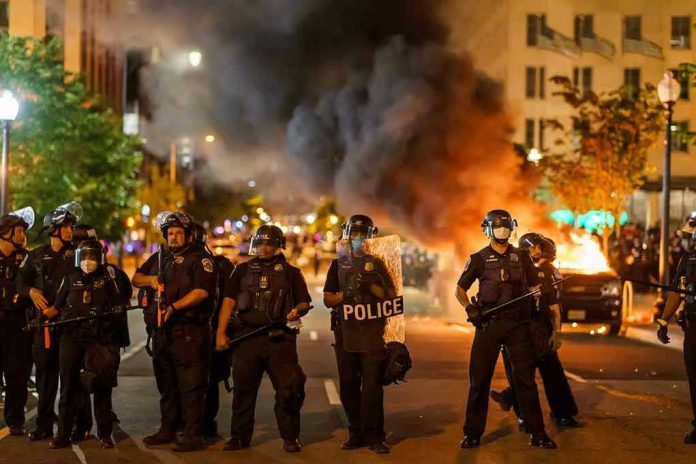
- A dumpster later burned after most of the crowd left, and officials said people blocked firefighters before federal agents put it out.
How a Downtown March Became a Test of Control at a Federal Facility
Los Angeles saw the familiar ingredients of a big-city protest: a large crowd, a defined route, and high emotion aimed at federal immigration enforcement. Demonstrators gathered near City Hall, moved through downtown, and pushed on toward the Edward R. Roybal Federal Building and the Metropolitan Detention Center. Organizers and city leaders publicly urged peaceful protest, but the night’s defining images came from the perimeter near the loading dock, where confrontation replaced chanting.
LAPD described the turning point as the arrival or emergence of “violent agitators” who began throwing bottles, rocks, and metal objects toward officers and federal agents. Reports also described a slingshot being used to launch objects, a detail that matters because it signals premeditation rather than spontaneous anger. Once projectiles start flying, police commanders shift from crowd management to officer safety, and the playbook narrows fast.
The Dumpster Tactic: Blocking an Entry Point Changes the Whole Night
Street protests often pivot on access. A march can occupy lanes and sidewalks without crossing into a direct fight, but the moment protesters target a facility entrance, the event becomes about control of infrastructure. Authorities reported a construction dumpster got pushed to block the detention center’s loading dock, then vandalized with anti-ICE graffiti. That move forced law enforcement to treat the scene as more than a demonstration; it became a physical interdiction.
From a common-sense public safety standpoint, blocking a loading dock is not symbolic theater. Facilities use those access points for secure transport, deliveries, and emergency response. A barricade creates a hazard for detainees, employees, and first responders alike, regardless of anyone’s politics. Conservatives tend to value orderly protest precisely because it keeps the moral high ground intact; once the protest starts controlling entrances, it hands the argument to the state.
Dispersal Orders and Less-Lethal Force: Why the Sequence Matters
Reports placed the first dispersal order around 5:45 p.m. on Alameda Street between Union Station and First Street, with a tactical alert declared as objects struck near federal personnel. That timing matters because dispersal orders are the legal hinge. After that point, officers can start making arrests for failure to disperse, even if an individual did not throw anything. The public often debates tactics, but the law turns on that announcement.
Police then deployed less-lethal tools such as pepper balls and tear gas as clashes continued. Critics will argue escalation; supporters will argue necessity. The cleanest factual read is simple: projectiles and improvised weapons compress decision time, and commanders reach for tools that create distance. Less-lethal munitions carry risks, but a line of officers absorbing rocks and metal objects is not a sustainable posture in any American city.
Political Messaging on the Street, and a Mayor’s Warning About Escalation
Mayor Karen Bass emphasized constitutional rights while urging people not to give “this administration” a pretext to escalate, including a stated fear of military involvement. That warning reflects a political reality: disorder can invite stronger federal posture, and local officials know it. Rep. Maxine Waters appeared on scene and joined chants calling for ICE to leave Los Angeles, reinforcing the movement’s top-line demand even as conflict unfolded nearby.
Those two messages—Bass urging restraint, Waters amplifying the cause—capture the tension inside modern protest coalitions. The cause needs peaceful optics to win lasting support, but the loudest moments often come from the most confrontational edge. From a conservative values lens, elected officials should draw a bright line: protest is protected; assault, arson, and obstruction are not. Blurry language encourages repeat performances.
The Late-Night Fire and the Unanswered Questions That Follow
After 10 p.m., most of the crowd dispersed, but reports said a smaller group returned and set the dumpster on fire. Firefighters reportedly faced delays because people blocked access, and federal agents ultimately extinguished the blaze. That detail should bother anyone who expects basic civic responsibility. A fire is not a message; it’s a threat to the public, including nearby residents and the very protesters who might get caught in it.
Arrest totals remained a point of uncertainty, with some reporting at least five arrests for failure to disperse while other accounts described multiple arrests tied to violence. Investigations typically move slowly because officials must sort out individual conduct in a chaotic scene, often using body camera and bystander video. The broader takeaway is immediate, though: a minority can hijack a majority, and the cleanup always lands on law-abiding Angelenos.
Anti-ICE Rioters Clash with Federal Agents and Local Police, Set Dumpster Ablaze Outside Los Angeles ICE Facility (VIDEOS) https://t.co/P9PVPVpHgn #gatewaypundit via @gatewaypundit
— BigQYoda (@BigQYoda1) January 31, 2026
Future demonstrations tied to “ICE Out Everywhere” will likely face tighter perimeters, faster dispersal orders, and more aggressive early arrests if officers spot the same signals—projectiles, barricade attempts, and coordinated masking. Peaceful protesters should demand that separation, loudly and early, because the state will not pause to parse motives once violence starts. The right to protest survives only when communities treat violence as a deal-breaker, not an accessory.
Sources:
Violent agitators arrested during chaotic Los Angeles anti-ICE rally: police
LAPD arrests ‘violent agitators’ as protests erupt outside federal detention center in Los Angeles
“National Shutdown” Los Angeles walkout, day of action ICE immigration protests
Live updates: Protesters clash officers during ICE protest downtown LA
Photos: Anti-ICE protest gets heated on National Shutdown Day