
The most heavily policed line in America is about to get another militarized zone, and the real story is what that reveals about how far a government will go when it decides “security” always outranks liberty, local control, and common sense.
Story Snapshot
- Trump officials plan a new militarized zone on the California–Mexico border as part of a broader crackdown on unlawful crossings.
- The move expands federal muscle over state preferences, private land, and long-standing border communities.
- Supporters frame it as restoring law and order; critics warn of creeping normalization of permanent emergency powers.
- The deeper question is what kind of border Americans want: a defensive front line or a controlled but livable neighborhood.
What A “Militarized Zone” On The Border Really Means
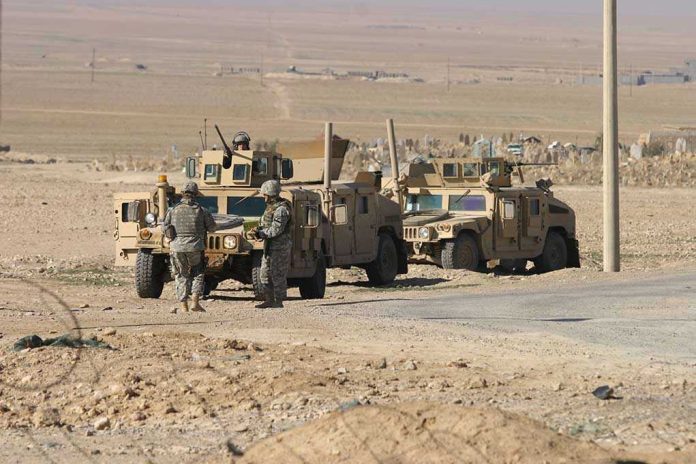
The Department of the Interior’s statement sounds dry: the Trump administration “will add a militarized zone in California along its border with Mexico” as part of a crackdown on unlawful crossings. That phrase hides what people on the ground feel. A militarized zone is not just more agents. It is layers of fencing, vehicle barriers, surveillance towers, drones, floodlights, and rapid-response units treating a desert corridor like a forward operating base, not a civilian landscape.
Border residents in California already live with checkpoints on highways, roving patrols, and cameras perched on ridgelines. Expanding that into a formal zone tightens the vise. Property owners find new restrictions on how they use their land. Ranchers adjust to constant overflights and surprise encounters with tactical teams. Families with relatives on both sides of the boundary watch their everyday movement treated more like a privilege than a right. A line on a map becomes a lived atmosphere of scrutiny, suspicion, and steel.
How Washington Uses “Emergency” To Rewire Everyday Life
Every administration in Washington faces the same temptation: declare a pressing threat at the border, then use that urgency to expand federal authority in ways that would never fly inland. The Trump team’s new California militarized zone follows that logic. Once the Department of the Interior designates land for “security,” longstanding environmental rules, local zoning, and even some property protections start to bend. The justification is always that unlawful crossings demand immediate, extraordinary measures.
Conservatives value secure borders, but they also distrust permanent emergency government. When a “temporary” crackdown hardens into permanent infrastructure, power shifts quietly from local sheriffs and county boards to alphabet agencies with armored vehicles. Federal agents gain more discretion over stops, searches, and seizures in the border band. The more normalized the militarized zone becomes, the easier it is to renew it, fund it, and quietly expand it, even when the spike that “justified” it has long faded.
The Conservative Split: Law And Order Versus Limited Government
Republican voters who cheered Trump’s promise to get control of the border now confront a familiar tension. On one side sits the conviction that a sovereign nation must enforce its laws and stop unlawful crossings, not shrug and look away. On the other side sits skepticism of any federal project that turns swaths of U.S. territory into something that feels like a security state corridor. Both instincts grow from the same root: ordered liberty, not chaos and not control for its own sake.
Trump administration setting up another militarized zone on California-Mexico border https://t.co/5CcfC3xIK4
— Ryan Mancini (@ManciniRA) December 11, 2025
Assessing the militarized zone through that lens raises hard questions. If the federal government can carve out quasi-military belts wherever enforcement is difficult, how durable are constitutional norms inside those belts? If the government can bypass some state priorities and local objections in the name of border control, where does that precedent end? Conservative common sense says a serious border policy should not require twilight constitutional zones where normal expectations of privacy and property shrink.
What This Means For Californians On The Front Line
California’s border communities sit at the crosshairs of national politics. Sacramento tends to favor sanctuary policies and a lighter enforcement touch; Washington under Trump favored visible toughness and rapid crackdowns. A new militarized zone wedges that divide into the dirt itself. Local officials will live with the fallout: strained trust between residents and federal officers, more legal fights over land access, and intensified pressure on hospitals, schools, and small businesses near the line.
People who live there do not debate abstract “border security”; they debate whether their kids can safely walk to school past a tactical staging area, whether an ambulance will be slowed at a checkpoint, whether a mistaken identity encounter with agents will spiral. Their daily lives test whether the promised gains in deterrence and control outweigh the friction, fear, and federal overreach that militarization can bring. They become, in effect, the control group for how far America is willing to go at its edges.
What Kind Of Border Do Americans Really Want?
The Trump administration’s decision forces a larger conversation that neither party likes to hold for long. A country can have a border that is serious, enforced, and fair without turning it into a permanent combat zone. That requires a mix of physical barriers where they work, smart technology, well-resourced courts, and clear asylum and work rules that are applied consistently not a reflexive escalation of more guns, more gates, and more gray zones of authority.
Common-sense conservatives should judge the militarized zone by a simple test: Does it actually reduce unlawful crossings in a durable, measurable way, or does it mainly signal toughness while deepening Washington’s grip and eroding the everyday liberty of law-abiding Americans who happen to live near a line on a map? The answer to that question, not the press conference rhetoric, will tell whether this latest “crackdown” strengthens the country or quietly changes it.
Sources:
Trump Administration Adds Militarized Zone in California Along Southern US Border