As the United States steps up air operations against Iran, tiny Bulgaria has quietly agreed to host American refueling jets—raising big questions about how far a NATO ally can go before it becomes part of the war.
Story Snapshot
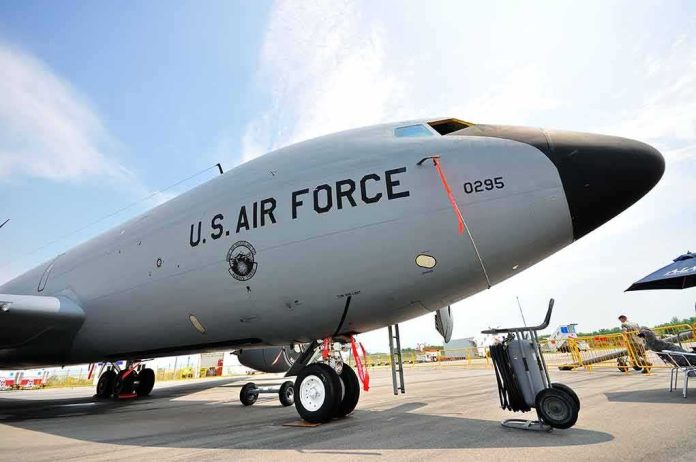
- Bulgaria’s parliament approved U.S. KC-135 tanker aircraft and troops at Bezmer Air Base to support Middle East operations.
- Sofia insists the mission is “logistical only” and says no combat flights will launch from Bulgarian soil.
- Iran warns that allowing U.S. tankers on Bulgarian territory makes the country complicit in attacks and “war crimes.”
- The move shows how far Washington’s wars now reach into allied homelands, even when governments promise they are not “in the fight.”
Bulgaria Opens Its Air Base to Support U.S. Missions
Bulgarian lawmakers voted this week to let the United States station up to eight KC-135 aerial refueling aircraft and 250 American troops at Bezmer Air Base in the country’s southeast. The deployment runs from July 24 to October 1, 2026, under a 2006 defense agreement that makes Bezmer a joint-use facility for the two countries. Officials say the tankers will support United States operations in the wider Middle East, including missions linked to the ongoing conflict with Iran.
Prime Minister Rumen Radev told members of parliament the decision is about meeting Bulgaria’s “allied commitments” as a North Atlantic Treaty Organization (NATO) partner. He stressed that it is “categorically out of the question” for combat operations in the Middle East to be flown from Bulgarian territory. Television footage showed him explaining that the tanker deployment is solely for in-flight refueling outside Bulgarian airspace, with no offensive weapon systems based at Bezmer.
Iran Warns: Hosting U.S. Tankers Is Complicity in War
Iran’s government reacted sharply to Sofia’s move, warning Bulgaria not to allow its territory or military bases to support United States operations targeting Iran. Foreign Ministry spokesperson Esmail Baghaei said any activity that helps U.S. attacks on Iran amounts to “aggression and war crimes,” and he urged Bulgaria’s full parliament to reject the proposal. Tehran’s note frames even logistical support—like refueling aircraft—as direct involvement in the conflict, not a neutral technical service.
This clash of views follows a familiar pattern whenever the United States uses allied bases for regional wars. Host governments often describe these arrangements as limited logistics or training, while critics argue they are operational participation because they enable combat missions elsewhere. In Bulgaria’s case, the short deployment window, the joint-use legal framework, and the promise of no offensive weapons are paired with outside warnings that the country is helping attacks against Iran.
Logistics vs. War: Where Is the Line for Allies?
President Iliana Iotova has tried to calm public fears by saying that hosting up to eight United States tankers and 250 personnel “would not make Bulgaria a party to the military action in Iran.” Defense Minister Dimitar Stoyanov told legislators that Bulgaria had requested and received security guarantees from Washington to minimize risks to the country’s safety and avoid direct involvement in any conflict. For Bulgaria’s leaders, this is support for an ally, not entry into someone else’s war.
🇧🇬 Bulgaria has approved the deployment of US military aircraft on its territory to assist with operations related to Iran. Parliament authorized this today.
The deployment includes eight KC-135 aerial refueling tankers and 250 US military personnel stationed at Bezmer Air Base,… https://t.co/aRzDVqN5yv
— Data Explained (@dataexplain) July 22, 2026
But the basic facts are hard to ignore. Aerial refueling planes let strike aircraft fly farther, stay in the air longer, and hit targets they otherwise could not reach. When these tankers launch from Bulgarian soil, the United States gains a stronger hand in its Iran campaign, even if no bombs drop from Bulgarian jets and no missiles sit on Bulgarian runways. This is exactly the kind of gray zone that makes many Americans feel their government drags other nations—and sometimes their own allies drag them—into conflicts decided far from home.
What This Means for Americans Watching From Afar
For conservatives and liberals back in the United States, this story taps into growing anger that wars are planned by distant elites while ordinary people carry the costs. Many on the right already distrust global military commitments and feel “America First” gets quietly watered down when Washington leans on foreign bases to keep endless campaigns going. Many on the left see another example of a security system that serves powerful interests while everyday citizens face rising prices, unstable energy, and constant risk of new crises.
Here, a small European ally is opening its territory to deepen an Iran fight that most Bulgarians did not choose and most Americans never voted on directly. Bulgarian leaders insist they are not at war, just helping a partner with logistics. Iranian officials say that help makes them part of the aggression. Whatever label politicians use, the core truth is simple: decisions made in Washington and Sofia change real lives on the ground in Iran, in Bulgaria, and in the United States—and they are made by a small group of leaders, not by the millions of citizens who will live with the fallout.
Sources:
bta.bg, sofiaglobe.com, english.alarabiya.net, en.haberler.com