

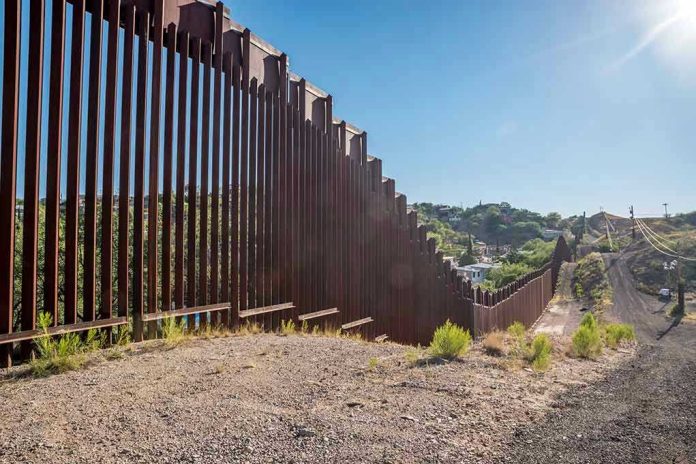
The United States is quietly turning a stretch of the California–Mexico line into something that looks less like a border crossing and more like a forward operating base.
Story Snapshot
- The Trump administration plans another militarized zone on the California–Mexico border as part of a broader crackdown on unlawful crossings.
- The move accelerates a long-running shift from civilian-style border management to hard-security posture.
- Supporters see a necessary deterrent; critics see mission creep that blurs lines between military and domestic governance.
- The real question is not just whether it “works,” but what kind of border and country this approach builds over time.
Why another militarized zone is being added now
The Trump administration is adding a new militarized zone along the California–Mexico border to intensify efforts against unlawful migrant crossings. The Department of the Interior framed the step as part of a broader crackdown, signaling that Washington views this stretch of the border as a pressure point that demands more than extra fencing or a few additional agents. The language of “zone” suggests layered security: barriers, surveillance, staging areas, and a semi-permanent security footprint.
This move fits a familiar pattern: when Congress stalls on broader immigration reform, the executive branch reaches for the tools it controls directly, land management, federal law enforcement, and cooperation with the Pentagon. California has become a symbolic arena in that tug-of-war. The administration can claim it is acting where others talk, but the choice of a militarized structure rather than purely civilian resources reveals its theory of the problem: they don’t see a paperwork backlog; they see a security breach.
Trump administration setting up another militarized zone on California-Mexico border https://t.co/5CcfC3xIK4
— Ryan Mancini (@ManciniRA) December 11, 2025
How militarization changes the character of the border
A militarized zone is not just more Border Patrol trucks on the highway. It usually means hardened infrastructure, expanded surveillance tech, and rules of engagement that feel closer to a deployment than to community policing. Residents on both sides of the line experience it daily: low-flying aircraft, floodlights at night, and a constant sense that routine movement is now suspect. Even those who support strict enforcement often grow wary when every trip to work feels like passing through a checkpoint.
From a conservative, common-sense perspective, any government that fails to control its borders risks losing both sovereignty and citizen trust. At the same time, a free country should be cautious about normalizing a permanent quasi-military presence on domestic soil. The question becomes whether this zone is a targeted, temporary response to a measurable threat, or whether it is one more brick in a structure that steadily treats the borderlands as a perpetual emergency theater.
Security benefits versus long-term political costs
Supporters argue that militarized zones project strength, deter smugglers, and disrupt large unlawful crossings before they happen. A visible show of force can alter the risk calculus of cartels that treat border enforcement as just another business cost. If crossings fall in that sector, the administration will claim validation. From that vantage point, failing to use every available tool looks irresponsible, especially when local communities complain about crime linked to smuggling corridors.
Opponents counter that heavy-handed zones drive migrants into more remote and dangerous terrain, increasing deaths without solving root causes. They also warn of mission creep: once the infrastructure and mindset of militarization are in place, future administrations may expand their use to other domestic priorities. For Americans who distrust a permanently enlarged federal footprint, that risk carries weight. A border policy that looks tough today can become a template for federal intrusion tomorrow if guardrails are not clearly set and respected.
What this means for California and the national debate
California’s state leadership has frequently clashed with federal immigration policy, branding itself a counterweight to Trump-era enforcement. That tension makes the new militarized zone more than a local operational decision; it becomes a stage for competing visions of national identity. One vision stresses uniform federal control of the perimeter; the other emphasizes state-level resistance to policies seen as excessive or inhumane. The zone will stand at the fault line of that conflict, both literally and politically.
For voters nationwide, the zone tests how far they want security measures to go when border numbers surge. Some will see it as overdue seriousness, a signal that Washington finally treats illegal crossings like the organized operations they often are. Others will view it as another step toward a country that treats its own frontiers as battlefields. Over time, the country must decide whether it prefers a border that feels like a guarded fortress or a lawful gateway that still looks and feels civilian.
Sources:
Trump Administration Adds Militarized Zone in California Along Southern US Border