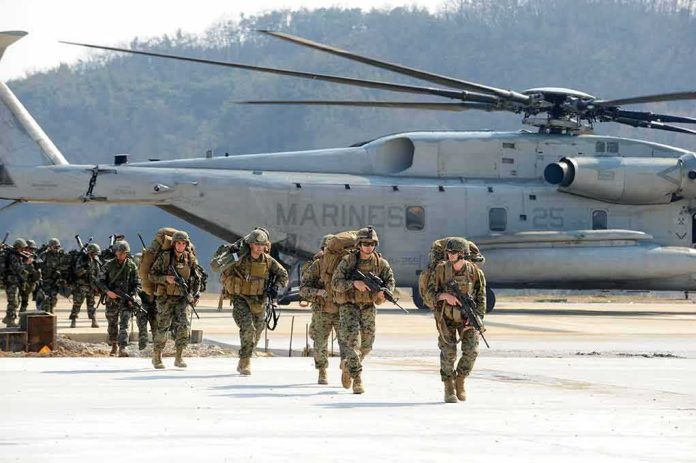
A sudden decision to halt 4,000 U.S. troops bound for Poland has stunned Pentagon insiders and European allies, raising sharp questions about who runs American defense policy and what burden-sharing really means.
Story Snapshot
- The Pentagon abruptly canceled a planned armored brigade deployment of roughly 4,000 troops to Poland, surprising U.S. officials and lawmakers.
- Equipment and advance personnel had already begun moving into Europe when the order was reversed, disrupting an active rotation.
- Polish and North Atlantic Treaty Organization (NATO) officials expressed concern, while Warsaw publicly tried to downplay fears of a permanent cut.
- The Trump administration frames the move as part of a broader realignment and burden‑sharing push, but official explanations remain thin.
What Actually Changed On The Ground In Poland
ABC News reported that the Pentagon scrapped plans to deploy an armored brigade of about 4,200 U.S. troops to Poland, a move that would slice American combat power there nearly in half according to five U.S. officials.[1] Those troops were slated to replace another unit already on the ground, keeping a heavy armored presence near NATO’s eastern flank. More than 10,000 American troops are currently in Poland on rotation, so this is not a total pullout—but it is a serious reduction in frontline muscle.[1]
Defense News detailed that the specific unit was the 2nd Armored Brigade Combat Team of the 1st Cavalry Division, more than 4,000 soldiers and associated equipment based at Fort Hood, Texas.[6] The brigade had already “cased its colors” on May 1 in preparation for the nine‑month deployment, a formal step that signals a mission is essentially locked in.[6] Portions of the advance party were already in Poland and equipment was in transit when the deployment was abruptly canceled, confirming this was not just a paper exercise.[6]
Why Officials Say They Were ‘Blindsided’
Multiple outlets describe the decision as abrupt and unexpected inside the Pentagon itself. ABC News quoted five U.S. officials who said the move came as a surprise not only to the unit but also to defense officials and members of Congress.[1] Anadolu Agency likewise reported that Pentagon officials were unaware of the decision to cancel the deployment until after it was made, quoting one official saying, “We had no idea this was coming.”[4] That level of surprise signals a breakdown in normal consultation inside the chain of command.
Polish leaders and NATO staff also appeared to be caught off guard. Euronews reported that a senior NATO military official confirmed the cancellation of the 4,000‑troop force already scheduled to replace units in Poland but insisted replenishment forces “do not factor into NATO’s deterrence and defence plans.”[2] At the same time, the outlet described “disappointment in Warsaw,” where officials had hoped to host the repositioned American troops as added insurance against Russia.[2] A Polish official separately characterized the move as a “surprise,” underscoring the diplomatic shock.[1]
Trump, Hegseth, And The Burden‑Sharing Message To Europe
The Trump administration and Defense Secretary Pete Hegseth present this less as confusion and more as a deliberate strategic signal. Defense News noted the Army’s confirmation that the deployment was canceled following a broader Pentagon plan to withdraw about 5,000 troops from Germany, with Hegseth’s team citing “theater requirements and conditions on the ground” after a review.[6] Anadolu Agency similarly reported that the armored brigade cancellation is a “significant move in line with President Trump’s push” to reshape U.S. force posture in Europe.
Euronews tied the Poland decision directly to Washington’s earlier announcement that 5,000 troops would be pulled from Germany after German Chancellor Friedrich Merz publicly criticized the U.S.‑led war in Iran.[2] In that framing, the paused Poland deployment is part of a larger repositioning and a warning shot to European leaders who enjoy American protection while undercutting U.S. policy.[2] For many conservative Americans tired of subsidizing wealthy allies, using troop movements as leverage on NATO spending and policy alignment matches long‑standing calls for tougher burden‑sharing.
Confusion, Mixed Messaging, And The Costs To Readiness
Even if the realignment goal makes sense to many on the right, the way this move rolled out created unnecessary turbulence. Politico reporting summarized in the research describes Hegseth’s decision as “last‑minute,” with Pentagon staff and European allies stunned by the reversal.[5] ABC News added that preparations were “well underway,” with equipment and advance personnel already shipped into Europe before troops were told to halt deployment.[1] When a brigade is spun up, families are disrupted, training cycles are built around the mission, and shipping costs soar.
The Pentagon is cutting US troop deployments in Europe after pressure from President Trump over NATO burden-sharing.
A planned deployment of about 4,700 troops from the 2nd Armored Brigade Combat Team to Poland and Eastern Europe was canceled.
A long-range missile battalion… https://t.co/mT37VrQfKz
— Crescent Desk (@TheCrescentDesk) May 15, 2026
Such whiplash feeds narratives that the United States is “anti‑NATO” or unreliable, narratives globalist media outlets are eager to weaponize.[2] At the same time, official Pentagon silence has created a vacuum. ABC News and Defense News both noted that Defense Department press offices declined to comment or referred questions elsewhere.[1][6] Without a clear, on‑the‑record explanation tying the cancellation to a defined strategy or budget line, critics can claim chaos, while supporters are left to defend the move without solid facts.
How Conservatives Should Read This Fight
For constitutional conservatives, two truths can sit side by side. First, the United States cannot be the endless piggy bank and security blanket for Europe while European elites lecture Americans about foreign policy and climate quotas. Pressuring NATO partners, especially Germany, to carry more of their own defense weight is overdue and aligns with President Trump’s America First mandate.[2] The reported linkage between Germany troop cuts, the Poland decision, and allied criticism of U.S. policy fits that broader push.[2]
Second, demanding accountability for how such a major move was executed is not anti‑Trump; it is pro‑civilian control and pro‑competent defense. Congress has every reason to ask who knew what, when, and how much taxpayer money and unit readiness were burned by an about‑face after equipment was already en route.[1][3][6] Transparent answers from Hegseth and the Pentagon would strengthen, not weaken, the case that this is a disciplined realignment rather than bureaucratic chaos. A serious superpower can send tough messages to NATO without scrambling its own forces in the process.
Sources:
[1] Web – Pentagon abruptly cuts US combat forces in Poland, officials say
[2] YouTube – US cancels planned troop deployment to Poland, Euronews confirms
[3] Web – US senators alarmed by Pentagon’s ‘halt’ to Poland deployment
[4] Web – Pentagon officials unaware of decision to halt troop deployment to …
[5] Web – Pentagon officials stunned by Hegseth decision on troops …
[6] Web – US Army abruptly cancels deployment of 4000 soldiers to …