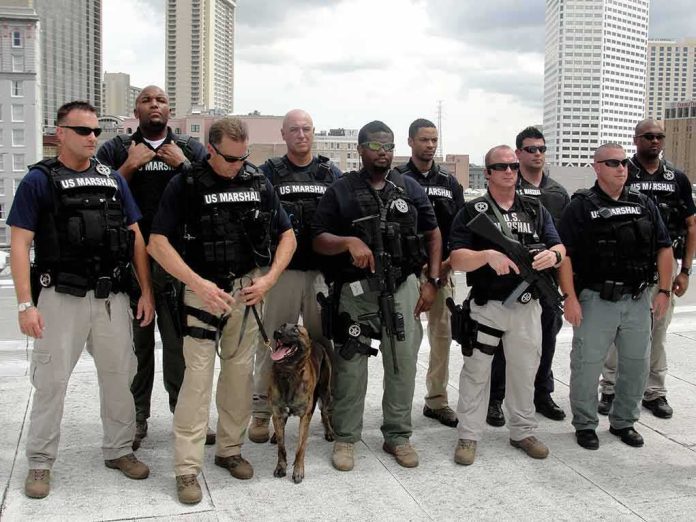
As the Justice Department celebrates a historic crime drop and thousands of arrests, the real question for Americans is whether these crackdowns are truly making our streets safer or just inflating federal power and budgets.
Story Snapshot
- The Justice Department reports major crime declines and thousands of arrests in nationwide crackdowns under President Trump’s second term.
- Federal operations have charged gang members, seized fentanyl and firearms, and rescued children from predators, showcasing real wins.[2][3][5][6]
- Critics note that arrest and seizure numbers prove activity, not that these actions alone caused nationwide crime drops.[3][5]
- Conservatives must weigh tough-on-crime successes against the risk of expanding Washington’s reach without clear accountability.[1][3]
Trump-Era Crackdowns Deliver Tangible Wins Against Violent Crime
Since January 2025, the Department of Justice has rolled out coordinated enforcement operations that highlight a renewed federal focus on violent criminals, cartels, and child predators under President Trump’s second term.[2][3] In a nationwide crackdown on the Venezuelan gang Tren de Aragua, the department reports more than 25 defendants charged and over 260 gang members and associates federally charged since January 20, 2025.[2] That operation alone seized more than 80 firearms and about 18 kilograms of drugs including fentanyl, cocaine, and methamphetamine, along with ammunition and cash.[2]
Parallel operations targeting crimes against children have produced sobering but important numbers. Operation Relentless Justice, a coordinated child exploitation crackdown, resulted in over 205 child victims being located and 293 child sexual abuse offenders arrested nationwide.[3][4] Operation Restore Justice, an earlier effort, rescued 115 children and led to the arrests of 205 child sex abuse offenders in a Federal Bureau of Investigation (FBI)–led nationwide sweep.[5][6] Another nationwide initiative, Operation Iron Pursuit, reported more than 200 child victims located and over 350 child sexual abuse offenders arrested across all 56 FBI field offices and United States Attorneys’ Offices.
Historic Crime Drop Claims and the Causation Question
The Justice Department now pairs these enforcement totals with broader claims of a historic nationwide crime drop, using them to argue for sustained or expanded federal crime-fighting resources.[1][2][3] Federal summaries of recent crime data show multi-year declines in murder, robbery, and aggravated assault since the early 2020s, with outside analysts also reporting major reductions in homicide across dozens of cities.[3][4] These trends align with Trump-era messaging that tough-on-crime policies, stronger sentencing, and aggressive federal–local partnerships are finally reversing the surge in violence that began earlier in the decade.[2][3][4]
Critics, however, draw a careful distinction between what the Justice Department can clearly document and what it merely implies. The public press releases for operations like Restore Justice, Relentless Justice, Iron Pursuit, and the Tren de Aragua crackdown list arrests, rescues, seizures, and interagency coordination but provide no formal causal analysis showing that these specific operations directly produced the reported nationwide crime declines.[2][3][5] Analysts argue that these are operational “outputs” rather than proof that the initiatives alone drove the broader statistical trends, which are also influenced by local policing, state laws, economic conditions, and community-level factors.[3]
Accountability, Federal Power, and Conservative Priorities
For constitutional conservatives, the tension lies in supporting real law-and-order victories while staying wary of how Washington uses the numbers. Large federal crackdowns against transnational gangs, fentanyl traffickers, and child predators are squarely in the federal government’s lane and align with core duties like securing borders, protecting children, and dismantling interstate criminal networks.[2][3][5] At the same time, history shows that federal agencies often highlight arrest counts and dollar-value seizures to justify permanent budget increases and expanded authorities without proving long-term impact.[1][3]
ATTORNEY GENERAL TODD BLANCHE ANNOUNCES THE DOJ HAS A 20% DECREASE IN MURDER RATE, ARRESTED 44,000 VIOLENT CRIMINALS, SEIZED OVER 2,200 KG OF FENTANYL, LOCATED 6,300 MISSING CHILDREN, ARRESTED OVER 2,000 CHILD PREDATORS; 3,800 MARHSALLS ARRESTED 73,000 FUGITIVES AND HOUSED 55,000… https://t.co/tlN1vjL5NJ pic.twitter.com/iUpjCI00eM
— Zach Jones – Secretary of Psyops (@ZachJones1994) June 3, 2026
That caution is reinforced by how crime data is often presented. State-level databases, such as those maintained by the State of California Department of Justice, track arrests and reported offenses but rarely tie outcomes directly to federal operations in a way the average citizen can verify. Conservative readers who lived through years of “woke” criminal justice experiments, soft-on-crime prosecutors, and rising urban violence may welcome the Trump administration’s tougher stance, while still demanding transparent evidence, clear sunset dates on emergency powers, and respect for due process, gun rights, and federalism as the Justice Department presses its case for continued funding.[1][3]
Sources:
[1] YouTube – DOJ Reports Historic Crime Drop, Thousands of Arrests in Nationwide …
[2] Web – DOJ announces 324 arrests in $14.6B healthcare fraud crackdown
[3] Web – More than 25 Defendants Charged in Nationwide Tren de Aragua …
[4] Web – Justice Department Announces Results of Operation Relentless …
[5] Web – Justice Department announces results of Operation Relentless Justice
[6] Web – Justice Department announces results of Operation Restore Justice