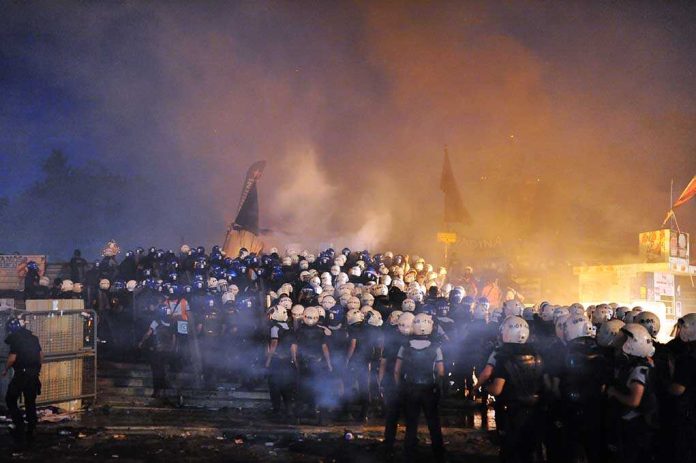
Riot police firing tear gas to seize an opposition party’s headquarters is the latest warning that when courts and cops merge with politics, rights get trampled.
Story Highlights
- Turkish police stormed the main opposition party’s headquarters after a court nullified its leader’s election [4].
- Reports tie the intervention to a request linked with former leader Kemal Kılıçdaroğlu amid a bitter leadership fight [1].
- Video and eyewitness accounts describe tear gas, smashed doors, and a forceful eviction of staff and members [4].
- Key documents, including the exact court order and police authorization, have not been publicly produced [1][4].
Police Clash With Opposition Amid Court-Backed Eviction
News outlets reported that Turkish riot police entered the Republican People’s Party headquarters in Ankara after an appeals court nullified Özgür Özel’s leadership and suspended his executive board, triggering an attempted handover to a rival faction [4]. Coverage describes a violent end to a tense standoff, with officers deploying tear gas and rubber bullets as they pushed through the building to evict the current leadership team and supporters who refused to leave the premises [4]. Footage and photos documented chaotic clashes inside corridors and courtyards [4].
Accounts indicate the operation unfolded as part of a leadership dispute rather than a conventional criminal probe, which sharpened fears that legal tools are being used to control opposition organizations [4]. Among those inside, according to reporting, was Özgür Özel, elected in 2023 and then dismissed by the disputed ruling, underscoring the political stakes of the intervention [4]. Observers described smashed doors, pepper spray, and a rapid police advance that cleared rooms and stairwells, culminating in a full eviction of party officials [4].
Legal Basis Cited, But Transparency Gaps Remain
Some outlets attribute the intervention to a request associated with former party leader Kemal Kılıçdaroğlu after the appellate decision unsettled the leadership order [1]. Reports assert authorities directed police to implement the ruling by removing the ousted leadership from the property, presenting the action as enforcement rather than a criminal raid [3][4]. However, the record available through public reporting lacks the court order text, case number, or a named authorization chain that would clarify enforcement scope and timing [1][4].
Without the underlying documents, fundamental questions remain. Coverage does not show whether the ruling was final, stayed, or immediately executable, or who precisely issued the operational directive to enter with force [1][4]. That opacity matters because the use of tear gas and rubber bullets during what appears to be a civil or administrative eviction raises proportionality concerns. The absence of body-camera logs, after-action reports, or stated rules of engagement leaves the public to rely on conflicting headlines and dramatic clips rather than verifiable procedure [4].
Coercive Optics Fuel Political-Persecution Narrative
Descriptions of police smashing glass, firing tear gas in confined offices, and rushing past party banners feed a narrative of repression that predictably drowns out any technical legality argument [2][3][4][5]. The opposition framed the raid as part of broader harassment, while international coverage spotlighted images of choking staffers and chaotic corridors, creating a coercive-imagery bias that shapes perception before legal details are known [1][4]. In polarized systems, scenes like these are read as power plays, not paperwork disputes.
Turkish riot police stormed CHP headquarters in Ankara on Sunday, using tear gas and rubber bullets against opposition supporters inside.
BBC News and AP report the raid followed a 3-day standoff after a court nullified chair Özel's election and ordered him replaced. pic.twitter.com/AvKJHxQDkE
— Walter Croncat (@mewscast) May 24, 2026
For Americans who value constitutional limits, this episode is a cautionary tale: when courts and police wade into partisan fights, process must be transparent, proportionate, and accountable. A court decision, if valid, should be posted; a police order, if proper, should be signed and reviewable. Otherwise, governments invite mistrust, and force becomes the message. The remedy is sunlight—publish the ruling, disclose the authorization, and release use-of-force records so citizens can judge facts, not footage [1][4].
Sources:
[1] Web – Police raid on CHP headquarters in Ankara | Demócrata
[2] YouTube – Turkish Police Storm CHP HQ, Evicts Opposition Leader Ozel After …
[3] YouTube – Chaos In Ankara As Turkish Riot Police Smash Into Opposition Party …
[4] Web – Turkish police storm Ankara HQ of CHP party – WFTV
[5] YouTube – Riot police storm opposition HQ in Turkey