The most unnerving part of the Glacier grizzly video is not the bears at full sprint—it is how little margin for error separates a viral “close call” from a body recovery.
Story Snapshot
- Two young grizzlies barreled down a Glacier National Park trail, passing within a few feet of hikers who froze and hugged the uphill bank.
- National Park Service data show that when people hike in small groups and deploy bear spray quickly, many potentially deadly encounters end without fatalities.
- Glacier’s history also records fatal maulings, surprise encounters, and incidents where people’s choices—like leaving trails or approaching bears—made things far worse.
- The deeper fight is over responsibility: personal preparedness and common sense versus faith that park policies alone will keep visitors safe.
How Two Sprinting Grizzlies Turned A Holiday Hike Into A Near Miss
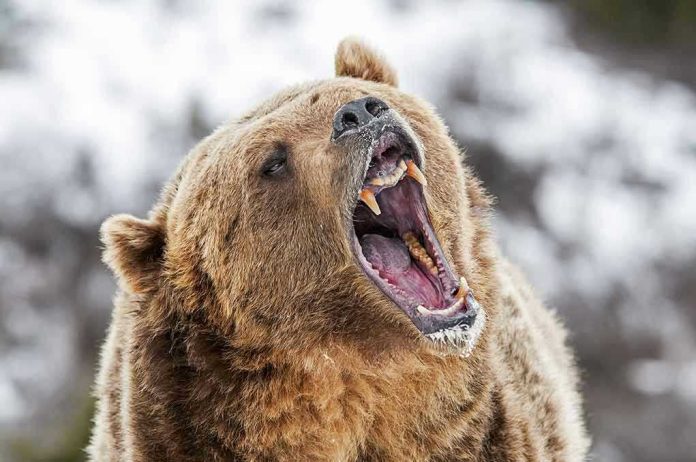
The viral clip from Glacier National Park shows two young grizzly bears charging at a full run straight down a narrow trail as a couple of hikers press themselves into the hillside and hold their ground while the animals rocket past at arm’s length. The bears never turn toward the people and clearly use the path as the quickest travel route, but the woman later estimated they came within about five feet, which is one bad flinch away from contact. That is not a safe distance; that is a mercy.
Glacier National Park’s own bear-safety guidance tells visitors to give bears at least one hundred yards of space and to avoid situations where an animal’s line of travel is blocked.[1] Rangers warn that if a bear is moving your way on a trail, the priority is to get out of its path and let it pass rather than try to slip by at close range.[1] That is exactly what the hikers did: they stopped, yielded the trail, avoided running, and allowed the bears an unobstructed lane.[1] When you watch the video frame by frame, that textbook behavior is what keeps a routine travel run from turning into a defensive charge.
What Glacier’s Incident Files Reveal About Bears, People, And Blame
Glacier National Park’s incident history reads like a long argument about what “avoidable” means in bear country.[1] One National Park Service archive entry describes a hiker who spotted a female grizzly with cubs, left his companion, and moved closer to take photographs before the encounter turned violent.[2] Another reports injuries after hikers left a designated trail and flushed a grizzly from cover, creating a classic surprise encounter that never would have occurred if they had stayed on the route.[2] These are not acts of fate; they are errors of judgment that put human curiosity above common sense and above clear park rules.
Other incidents look more like bad luck than bad behavior. A recent Glacier press release details a case where two hikers on a maintained trail near Lake Janet surprised a bear with cubs at close range; the animal charged, knocked one hiker down, and swiped her before the partner deployed bear spray, sending the bear running immediately. The victim had shoulder and arm injuries but survived and was evacuated in stable condition after a rapid park response. When people follow the core guidance—hike in a group, carry bear spray, react quickly—the outcome is often painful, expensive, but not fatal.
Bear Spray, Personal Responsibility, And The Limits Of Policy
Glacier’s official safety page emphasizes that bear spray is the single most effective deterrent when a charge turns into an attack and that it must be worn where a hiker can deploy it within seconds, not buried in a pack.[1] The Lake Janet case powerfully supports that claim: one precise burst ended a charge instantly and almost certainly prevented a mauling. But other high-profile Rocky Mountain attacks, including a suspected fatal mauling of a solo Glacier hiker whose body was recovered with injuries consistent with a grizzly attack, show that bear spray and rules cannot neutralize every risk.
Critics look at that record and argue that parks oversell their management success and underplay just how fast a “surprise encounter” can turn lethal. From a conservative, common-sense viewpoint, the right lesson is not that the government failed; it is that no policy can substitute for individual responsibility in dangerous country. Bears are apex predators. They are not theme-park characters managed by a liability department. Personal choice still drives most outcomes: whether you hike alone at dusk, whether you leave the trail, whether you carry and know how to use bear spray, whether you crowd wildlife for a selfie.
Why The Glacier Video Became A Culture-War Rorschach Test
Grizzly incidents in Glacier consistently ignite debate over labels like “surprise encounter,” “defensive behavior,” and “human provocation,” because those words quietly assign blame.[1] When rangers call the Memorial Day sprint a simple trail encounter with no aggression, wildlife advocates emphasize that the hikers complied with training, and that the park’s closures and education efforts are working as intended.[1] When a solo hiker turns up dead with suspected bear wounds, or when old files reveal injuries after someone left the trail for a closer look, skeptics argue that the park’s bland language minimizes real risk and shields people from the need to change their own habits.[2]
Two young grizzly bears gave a pair of hikers quite the fright when they came barreling down a trail at Glacier National Park in Montana.
“We’re going to die. We’re actually going to die. Holy heck!” Alyssa Olsen says in the footage. pic.twitter.com/Zpv54NKXTL
— ABC7 Eyewitness News (@ABC7) May 28, 2026
From a grounded, right-of-center perspective, the reality lands in between. Glacier National Park has made reasonable efforts: strict distance rules around bears, clear guidance to avoid surprising animals, and repeated warnings that bear bells are not enough and that human noise plus spray are the best tools.[1] At the same time, the government cannot bubble-wrap millions of visitors scattered across hundreds of miles of trails. The Glacier grizzly video is not an indictment of mismanagement; it is a vivid reminder that wild places are truly wild, and survival still depends more on self-discipline than on signage.
Sources:
[1] YouTube – Hikers dodge charging grizzly bears at Glacier National Park. See the …
[2] Web – NPS Incident Reports – Glacier National Park