
President Trump turned a Michigan drag race stop into a sharper pitch on jobs, cars, and the economy.
Quick Take
- Trump visited General Motors’ Milford Proving Ground in Michigan before speaking on the economy.
- Reporting says the stop was meant to highlight manufacturing and auto industry jobs.
- Coverage says Trump also viewed a drag race demonstration at the facility before his remarks.
- His comments tied tariffs, manufacturing, and auto-sector strength to his broader economic message.
What Happened in Milford
President Trump visited General Motors’ Milford Proving Ground in Michigan and was expected to focus on American manufacturing and the economy. Coverage says he viewed a drag race demonstration before his speech and met with General Motors Chair and Chief Executive Officer Mary Barra and President Mark Reuss at the facility. The stop came as midterm election season tightened and the White House pressed its economic message in a battleground state.
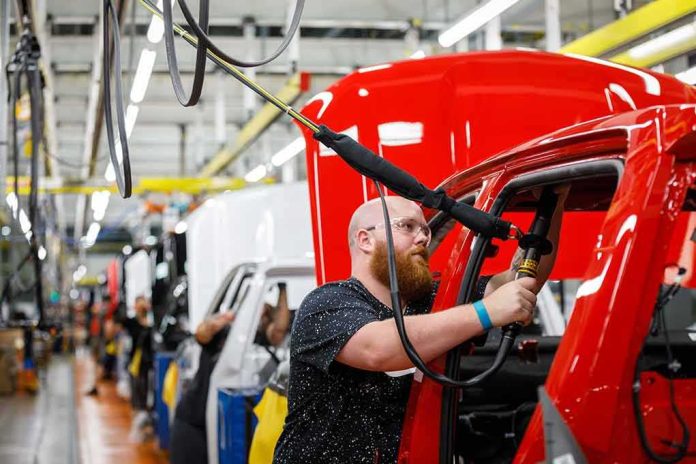
The setting mattered as much as the speech. General Motors’ test track is not a random campaign backdrop. It gave Trump a visual link to cars, speed, and industrial work, which fit the message his team wanted to push. That message was simple: American manufacturing should be front and center, and Michigan remains one of the best places to sell that argument to voters who care about factory jobs and paychecks.
Why Michigan Still Matters
Michigan has long been a key state in the fight over trade, jobs, and industrial policy. Trump’s campaign has repeatedly used manufacturing-related venues there, including factory sites and town halls, to reinforce that theme. The latest stop follows a familiar pattern. When a candidate speaks in a state built around cars and supply chains, the venue itself becomes part of the message, even before the first line of the speech lands.
That is why this visit drew attention beyond the usual campaign noise. Supporters see proof that Trump is still leaning into the worker-and-industry argument that helped him build a political base in the Midwest. Skeptics see something narrower: a polished stage designed to suggest economic success without proving it. The supplied reporting confirms the campaign framing, but it does not provide hard data showing that the policies caused a manufacturing revival.
The Economic Claim and the Missing Proof
Trump has argued that tariffs and trade changes helped domestic manufacturing, and one report says the White House planned to have him talk up manufacturing jobs and foreign investment. But the available coverage stops at message and venue. It does not include a labor market study, plant-level output data, or an independent review tying his trade policy to stronger Michigan auto results. That leaves the public with a familiar gap between campaign language and measurable proof.
Manufacturing cars in America helps create American prosperity.
Since taking office, President Trump has ignited an automotive renaissance, onshoring production, restoring factory jobs, and driving massive investment from automobile companies.
Don't miss his speech at General… pic.twitter.com/okOKbsWy3A
— The White House (@WhiteHouse) July 27, 2026
That gap matters because both sides have reason to distrust broad economic claims that are not backed by clear numbers. Trump’s allies may see a president standing inside an auto facility as evidence that his approach is working. Critics may see another example of politics dressed up as proof. In a state where factory work still shapes family income and local identity, that split can be especially sharp and easy to exploit.
What the Stop Says About the Bigger Debate
The Milford appearance also shows how economic politics now travels through visual moments, not just policy papers. A drag race, a proving ground, and a speech about jobs create a ready-made story line for television and social media. That does not settle the argument over tariffs, trade deals, or auto-sector performance. It does show how modern campaigns turn industrial settings into symbols, even when the evidence behind the claims remains contested.
Sources:
facebook.com, cbsnews.com, thehill.com, fox2detroit.com