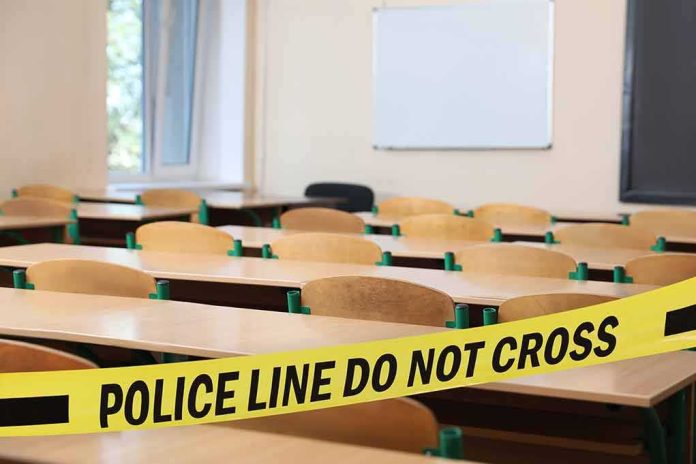
When a 17-year-old can slash two adults inside a New York City high school and walk out the door, it feeds a growing sense that those in charge have lost control of the basics.
Story Snapshot
- A 17-year-old student allegedly slashed two aides during a dispute inside William Taft High School in the Bronx.
- Both men suffered cuts, were taken to the hospital with minor injuries, and the student suspect fled the scene.
- The attack is one of several recent knife incidents in and around New York City schools, raising safety concerns.
- Parents and workers on both left and right see a system that talks about safety but struggles to deliver it in real classrooms.
What Police Say Happened Inside the Bronx Classroom
Police in New York City say the violence started with a dispute between a 17-year-old male student and a 53-year-old male aide inside William Taft High School in the Bronx. During that argument, officers say the teen used what they believe was a scalpel to slash the aide’s left arm just after 10 a.m. A second aide, age 30, stepped in to break up the fight and was cut on the hand. Emergency crews took both men to a local hospital with what officials called minor injuries.
Reporters say the teen suspect ran from the school after the attack, carrying a blue backpack and wearing a black shirt and blue sweater. As of the latest reports, police had not announced an arrest, and the investigation was still active. That means the public has not seen an official complaint, court charging papers, or a full report from the New York City Department of Education. Most details so far come from what police and sources told local news outlets at the scene.
School Violence Is Becoming a Disturbing Pattern
This slashing is not an isolated case. In recent years, New York City schools, especially in the Bronx, have seen multiple stabbings and slashings in or near campuses. In one case, a fifteen-year-old was slashed by another student at a Bronx high school, marking the third such school attack in just three days. Other reports describe teen fights where several students were stabbed or slashed outside or just beyond school grounds, turning dismissal time into a danger zone instead of a daily routine.
These incidents are part of a longer history of serious violence tied to certain troubled schools, including older stories about teachers pushed down stairwells or attacked with bricks. For many families and staff, each new headline feels less like a shock and more like proof that the system never fixed deeper problems. Privacy rules and sealed juvenile records make it hard for the public to see full case files, but the pattern that does break through is alarming: knives in schools, repeat trouble at the same campuses, and adults who do not feel safe at work.
Why This Alarms Both Conservatives and Liberals
Parents and taxpayers across the political spectrum care about one basic promise: when a child or a worker walks into a school, they should walk out safe. Conservatives often point to these stories as proof that discipline has broken down and that leaders spent years focused on politics instead of enforcing rules and backing up staff. Liberals often focus on a different but related fear, that rising school violence reflects widening gaps between rich and poor, and a system that fails students long before they bring a weapon to class.
On both sides, many see a common thread: a large school system that issues statements after every incident but struggles to prevent the next one. People hear phrases like “safety is always a priority” and “we are investigating” while videos of attacks race across social media. That gap between words and lived reality feeds distrust in what many call the “education establishment” and, more broadly, in a federal and local government network that seems better at paperwork than protection.
What This Says About a System Under Strain
Events like the Taft High School slashing sit at the crossroads of several national worries. There is concern about youth mental health, broken families, and an online culture that can glorify violence. There is anger over policies that, in the name of fairness or statistics, may discourage removing dangerous students from classrooms. And there is deep frustration that front-line staff, like aides and substitute teachers, often face the most risk for the least pay and the least voice in policy decisions.
At the same time, this case shows how hard it is for the public to get full facts. Because the suspect is a minor, key records will likely stay sealed. That protects privacy but also shields school and government failures from sunlight. As more families on the right and left lose faith in official reassurances, they start to look elsewhere for answers—homeschooling, charter schools, private security, or neighborhood efforts. The shared question after another knife appears in a classroom is simple and cuts across politics: if the system cannot keep teachers and aides from being slashed at work, who is it really serving?
Sources:
youtube.com, abc7ny.com, bronxda.nyc.gov, manhattan.institute, abcnews.go.com, nydailynews.com, bronx.news12.com