As President Trump promises that “Americans will never stop winning,” many citizens wonder whether his golden-age vision matches the hard facts of life in today’s United States.
Story Snapshot
- Trump is using America’s 250th birthday to sell a new “golden age” of nonstop national victories.
- He claims massive investment, military wins, and restored safety, but many of the numbers are disputed or undocumented.
- Mainstream outlets and fact-checkers say his speeches are unusually political and question key economic and war-related claims.
- Trump’s upbeat message and its critics reflect a deeper fear on left and right that elites are spinning stories while everyday Americans still struggle.
Trump’s America 250 message: a promise of endless wins
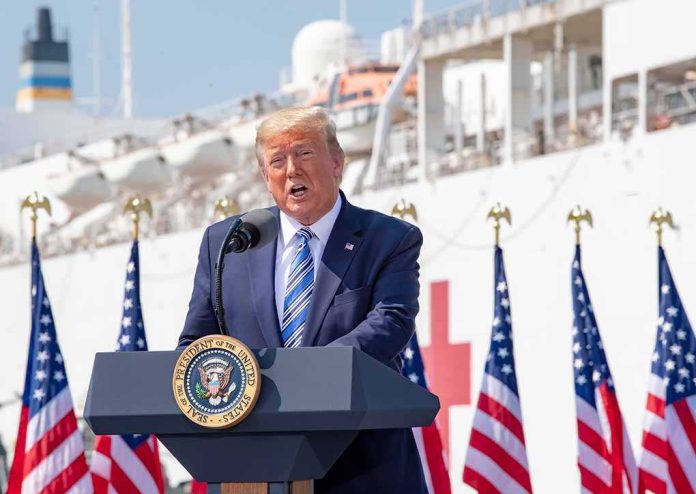
President Donald Trump has turned America’s 250th birthday into a stage for a sweeping promise: a “golden age of America” where “Americans will never stop winning.” In his Mount Rushmore address and later America 250 speeches, he links past heroes to a future of constant victories in the economy, national security, and culture, and he frames himself and his movement as the engine of that change. A White House order in 2025 even created a Task Force on Celebrating America’s 250th Birthday, with Trump himself as chair, formalizing his central role in shaping the anniversary story. For many listeners tired of division and decline, that message of endless wins feels hopeful. For others, it sounds like a campaign speech wrapped in red, white, and blue.
Trump’s language fits a long tradition of presidents selling “golden age” narratives, but he pushes it further by saying this era will be one where America beats enemies quickly, restores safety at home, and outperforms any past boom. Supporters hear this as a needed break from what they see as years of weakness, globalism, and elite contempt for ordinary citizens. Critics, including many who once backed Democrats, worry that the picture of nonstop winning ignores stubborn realities they feel every day: high costs, insecure work, and a political class, right and left, that talks more about victory than about fixing broken systems.
Big economic and military claims face tough questions
At the heart of Trump’s golden-age pitch is a striking economic claim: he says $19.2 trillion “poured into the United States” in just 12 months, far more than under the previous administration. That number sounds impressive, but it comes only from his own speeches and has not been backed by public data from the Treasury Department or the Bureau of Economic Analysis. Fact-checkers who reviewed similar claims about $18–$19 trillion in investment found that official White House tallies reached about $9.6 trillion, and even that figure included informal pledges and projects already underway. This gap between Trump’s headline numbers and documented totals feeds the sense, on both right and left, that leaders use huge statistics to impress voters without giving proof that stands up under scrutiny.
Trump’s rhetoric about war and national security follows the same pattern. In his America 250 speeches, he boasts that the United States “beat Venezuela in one day” and “knocked Iran hard,” presenting these lines as proof of unmatched American military strength under his watch. Yet there are no released Department of Defense records or international news reports confirming a one-day U.S. victory over Venezuela. Earlier, when Trump claimed he had ended multiple wars in ten months, an annotated review by National Public Radio found the statement exaggerated, noting that ceasefires were partial and fighting continued in key regions. Many Americans who support a strong military still worry when major war claims are made without clear evidence. They remember past eras, from Vietnam to Iraq, when confident victory talk hid long, costly conflicts managed by the same “deep state” they distrust today.
Communism, threats, and a sharply political July 4
Trump also used the 250th anniversary to revive a Cold War-style warning. He called communism “the greatest threat to our country,” ranking it above World War I, World War II, Pearl Harbor, and even the September 11 attacks. That statement signals how Trump wants Americans to view the world: not mainly through lenses of terrorism or great-power war, but through a clash between free markets and state control. However, he offered no intelligence reports, historical studies, or expert threat assessments to support that ranking, and none are cited by the White House. For many citizens who distrust both big government and big corporations, this hard focus on communism can feel out of step with their daily experience of threats like cyberattacks, cartel violence, addiction, and economic precarity.
Major news outlets say Trump’s America 250 speeches broke from the usual tone of national unity. The Associated Press and Public Broadcasting Service reported that his address “veered into darkly political” territory and “swerved from typically apolitical, unifying speeches” that past presidents used on milestone holidays. Instead of centering the message on shared civic ideals, his remarks mixed praise for American exceptionalism with harsh attacks on communism and implied criticism of domestic opponents. On social media, former President Barack Obama posted about “radical self-government” and “unalienable rights,” stressing equality and the duty of citizens to hold leaders accountable. The contrast between Trump’s nationalist language and Obama’s rights-focused message highlights a real divide in how elites frame patriotism, even as many ordinary Americans on both sides feel that neither camp is listening closely to their struggles.
A golden age story in a time of deep distrust
The White House has worked hard to turn the “golden age” theme into formal policy branding. A Freedom 250 initiative promotes a national fair and patriotic events, and an official Presidents’ Day statement from Trump’s team claims that inflation has “plummeted,” stock indices have set repeated records, and violent crime has dropped to historic lows, all as proof that a “Golden Age of American greatness” has begun. Some conservative scholars echo this framing, saying the country is returning to “permanent things” such as work, production, and independence, and crediting Trump for pushing back against what they call a corrupt ruling class. Yet historians comparing the current moment to the old Gilded Age point out that boom times in headline numbers can hide deep inequality, widespread corruption, and a growing gap between powerful insiders and the rest of the public.
This is President Trump.
With his powerful, confident and unapologetically proud speech on July 4, 2026, he transformed this historic day into something truly majestic – a celebration worthy of America’s 250th anniversary of independence. On the National Mall, before hundreds of…— OneMoreMe-ButAnother (@TheMiglena) July 5, 2026
That tension helps explain why Trump’s promise that “Americans will never stop winning” hits such a nerve. Many conservatives over 40 hear the line as a long-awaited reversal of what they view as “woke” agendas, open borders, and failed globalist experiments that made their lives harder and more expensive. Many liberals over 40, who dislike Trump’s America First stance, still share the feeling that the system is rigged and that both parties protect donors and bureaucrats over workers and families. The golden-age branding, the huge but shaky numbers, and the highly political July 4 messaging together raise a key question that crosses party lines: are today’s leaders, including Trump, describing real change on the ground, or are they mainly selling stories of victory while the deeper problems of cost of living, trust in institutions, and access to the American Dream remain unsolved?
Sources:
youtube.com, whitehouse.gov, pbs.org, news.sky.com, instagram.com, thehill.com, bbc.com, iperstoria.it, theconversation.com, rbhayes.org