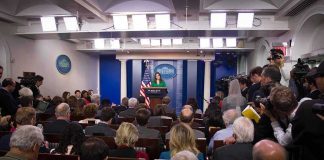

As fireworks lit the sky for America’s 250th birthday, President Trump declared a “new Golden Age” even as fact‑checkers and critics warned that many of his bold claims do not match the numbers on the ground.
Story Snapshot
- Trump used the America 250 stage to promise a “Golden Age” of strength, safety, and prosperity.
- White House releases and allies echo that narrative, saying inflation is down, markets are soaring, and crime is falling.
- Independent fact‑checkers say some headline claims, like trillions in new investment, are overstated or lack public proof.
- Critics on the left and right see the 250th celebrations as another example of political elites selling a story instead of fixing real problems.
Trump’s “Golden Age” Promise in His America 250 Speeches
President Donald Trump has turned the America 250 celebrations into a showcase for his claim that the United States is entering a “new Golden Age” under his leadership. In speeches at Mount Rushmore in 2023 and again on the eve of the July 4, 2026 milestone, he painted a picture of a nation stronger, richer, and safer than ever before, telling Americans they will “never stop winning” as the country turns 250 years old.
The White House has backed up this theme in official releases, saying inflation has dropped to its lowest levels in years, major stock indexes have hit repeated record highs, and violent crime has fallen to record lows. Supporters argue these trends prove that Trump’s “America First” push, tighter borders, and focus on domestic industry are finally paying off for workers and families after years of globalist policies and economic anxiety.
Where the Numbers Support the Narrative — and Where They Do Not
Some pieces of Trump’s economic story have outside support, such as job reshoring trends. A conservative analysis notes that at least 1.3 million manufacturing jobs have returned to the United States since 2017, with the pace picking up again in Trump’s second term, as companies move production back home. That helps explain why many blue‑collar voters, tired of offshoring and plant closures, are willing to give the “Golden Age” label a chance.
But other headline claims are on much shakier ground. Fact‑checkers looking at Trump’s repeated boasts of $18–$19.2 trillion in new foreign investment found that internal White House counts reached only about $9.6 trillion, and even that figure included pledges and projects that were already planned. A British review also reported no public evidence for the full $18 trillion number, putting Trump’s brag far beyond what outside data can confirm.
Security, War Claims, and Warnings About Communism
Trump has tied his Golden Age theme to national security, claiming major military wins and a tougher, safer America. In different speeches he has said he “beat Venezuela in one day” and hit Iran hard, presenting these as proof of restored American strength. Yet there are no publicly available Defense Department records or major international reports that match a one‑day victory over Venezuela, which leaves these lines in the realm of political storytelling, not documented campaigns.
On foreign and domestic threats, Trump has also put communism at the center of his warning, calling it the greatest danger America has ever faced, even compared with World War I, World War II, Pearl Harbor, or the attacks on September 11. Supporters hear this as a defense of faith, family, and property against radical ideology. But historians and intelligence experts have not ranked communism above those wars and attacks in any official threat studies released to the public, so his comparison reflects a political view, not a settled expert judgment.
How Media, Obama, and Historians Push Back
Major news outlets covering Trump’s July 3–4, 2026 speeches described a sharp break from how past presidents handled big national anniversaries. A report carried by Public Broadcasting Service and the Associated Press said Trump started by praising American greatness, then “veered into” a darkly political attack on communism and his opponents, unlike earlier leaders who tried to unify the country during such events. That framing casts his Golden Age message as more campaign rally than civic ceremony.
Trump hails ‘golden age of America’ in speech marking nation’s 250th anniversary
Donald Trump has hailed the “unmatched achievement and unlimited potential” of the US in a triumphalist address marking the country’s 250th anniversary.
In a late-night campaign-style speech in… pic.twitter.com/57NKgFD2lR
— Good news for you (@qlineq912) July 5, 2026
Former President Barack Obama offered a very different 250th message in his own social media post. He focused on “radical self‑government” and “unalienable rights,” stressing equality and participation rather than national triumph. At the same time, scholars comparing Trump’s era to past “golden ages” point back to the Gilded Age of the late 1800s, which mixed great wealth with deep corruption and harsh gaps between rich and poor, a warning that talk of golden ages can hide serious cracks in the system.
Why Many Americans on Both Sides Remain Skeptical
For many conservatives over 40, Trump’s speeches tap into real anger over past “woke” policies, open borders, high energy prices, and a sense that global elites got rich while working Americans fell behind. For many liberals in the same age group, his Golden Age claim clashes with fears about cuts to social programs, aggressive deportations, and widening gaps between the haves and have‑nots. Both groups, though, share a deeper worry: that Washington is run for the benefit of insiders first.
That is why the fight over the America 250 story matters. Trump chairs the official task force that shapes the celebrations, giving him rare control over how the nation’s own birthday is framed. Supporters see this as overdue pushback against a coastal media and bureaucratic class they view as biased. Critics, including some on the right, see yet another example of politicians selling a polished “Golden Age” while inflation, debt, and distrust remain stubborn facts of daily life.
Sources:
youtube.com, whitehouse.gov, pbs.org, thehill.com, bbc.com, instagram.com, iperstoria.it, theconversation.com