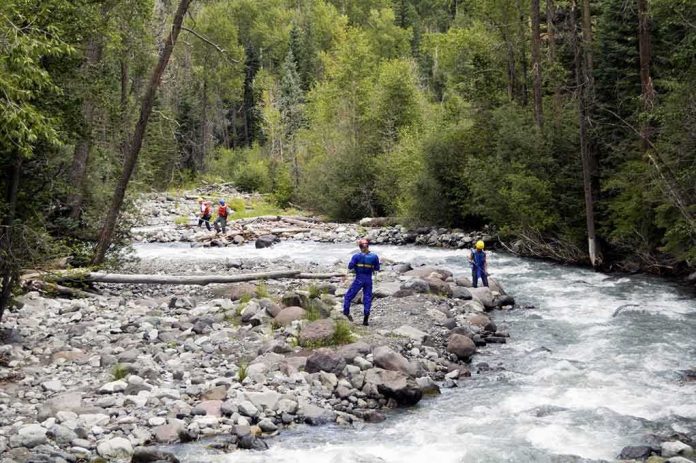
Three Michigan tubers disappeared on a casual river trip and were found three days later in the woods, a reminder of how quickly ordinary life can slip into real danger when basic safeguards fail.
Story Snapshot
- Two women and a 9-year-old boy were rescued after spending about three days lost near the Muskegon River in Michigan.
- Search teams followed footprints, bent grass, and broken sticks through thick woods until body camera video captured the moment of rescue.
- Officials say the group likely used pool-style floats on a fast, obstacle-filled river instead of river-rated gear.
- The story raises broad concerns about safety, planning, and how much we rely on thin government systems when trouble hits.
How a Simple Tubing Trip Turned into a Three-Day Search
Michigan conservation officers and state police spent three days searching for 28-year-olds Jazmin Hock and Sarah Vida, and Vida’s 9-year-old son, Kayden Kovalcik, after they did not return from a tubing trip on the Muskegon River. Reports say they launched near the Maple Island Boat Launch on a Tuesday and vanished along a stretch of river that runs through thick, hard-to-reach woods in west Michigan.
Search teams used boats, drones, and officers on foot as hours turned into days, raising fears that the river had claimed three more lives. According to reports, rescuers finally picked up a trail of footprints, bent grass, tipped ferns, and broken sticks near a logjam, leading them off the water and into the woods. That trail brought officers to the missing family, who were found in rough shape but alive and able to walk with help.
What the Rescue Video Shows — and What We Still Do Not Know
Body camera footage released by the Michigan Department of Natural Resources shows officers pushing through brush, calling out, and then finding the three huddled in a wooded clearing. The video caught the moment one officer shouted that help had arrived, a scene many local outlets shared as a rare happy ending to a missing-person search. Officials later said all three were taken to a hospital and were expected to recover from dehydration and exposure.
Some coverage claimed the group survived on tree bark, flowers, and untreated river or swamp water over roughly 72 hours, but public records so far do not clearly back up every detail of that survival tale. Available reports focus mainly on their poor condition, need for medical care, and the length of time they were missing, not on a confirmed medical record of what they ate or drank during those days. That does not mean the claims are false, but it shows that dramatic details can outpace verified facts.
Gear Choices, Planning Gaps, and the Thin Line Between Fun and Risk
One detail that does appear in official statements should make every outdoor family pause: investigators found four inflatable pool floats they believe belonged to the group and stressed that they “weren’t river flotation devices.” Pool toys are built for calm water, not for a river with hidden logs, strong currents, and debris that can rip cheap plastic in seconds. Reports say officials think the tubes likely struck logs and failed, leaving the group stranded off the main channel.
Search and rescue experts say time is the biggest factor in whether lost people are found alive, and the odds drop as hours pass. Clear trip plans, proper gear, and telling someone exactly where you are going and when you will be back are the simple steps that often decide who gets home and who does not. Girl Scouts and other groups that teach tubing safety stress knowing river conditions, wearing life jackets, and avoiding fast water near the riverbed where people can get trapped or hurt.
Why This Local Rescue Echoes National Frustration
This story could be shrugged off as “just” an outdoor scare, but it also taps into a deeper worry many Americans share: our systems only barely work, and often thanks to individual front-line workers, not careful leadership. Local officers, not distant officials, pulled these three out of the woods. Their work shows dedication and skill, even while broader safety rules and public education clearly lag behind what people need for basic trips outdoors.
Footage shows rescue of tubers who went missing on Muskegon River https://t.co/5KUQfcmbBR
— The Detroit News (@detroitnews) August 11, 2026
For conservatives and liberals alike, this rescue underlines a common concern. Families are pushed to seek cheap, simple escapes close to home, yet they are rarely given clear, no-nonsense safety guidance that matches today’s real risks. Agencies can push dramatic video clips faster than they release full incident files or plain-language lessons learned. The result is a feel-good story on the surface, but a quieter question underneath: in a country run by distant elites, are regular people still getting the basic information and tools they need to stay safe?
Sources:
youtube.com, wilx.com, freep.com, facebook.com, woodtv.com, cbsnews.com, detroitnews.com, news.virginia.edu