
Five years after the U.S. exit, United Nations officials say Afghanistan is quieter under Taliban rule—even as millions face rights crackdowns and deepening need.
Story Snapshot
- United Nations missions report improved security and Taliban control across Afghanistan.
- Human rights groups document sweeping bans on girls’ education and women’s public life.
- Aid groups warn nearly half the country needs help and hunger remains widespread.
- Parades in Kabul showcase power while trust, jobs, and transparency lag.
Security Gains Under Tight Central Control
United Nations officials say Afghanistan has seen “a period of improved security” since the Taliban took power in 2021, with fewer armed clashes and broader freedom of movement in many areas. A United Nations Security Council report from May 2026 states the Taliban maintain control over national territory and continue centralized governance based on their interpretation of Islam. That control reduced day-to-day fighting that long plagued rural roads and city streets, easing some fears for families traveling or working outside their homes.
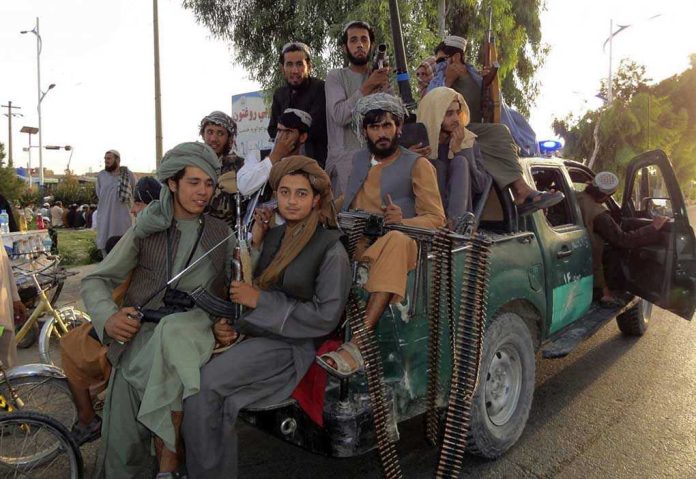
Taliban leaders marked the five-year milestone with armored vehicles parading outside the former United States embassy in Kabul, branding the day a victory over Western domination. Reuters and other outlets reported displays of flags and a focus on national unity, while residents told reporters they felt safer but needed jobs and schools reopened to build a real future. The official show of strength underscored a hard truth: lower visible violence does not equal broad legitimacy or prosperity.
Women and Girls Face Severe Restrictions
Human Rights Watch says Taliban decrees have stripped women and girls of basic freedoms, from schooling beyond the sixth grade to many forms of work and public participation. A Reuters report cites United Nations cultural officials estimating 2.4 million girls have been barred from secondary education since 2021. United Nations news reporting adds that Afghans rarely learn whether officials who abuse power face discipline, eroding trust in state institutions and leaving victims without clear recourse. These policies isolate half the population and drain long-term human capital.
Local testimonies gathered by major outlets say daily life for many women has narrowed to the home or tightly controlled spaces. The rules restrict movement, speech, and dress, and have shrunk access to higher education and many workplaces. Such limits weigh on families’ incomes, on the skills pipeline for key jobs like teaching and health care, and on the national economy. They also complicate aid delivery when agencies cannot hire or deploy qualified women to reach women and children in need.
Humanitarian Strain and a Shrinking Economy
International reporting indicates nearly half of Afghans need humanitarian assistance in 2026, and more than 14 million face acute food insecurity, reflecting weak growth and low job creation. Residents interviewed by global outlets say the top concerns now include employment, cash wages, and affordable food, not only street safety. Sanctions and limited formal recognition constrain banking channels, while the regime’s tight social rules drive out skilled workers and keep many women from the labor market.
United Nations Security Council actions extended sanctions monitoring on Taliban-linked individuals, signaling continued global pressure tied to counterterrorism and rights concerns. Policymakers abroad balance the need to keep aid flowing with the need to uphold human rights standards. That tension often slows programs, cuts direct budget support, and forces workarounds that add cost and delay. Ordinary Afghans bear the brunt in rising prices, fewer services, and thin safety nets.
What “Stability” Means—and What It Does Not
Security experts and development analysts stress that improved street safety is not the same as durable stability. A government can stop insurgent warfare yet still weaken over time if it blocks education, limits economic activity, and hides official misconduct. Afghanistan’s current path shows these two tracks moving in opposite directions: fewer firefights on one hand, and shrinking freedoms, weaker trust, and a stagnant job market on the other. That mismatch invites future shocks.
I still cannot understand why, after five years in power, Mullah Haibatullah Akhundzada continues to hide from his own people.
On the fifth anniversary of the Taliban’s return to power, Haibatullah Akhundzada appeared in Kandahar for the victory celebrations but from inside a… pic.twitter.com/zSZFD6psuN
— Sajjad Tarakzai (@SajjadTarakzai) August 16, 2026
For Americans still angered by the chaotic withdrawal, and for Afghans living the outcome, the lesson is similar: when leaders prize control over consent, people pay. The state looks orderly from a distance, but families face closed schools, thin paychecks, and little voice. That is the pattern many citizens on the left and right fear at home too—elite decisions made without clear accountability. Afghanistan’s five-year mark is a warning about what happens when power answers only to itself.
Sources:
zerohedge.com, aljazeera.com, ny1.com, reuters.com, washingtonpost.com, hrw.org, unama.unmissions.org, theguardian.com, nytimes.com