

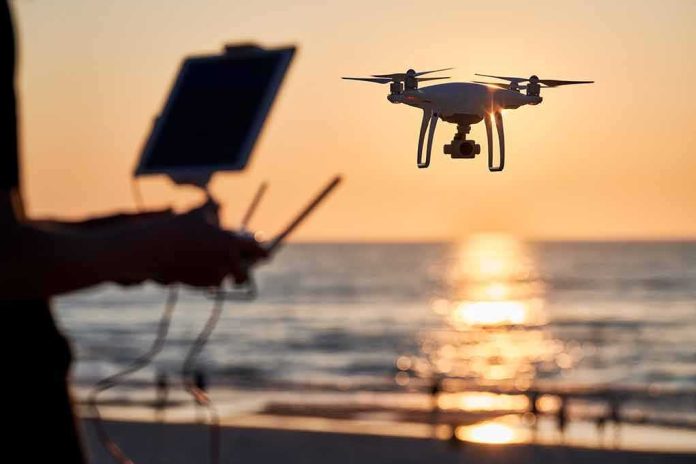
A low-flying drone barking orders at a lone swimmer on a dark Chinese beach is the latest reminder that high-tech “safety” tools can turn into always-on rule enforcers watching every move we make.
Story Snapshot
- A patrol drone over a Qingdao beach used a loudspeaker to order a man out of the water after dark.
- Local authorities say these drones enforce a nighttime swimming ban to prevent drownings and support rescues.
- The same system doubles as real-time surveillance, closely tracking people and broadcasting commands in public space.
- The viral clip feeds growing global worries that safety tech is becoming another tool for automated control by distant officials.
Drone Stops Night Swim on Qingdao Beach
Footage from a beach in Qingdao, a coastal city in eastern China, shows a drone sweeping low over the shoreline at night and locking onto a man as he approaches the water. The aircraft carries bright spotlights and a loudspeaker. It hovers just a few yards above him, lighting up the sand and waves while playing a recorded warning that swimming is banned after dark. Faced with the command from above, the man backs away and does not go into the sea.
Multiple outlets describe this as part of a nighttime swimming ban meant to reduce drownings when visibility is poor and lifeguards are off duty. Reports say the drone is remotely controlled by security forces assigned to watch the beach, and its job is to spot people who enter the water after hours, warn them, and push them back to shore. The video went viral across platforms, drawing millions of views and strong reactions from viewers who saw both a rescue tool and a symbol of control.
Authorities Frame Drones as Safety and Rescue Tools
Coverage citing local information says beaches around Qingdao restrict swimming at night for safety reasons, and drones are one way to enforce that rule. These patrol drones are said to carry spotlights, high‑resolution cameras, and sometimes thermal sensors to find people in low light when human guards would struggle. Chinese media also point to recent search‑and‑rescue operations where drones helped locate people adrift at sea for hours, arguing the same technology can save lives, not just scold rule breakers.
Reports from China and foreign outlets note that drones are now used widely in the country to monitor parks, tourist areas, roads, and beaches. The devices play voice messages to guide visitors, record video of accident scenes, and direct traffic after highway crashes. In this view, the Qingdao night‑swim clip is one example of a broader trend: public‑safety managers rely on flying cameras and speakers because they are cheaper than hiring more staff and can cover large areas quickly, especially after dark or in bad weather.
Surveillance Concerns: When Safety Patrols Feel Like “Big Brother”
Many viewers and commentators see something else in the Qingdao video: a close‑range, tracking machine telling a person what he can and cannot do in a public space. The drone does not assist a swimmer in distress; it watches a man from above, moves to stay right over him, and uses a command voice to force him out of the water. That behavior matches what people already fear about modern surveillance — a system that can detect, follow, and correct you automatically, with no nearby human officer you can talk to.
A drone equipped with a loudspeaker was filmed ordering a swimmer to leave the water after dusk on a beach in Qingdao, China. The aircraft was enforcing a local nighttime swimming ban, highlighting how drones are increasingly being used for public safety and rule enforcement. pic.twitter.com/UmUZhSpBJb
— Ground Truth Brief (@GTruthBrief) July 27, 2026
Similar drones were used during the coronavirus pandemic in China to scold people who were not wearing masks or were outside during lockdowns. Reports show them hovering over streets and villages, broadcasting instructions through loudhailers to “go home” or “wear a mask,” which fed a global image of drones as flying hall monitors. When the Qingdao clip hit social media, many viewers reached for that same frame, calling it “Big Brother on the beach” and asking how far such systems might go once officials can watch crowds from the sky at all hours.
What This Signals for Tech, Power, and Everyday Freedom
The incident matters beyond one man and one beach because it shows how fast “smart” patrol tools can move from rare experiment to normal daily control. In China, officials say drones help prevent drownings and speed up rescues. They may be right about some real successes, but they have not shared hard numbers on how many lives are saved or how often drones wrongly target harmless behavior. Without clear data or public debate, people are left with a simple picture: those in charge get more eyes in the sky, while ordinary citizens get more commands from machines.
Americans on both the right and left already worry that distant elites use technology to watch and manage everyday life, whether through phone tracking, facial recognition, or automated policing. The Qingdao beach drone reinforces that concern. It shows how a tool sold as safety can also enforce rules from above with no human contact and little transparency. As more cities worldwide test similar systems, the core question grows sharper: who controls the drones, what rules do they enforce, and how do citizens push back if those rules cross the line between common‑sense safety and constant control?
Sources:
insiderpaper.com, youtube.com, inshorts.com, gadgetreview.com, ilmessaggero.it, goodmorningamerica.com