

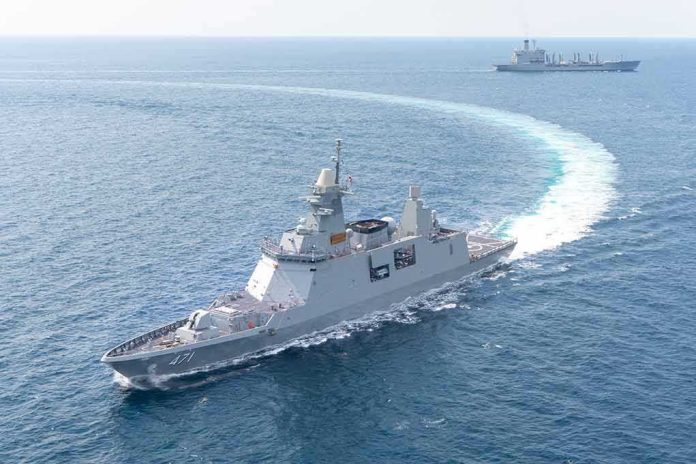
Russian naval activity near Britain has jumped enough to trigger a new round of Royal Navy patrols, and the latest figures show 21 days of monitoring in July alone.
Quick Take
- The Ministry of Defence says Royal Navy warships and helicopters spent 21 days in July tracking Russian activity near United Kingdom waters.
- Officials say maritime monitoring operations were up 25 percent across the first seven months of the year compared with 2025.
- The Royal Navy also reported watching nine Russian vessels in recent weeks, including submarines, destroyers, corvettes, and support ships.
- Separate incidents included a Russian warship’s live-fire exercise off Plymouth and repeated shadowing in the English Channel and North Sea.
What the Navy Says Happened
The Ministry of Defence said Royal Navy warships and helicopters spent 21 days in July on operations that monitored Russian activity in United Kingdom waters and the North Atlantic. It also said those monitoring missions were up 25 percent over the first seven months of the year compared with 2025. The same update named HMS Somerset, HMS Tyne, HMS Mersey, and HMS Severn as part of the response, along with Wildcat helicopters and Merlin aircraft.
The official message is not about one isolated sighting. It describes a steady pattern of watch-and-shadow missions tied to Russian ships moving through the English Channel, the North Sea, and nearby waters. In one recent Royal Navy release, officials said they monitored nine Russian vessels over two weeks, including a surfaced submarine, a destroyer, a corvette, and a patrol ship, with eight Royal Navy ships involved. That points to a broader tempo of operations, not a single crisis.
Why The Figures Matter
The 25 percent rise matters because it shows the Navy is devoting more time and resources to this mission. The government said those operations cover the United Kingdom’s Exclusive Economic Zone, where the Navy says it routinely patrols to protect national interests and keep watch on potential hostile activity. For readers frustrated by weak border control, high costs, or distant government decisions, this kind of reporting reinforces a familiar concern: major security problems often get managed through reactive patrols rather than open public planning.
The data also shows how hard it is for outsiders to test official claims. The public can see the patrols and read the press releases, but the raw counting method is not fully laid out in the reports. That leaves room for a simple but important question: does the 25 percent figure reflect more Russian movement, more British monitoring, or both? The available material does not cleanly separate those two forces.
What Recent Incidents Show
Recent incidents help explain why the Navy is sounding the alarm. The Royal Navy said it tracked Russian ships through the Dover Strait and English Channel in round-the-clock shadowing operations, and BBC reporting described similar patrols involving HMS Somerset, HMS Cattistock, and support aircraft. Separately, a Russian warship identified as the Neustrashimy carried out a live-fire exercise about 40 nautical miles south of Plymouth while the Royal Navy monitored it throughout. Those events give the government’s warning concrete weight.
Russian naval activity near UK waters rising, Royal Navy warns https://t.co/1TVHPx9IU7
— #TheRebelDemocrat (@ejnyamogo) August 8, 2026
The larger pattern stretches beyond one month. British officials have repeatedly described Russian maritime activity near the United Kingdom as increased, unusual, or significant in earlier releases. They have also said the Navy has exposed covert submarine activity around UK waters and monitored Russian vessels near undersea cables and pipelines. Across the political spectrum, that mix of events feeds the same public unease: a powerful state is probing close to home, while citizens are left relying on selective official updates instead of a full public accounting.
Sources:
humanevents.com, theguardian.com, bbc.com, gov.uk, naval-technology.com, forcesnews.com, royalnavy.mod.uk, youtube.com