
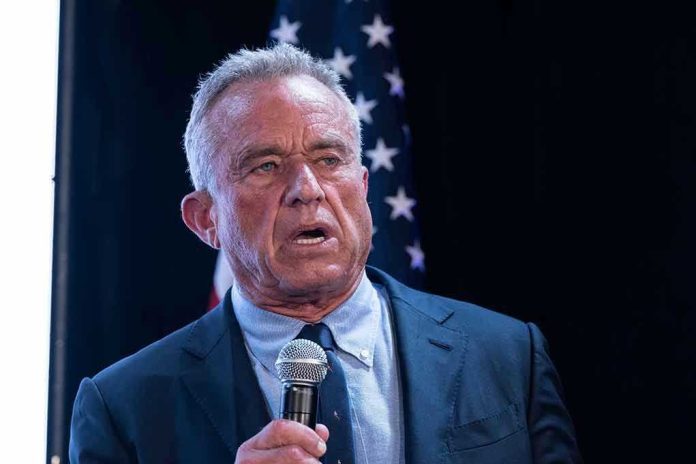
A newly surfaced 2019 letter appears to flatly contradict Health Secretary Robert F. Kennedy Jr.’s sworn claim that his Samoa visit “had nothing to do with vaccines.”
Story Snapshot
- A 2019 letter on Children’s Health Defense letterhead focused on Samoa’s measles, mumps, and rubella vaccines.
- Kennedy told senators his purpose in Samoa “had nothing to do with vaccines,” repeating that line in multiple exchanges.
- Samoa’s then-prime minister reportedly welcomed an “independent health assessment” of the nation’s measles, mumps, and rubella vaccines.
- The clash raises accountability questions that echo long-running doubts about whether Washington holds its own to the same rules.
What the new document says
Associated Press reporting describes a January 20, 2019 letter, on Children’s Health Defense letterhead, sent to Samoa’s then-prime minister months before Robert F. Kennedy Jr.’s June trip. The letter repeatedly referenced vaccines and proposed studying what happened with Samoa’s measles, mumps, and rubella vaccines after two infant deaths tied to improper mixing by nurses, not the vaccine itself. The letter’s wording centered on a vaccine assessment, using the word “vaccine” or “vaccination” several times, according to the reporting.
The prime minister’s office later replied in February 2019 and, as described by public-interest group American Oversight, welcomed the “benefit of your Team’s independent health assessment of our measles, mumps, and rubella Vaccines.” That response matched the vaccine-focused framing in Kennedy’s outreach and invited his team to visit Samoa. These paired letters anchor the timeline before the June 2019 travel and give outside readers concrete language to compare with Kennedy’s later statements.
What Kennedy told the Senate under oath
During Kennedy’s January 2025 Senate confirmation hearings to lead the Department of Health and Human Services, lawmakers pressed him on the Samoa visit. He stated, “My purpose in going down there had nothing to do with vaccines,” and he repeated that claim in more than one exchange, including with Senator Edward Markey. Those answers were categorical and left little room for a vaccine-centered motive, which makes the documentary record notable now.
A separate Associated Press account states Kennedy later wrote that his words had nothing to do with vaccine uptake in Samoa or with the 2019 epidemic. That written position tracks with his public stance in interviews, where he has also denied urging Samoans not to vaccinate. The dispute here is not about the outbreak’s cause but about how he framed the reason for the trip when questioned by senators.
Why this matters beyond one hearing
Congress depends on honest testimony to oversee the executive branch, regardless of party. When a signed or contemporaneous document appears to clash with sworn statements, trust erodes. Voters on the right see two sets of rules for elites and regular people. Voters on the left see power shielding insiders from consequences. Both sides worry the system shrugs at contradictions until a crisis forces action. That fear grows each year, and it bleeds into nearly every policy fight in Washington.
Legal outcomes will turn on intent and materiality, not just optics. A contradiction can suggest false testimony, but prosecutors usually need clear proof that a witness knew the statement was false and that it mattered to the proceeding. Today’s record leans on one key letter, the reported reply from Samoa, and hearing transcripts. That is meaningful evidence, but further documents, emails, or depositions would sharpen the picture and test how central vaccines were to the June 2019 itinerary.
The Samoa backdrop and the policy stakes
Samoa’s measles disaster followed a collapse in vaccine confidence after two tragic infant deaths caused by human error in mixing the vaccine. Coverage then surged only after the deadly outbreak. This history fuels a high-voltage debate over public health messaging and the impact of prominent figures. That debate often turns into a proxy war over government credibility, media trust, and whether institutions tell hard truths when mistakes happen, or manage the narrative and punish dissent.
🔴 Senator demands criminal probe of RFK Jr. over false Senate testimony on Samoa trip
Ron Wyden of Oregon called for a Department of Justice criminal investigation into Health Secretary Robert F Kennedy Jr after newly obtained letters contradicted his confirmation testimony.… pic.twitter.com/DKMJWpm9BD
— NewsTongue (@NewsTongueX) August 27, 2026
For the United States, the stakes are basic: Can leaders give straight answers when facts are uncomfortable? Americans face rising costs, weak services, and a sense that insiders always land softly. That is why this case resonates. If letters and testimony do not square, Congress should demand the full paper trail, release the official hearing transcript and video, and—if needed—seek sworn statements from the people who planned the trip. Transparency is the only way to rebuild trust.
Sources:
mediaite.com, pbs.org, rev.com, nytimes.com, apnews.com