

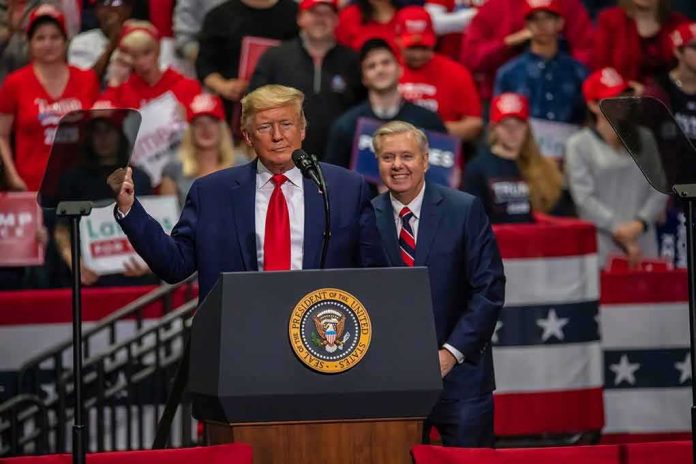
President Trump promised $5,000 to every adult American, but only if Republicans keep both the House and Senate, spotlighting a big-money pledge tied directly to election control.
Story Snapshot
- Trump vowed a $5,000 “dividend” for every adult U.S. citizen if Republicans win both chambers.
- The money would have to be spent inside the United States, according to Trump.
- No funding source, legal path, or timeline was detailed in public remarks.
- Reporters likened the idea to a company paying shareholders a cash distribution.
What Trump Pledged And The Strings Attached
President Trump told a party crowd that every adult citizen would receive $5,000 if Republicans win the House and the Senate. He called it the “Trump dividend” and tied it to the election outcome with no other preconditions in his public remarks. He also said the money must be spent in the United States. Multiple outlets reported the same core terms: adults only, $5,000 each, contingent on Republican control of both chambers after the midterms.
Trump framed the payout like a corporate cash distribution to shareholders. He said the payment would mirror what a successful company does when it shares profits with owners. He also referenced prior direct-payment style actions to build a narrative of giving cash back to citizens, including his claim of a $1,776 amount to military members last year. The message aimed to present the plan as a reward tied to national gains, not a one-off handout.
What Is Missing: Funding, Law, And Logistics
Public reporting shows no plan text, bill draft, or budget line that would fund the $5,000 checks. Outlets covering the speech said no legislative mechanism, funding source, or delivery timeline was provided. The remarks did not explain how the government would limit spending to purchases inside the United States, which is a major enforcement and technology challenge for any broad cash program. Without these parts, the pledge remains a campaign-style promise rather than an active policy.
Commentary across outlets stressed that any mass payment would require Congress to authorize and fund it. A Republican win creates political room but does not replace legal steps needed to spend federal money. Earlier coverage of related “dividend” ideas shows a pattern: big headlines followed by questions on cost, deficits, and authority. That cycle often shifts debate to feasibility and law instead of the promise itself, fueling skepticism among voters who already distrust how Washington handles money.
Why This Resonates With Voters Across Parties
Many Americans feel squeezed by high prices and rising bills. A $5,000 check sounds like real help now. Conservatives hear a pledge that rewards work and keeps dollars at home. Liberals see cash support that could reduce stress for families. But both groups also worry that leaders make big promises and then stall out in Congress, agencies, or courts. This pledge taps into hope and frustration at once, because it seems simple but runs into the same old roadblocks in Washington.
Trump Pledges $5,000 to Every US Adult if Republicans Win Midterms
• Trump pledged $5,000 to every adult US citizen if Republicans retain House and Senate control.
• The pledge was made during a speech at the Republican midterm convention.
• Trump urged voters to pretend he… pic.twitter.com/w0If8dAFbZ— The Unbiased Update (@unbiased_update) September 10, 2026
Direct-pay promises are easier to sell than to pass. Past ideas, like tariff-funded rebates, ran into legal, budget, and math concerns before reaching Americans’ bank accounts. This record helps explain why people on the right and left say the system serves insiders first. If the White House and Congress want trust, they will need to publish funding math, a clear legal path, and a delivery plan the public can track—not just a headline number tied to an election night result.
Sources:
wsj.com, politico.com, foxnews.com