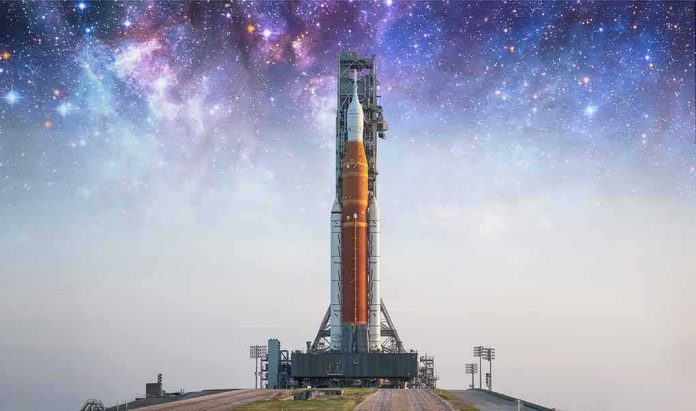
NASA’s Roman Space Telescope rode a SpaceX Falcon Heavy into space at 7:26 a.m. Eastern, starting a flagship mission to map the cosmos.
Story Snapshot
- Roman launched on a SpaceX Falcon Heavy from Launch Complex 39A at Kennedy Space Center.
- NASA targeted and achieved a 7:26 a.m. Eastern liftoff on Sunday, August 30, 2026.
- The observatory begins cruise to the Sun–Earth L2 region to start science after checkouts.
- Early operations will confirm separation, trajectory, and instrument health before full surveys.
Launch Details and Timeline
NASA and SpaceX targeted a Sunday, August 30 liftoff for the Nancy Grace Roman Space Telescope at 7:26 a.m. Eastern time. The Falcon Heavy lifted off from Launch Complex 39A at NASA’s Kennedy Space Center in Florida, meeting the planned window. NASA documented the rollout, fueling, and “go” for launch in the days leading up to liftoff, including the final pad operations and weather briefings by the United States Space Force unit overseeing range safety.
SpaceX listed the mission on its launch manifest with the same target time and a backup the next morning. Space industry trackers posted the planned 11:26 Universal Time liftoff on August 30. Live coverage from NASA and independent outlets showed ascent milestones and payload deployment events that follow a standard Falcon Heavy profile. Those steps include fairing separation, stage burns, and spacecraft deployment on the intended trajectory toward deep space.
What Roman Will Do in Space
NASA describes Roman as a wide-field infrared observatory designed to survey large swaths of the sky quickly. Roman will study dark energy by tracking how the universe expands, search for exoplanets using precise light measurements, and map dust and stars in our galaxy. The telescope heads for the Sun–Earth Lagrange Point 2 region, where stable lighting and thermal conditions help sensitive instruments. This location also supports steady communications and steady pointing for months at a time.
The mission plan calls for a months-long commissioning phase before full science. Engineers will confirm that spacecraft systems behave as expected, that instruments cool and calibrate, and that pointing is stable. That step-by-step approach reflects how space agencies define success. A clean launch starts the mission, but verified deployments, correct trajectory, and instrument health make the mission. NASA used the same measured process to certify Artemis I results after its 2022 flight review cycle.
Why This Launch Matters
The launch marks another high-profile use of Falcon Heavy for national science goals. The vehicle provides strong performance to carry Roman on its path to deep space. NASA’s timeline showed Roman was encapsulated in the payload fairing and moved to the pad before liftoff, confirming smooth integration across teams. The on-time launch also capped weeks of readiness reviews and range checks that cleared the way for ascent in a tight morning window at the Cape.
NASA launches newest space telescope 'Roman'
Telescope launch on Falcon heavy rocket
Roman begins a 3-month journey to an orbit 1 million miles away @JyotsnaKumar13 gets you more pic.twitter.com/t4aLhtWXG5
— WION (@WIONews) August 31, 2026
For citizens who worry Washington cannot deliver big projects, this mission is a reminder that complex American teams can still execute. NASA led the science, industry built and integrated the hardware, and SpaceX provided the ride. That kind of partnership mirrors older eras when the country set a goal and met it. The test now shifts to operations. Roman must prove its value by turning clean numbers from space into maps and discoveries that help us better understand our place in the universe.
Sources:
youtube.com, en.wikipedia.org, science.nasa.gov, space.com